May 19, 2024
On Tuesday North Country residents vote on next year’s school budgets. One alarming news item reported that Canton Central School district residents are looking at a 6.5% hike in their school tax rates. Why? An article by Jeff Cole in WWNY explains that the primary reason for that increase is declining enrollment. This raises several questions: Did enrollment decline similarly in Potsdam? And why, when enrollment goes down, does the cost of running schools not decline? How long can these levels of increase be sustained?
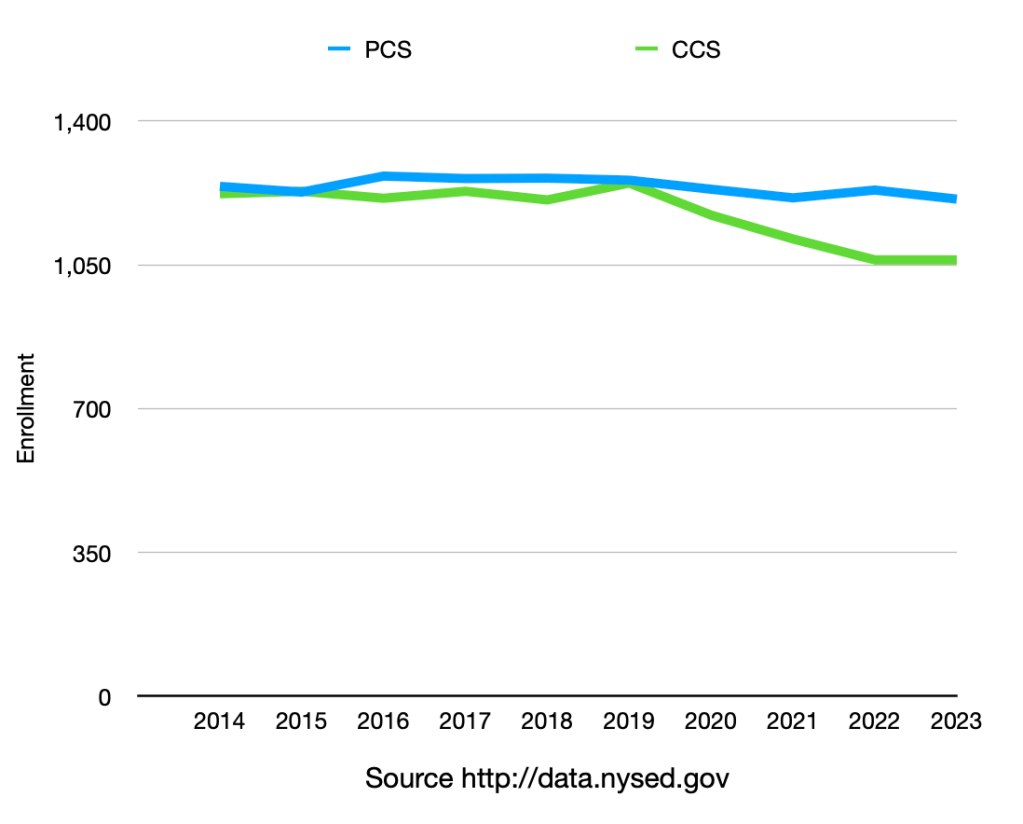
As discussed in an earlier post, during the last 10 years the population of Potsdam village went down 12% while that of Canton’s rose by 13%. That suggests that PCS must have suffered a similar decline in enrollment, right? But that is not the case. As the NYS Education Department reports, enrollment at PCS has remained steady, averaging close to 1,240 students for the past ten years. Enrollment at CCS, however, averaged 1,225 from 2014-2019 and then started to decline, as shown in the graph below. During the past two years, enrollment at CCS has been 1,062: a decline of over 13%. Why?
Do more retirees live in Canton than in Potsdam? Have the presence of alternative schools, including St Catherine of Siena Academy, Little River Community School and the Deep Root Center started to pull more students out of Canton’s public K-12 system? Or is there a growing trend to homeschool in Canton, as encouraged by organizations like the Christian Fellowship Academy? Whatever the reasons for the enrollment decline at CCS, it results in a real revenue reduction. As all homeowners pay school taxes, not just homeowners with children, the reduction is not due to decreased property tax revenue. Instead, State Aid is tied to enrollment numbers, and State aid amounts to more than 50% of most school’s total revenue.
How great is the reduction in NYS funding to CCS? NYSUT reports that the proposed NYS budget would have resulted in a $613,000 or 4.5% cut in State aid to CCS, while “only” a $189,000 or 1.3% cut in State aid to PCS. This seems to be one reason that residents of the CCS district face a 6.5% increase in their school tax rate and residents of PCS a lower 2.5% hike.
It seems no aspect of public-school financing is reduced when enrollment declines. Why? While buildings may cost the same to service and maintain, would not the costs associated with cafeteria services, bus transport, and insurances be tied to enrollment? Unfortunately, CCS does not provide online, line-item budgets like PCS (PCS’s full 51-page FY25 budget report is available under the Board of Education pulldown menu at potsdam.k12.ny.us ) Looking therefore only at the summary figures reported in the newsletters, we see that school budgets are divided into 3 portions: Program Expenses covering instruction and transport; Administrative Expenses; and Capital Expenses covering the costs of the operation and maintenance of buildings as well as debt services for building and infrastructure upgrades. All 3 sections include employee & fringe benefits for their respective employees.
Keeping in mind that the average rate of inflation last year ran at 4.1%, it is perhaps of interest to see where costs increased the most. Program Expenses at PCS increased 5.4% while these increased 2.5% at CCS as compared to last year. Administrative Expenses increased 8.0% at PCS while they increased 2.4% at CCS. And Capital Expenses increased 27.6% at PCS and a whopping 69.8% at CCS. I cannot ascertain why the Capital Expenses increased so much at CCS (up nearly $3.9 million compared to last year) without a line-item budget report, but I could study the online budget report of PCS. In that budget report we see under the Capital Expense category, the line item for Operation of Plant went up 4.3%; Maintenance of Plant went up 4.0%; Total Fringe Benefits for employees working in the Capital category rose 43.3% or a bit over a quarter million dollars; and the Interest (not the principal) on the Total Debt Payments increased a whopping 235%, from $722,000 to $1,703,000.
How long will schools be able to sustain this level of cost increases? Even without the diminishing enrollment as at CCS, PCS faces massive cost increases for health insurance for employees and retirees as well as pension benefits for retirees, and skyrocketing upgrade costs. This year PCS was able to lessen the tax hike by pulling nearly $3 million out of savings: will we be so lucky next year?
Will I vote for the school budget for PCS on Tuesday? Yes. (If I lived in the CCS district, would I support that budget? Without access to their budget and a report of fund balances and future forecasts, it would be harder to vote yes.) But regardless, it would be great to understand why the costs of running public schools don’t decline with fewer student, and how long we might be able to sustain these levels of cost-increases. Are PCS fund balances able to protect tax payers for a few more years?
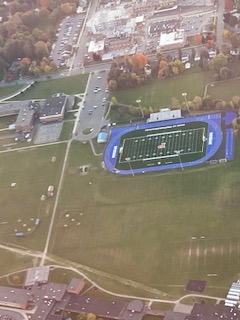
post script: I thank Jim Parks for flying me over Potsdam, where I could snap the image of PCS athletic field above.
 Local Government Matters