A long-time village resident recently challenged the suggestion that village taxes are excessive. First in person and later via emails she stated emphatically: “My figures show that for [around $200] a month…I get 24 hours police protection; 24 hour fire protection; 24 hour rescue squad availability; Museum; Library; Streets plowed; Sidewalks cleared; Summer and Fall yard debris pick-up; DPW work crew response to road, water, sewer [issues]; Access to water, sewer, and … trash and recycling services; Recreation program; Maintained parks…Compared to what I pay for television viewing monthly, I think the village gives me much for [around $200] a month”. I thanked her whole-heartedly for the clear-headed numeric analysis, and for reminding me why we live in the village.
Needless to say, I checked her figures and then applied the same analysis to my own finances for comparison and verification. I responded with a few provisos: The Potsdam public library is an independent institution run by its own elected board that sets its own tax rate and manages its own budget. Likewise, the Potsdam Volunteer Rescue Squad operates 100% independently: The PVRS owns its rescue squad building and all vehicles.
I also pointed out that the Potsdam Volunteer Fire Department mostly pays and operates on its own-the village does pay for the 4 fire drivers, who may only drive vehicles within village boundaries and who may not fight fires. In other words, we enjoy library books, rescue-squad/EMS and fire-fighting services largely thanks to volunteers. My new friend thanked me for the clarifications, saying “I did not realize that these organizations / services are so independent. I guess I will think of them as ‘soft’ advantages of village living…[including] access to natural gas for heat and hot water which is said to be less expensive than the oil, propane, or electric that non village residents are left with.”
I added one final proviso: the village does not operate municipal trash services. Instead, the village contracts with the Vermont based company, Casella Waste Systems, Inc. to collect all residential trash in the village using a fee structure set by Casella. The village does operate municipal Police, Public Works, Water, Sewer, as well as Parks and Recreation Departments, which provide many of the services she listed and more. Not only do we enjoy clean drinking water, a state of the art waste water recycling plant, around the clock police protection and street maintenance, but also the little perks of canoe launches, lively summertime beach and wintertime ice skating activities; pickleball courts, and an expanding municipal airport. And yes, we also own and operate two municipal hydroelectric plants that for the past 10 years have been operating at enormous losses.
She and I then checked our respective costs of village living; after correcting for a few matters, we discovered that she paid $237/mo and I paid $335/mo for the combined costs of village property taxes plus water, sewer and trash fees.
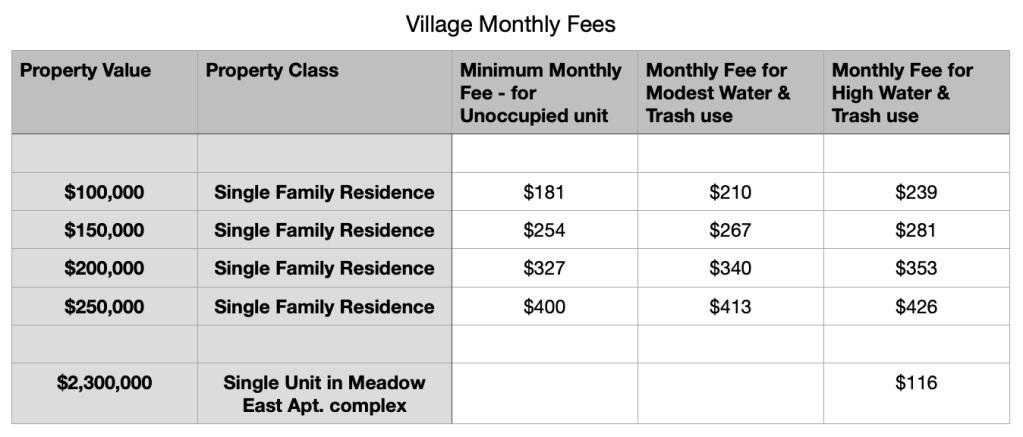
Generally, we cannot determine these costs for commercial enterprises within the village, including apartment complexes, due to the manner in which commercial water and sewer services and trash services are billed. By chance, however, I am familiar with the water and sewer billing at the Meadow East Apartment complex and the owners kindly shared their trash and recycling expenses with me; hence I could compute the cost burden shared by each unit in the Meadow East complex. It came to $116/mo per unit. Why is the cost burden amongst apartment renters significantly lower? Due to the economy of scale of living in a shared community: an apartment complex with 100 units cost far less than 100 separate homes.
If you’re curious how your situation compares, I include the following graph that breaks down the monthly cost of village life according to property value and whether water use is zero (for unoccupied dwellings), modest (6000 gallons / quarter), or high (12000 gallons / quarter); plus whether the number of trash bags used is zero (unoccupied dwelling), modest (4 per month) or high (8 per month):
 Local Government Matters