Money raised from property taxes do not support the operation of the water treatment plant on Raymond St nor the waste water treatment plant on Lower Cherry St. The funds needed to operate, service and maintain the water plant and the sewer plant are raised by user-fees: the water and sewer portions of the quarterly W/S/W bills. Pre-2018 the water and sewer funds routinely ran in the red as predicted revenues failed to match yearly expenses. After the introduction of the EDU-based billing system, the water fund as well as the sewer fund have run profitably with nearly $1.3 million in the water fund and $864,000 in the sewer fund at the end of FY2021 in spite of heavy expenses at the sewer plant.
In 2015, the village board adopted a fund balance policy to maintain at least $250,000 in the water fund as well as $250,000 in the sewer fund. Given that both funds have generously exceeded this since 2019, is it not time to lower the EDU and usage rates? While I welcome a surplus in the water and sewer funds to cover unexpected or anticipated overhauls and updates, the village operates without a multiyear capital plan and without a multiyear financial/strategic plan, which might justify overcharging customers now for anticipated outlays in future.
If inclined, please share your opinion via email or at the Village of Potsdam FB page or in person at the next board meeting (Monday 6 Feb at 6:00 pm)
“News articles make it sound like I can’t afford to live in the village. How much would I pay for water and sewer, if I only use like 5,000 gallons a year?”
All one-family homes and all apartment units pay, per year, a fixed rate of $320 plus a variable rate of $8.50 per thousand gallons for water and sewer
Someone using 5,000 gallons per year (or just under 14 gallons per day) would pay $320 fixed cost plus $42.50 variable cost, or a total of $362.50 per year for water and sewer.
A residence using a more typical 120 gallons per day or 43,800 gallons per year would pay $320 fixed cost plus $374 variable cost or a total of $694 for water and sewer service per year.
Pre-2018, village residents paid $15 x 5 = $75 in total for 5,000 gallons of water and sewage, and $660 for 43,800 gallons of water and sewer use
How do these numbers compare to maintaining ones own water well and septic tank outside village boundaries?
The village is considering changing its trash hauling contract after consultation with Casella. Currently village residents pay a base rate of $12.12/month plus $1.95 per 10 gallon trash-bags or $3.90 per 15 gallon trash-bags. For those who use two 10 gallon trash bags per month, this translates to an annual rate of $192.24. This number is not exact, because the contract with Casella automatically adjusts charges to reflect changes in the price of diesel fuel, “tipping” fees to offload trash at landfill or recycling centers, and inflation. This cost would also change if the wholesale price of orange trash bags change.
Why change the contract now even though our current contract expires in 2026? Because Casella waited 5 months to receive its latest supply of orange colored trash bags and local retailers depleted their stock for customers. The trash bags that do arrive are not always of the best quality, adding further losses to customers’ and Casella’s operating budget. Casella suggests that if we switch to a flat-fee model, people could use whatever trash-bags, if any, they prefer and Casella would no longer invest time policing trash barrel contents for non-orange bags. To compute the alternative rate, Casella uses the fact that the average household uses 8 ten gallon bags per month, to offer a flat-rate fee of $26.14 per residence per month, or $313.68 per year.
Casella is the only trash hauling service in St Lawrence County able to provide this service for Potsdam: all other haulers can increase their customer base by 10 or 20, but not by the 1400+ customers within the village. Private haulers also could not supply the wheeled trash barrels, and do not offer a separate waste stream for recyclables. Casella is able to offer a discount to Potsdam customers for two reasons. One, their St Lawrence County HQ is in Potsdam so that fuel costs are lower for Potsdam residents. And two, since our municipality is a government entity, no taxes need be paid by the village (for the base service).
Will Casella continue to offer both trash and recyclable waste streams? Yes, for two reasons: State mandates and financial incentives. The Environmental Conservation Law, the General Municipal Law, the Solid Waste Management Act and Executive Order 142 are but some of the laws mandating source separation in NYS. The DEC commissioner and the State Attorney General continue to enforce source separation with hefty fines against municipalities and waste haulers who ignored or rejected recycling mandates. Does Casella profit from our recycling efforts? Yes, but barely. Casella Division Manager Matt Rose says that the only item in the recycled waste stream that can be sold for a profit is card board. They bale collected cardboard into 2000 pound bales to be sold. Other recovered recyclables (only about 30% of items placed in recycling bins can be brought to recycling centers) are brought to the new recycling facility (to open within days) in Ogdensburg. The tipping fees for trash (at Jefferson County’s DANC-run Rodman Landfill) is slightly higher than the tipping fee for recyclables at the Ogdensburg recycling facility.
The village board will be asked to consider keeping the current contract or switching to the new model with a contract effective until 2030. Our only other alternative, to not provide this service for village residents and expect all residents to contract with private haulers, would result in torn trash bags alongside the roads every day of the week, and so is not a consideration.
The mid-terms are over and they were so much less stressful than the 2020 election! And our local results don’t look half bad (with one exception). Our new State Senator, Dan Stec, is experienced and savvy and a graduate of Clarkson University. He seems eager to embrace Potsdam’s future developments. Scott Gray, who replaces Marck Walzcyk as our State Assemblyperson, also has lengthy credentials as a civil servant. Everyone seemed to agree from the outset that acting Surrogate Judge Michelle Holmes Ladouceur was doing a great job, and will now thankfully continue in that capacity. Dave Haggard has served the needs of our county in many capacities and will continue to serve as Potsdam’s Town Justice. And finally, of the 15 County Legislators, most are now from a single party, which might make getting things done easier? One can hope anyway. Of those 15 races, only 5 were contested. The result is that eleven members of the next County Board are Republican, 3 are Democrat and one ran as a Democrat, a Republican and a Conservative (John Burke). His Republican and Conservative tallies earned 60% of his total votes.
So the one cloud over our local political scene, as I see it, is the lack of support from our federal House member, Elise Stefanik. Most recently, board members and staff of the village drafted an impressive application for a “Congressionally Directed Spending Grant,” in order to keep our police department’s dispatch center operating. Our current dispatch center, which responds to 911 and 265-2121 calls to send Rescue, Fire and/or Police personnel to active scenes, is over 20 years old and made of components that are no longer made nor serviced. At some point our officers may be reduced to using walky talkies to communicate with people in the field. Everyone was sure that this project would receive full support from our Congressional House representative, but her office dismissed the application out of hand, with no clarifications, suggestions nor advice for how to draft a better document or indeed, where else to seek this essential funding. (We’re talking about a $220,000 investment). So I had truly hoped for another occupant in DC to fight for our needs.
On the other hand, a friend who had waited nearly 2 years for her renewal green card, asked Congressional Senators Gillibrand and Schumer for assistance, and their offices had her document Federal Expressed to her home within 7 days. So we do, thankfully, retain active support from our Congressional Senate delegation.
There’s much work to do, I hope we continue to work together to improve life in the North Country.
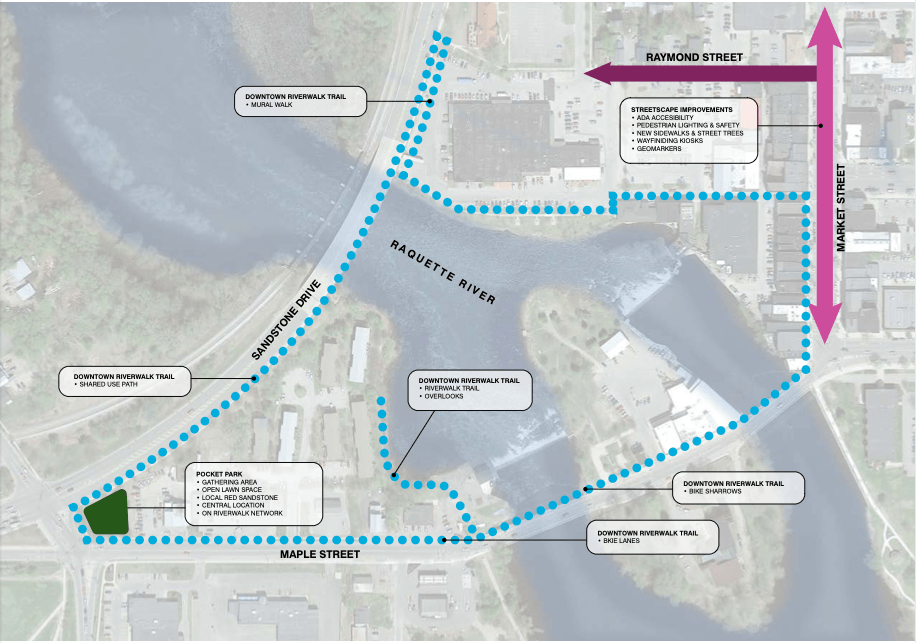
Lots of participants contributed, way back before the pandemic, in drafting a winning $10 million “DownTown Revitalization Initiative” or DRI, for Potsdam. Two of the winning projects include a Streetscape enhancement and a Riverwalk. Requests for proposals for these two projects were sent out and 3 companies returned proposals to develop ideas and design-specifications for contractors. (If anyone is interested in perusing these proposals, Potsdam’s village Clerk can email the PDF documents upon request.)
The Streetscape and Riverwalk projects include redesigns for the area enclosed by the Raquette river, Sandstoner Dr. overpass and Market St, an area including the Children’s Museum, several restaurants, stores and businesses, as well as the Potsdam Square Mall. The Riverwalk trail will run along the overpass and swing around the guard rails behind Mama Lucia to follow a planned mural-walk beneath the overpass to join the Garner Park walkway. The Riverwalk will continue along Raymond St, which will be redesigned to be inviting and pedestrian-friendly, to Market St., on to Maple St. and back to Sandstoner Dr. at the yet-to-be-developed “Pocket Park” next to the former Martin’s Maple St. Services. There may be a spur of the Riverwalk trail leading to an overlook along the western shore of the Racquette River, alongside and behind the Thai cuisine restaurant and next to Swan Landing.
In addition to DRI funding, the village was able to secure further funding in order to introduce a connector road linking Depot St. (just past Potsdam Tire) and Raymond St. The introduction of a roadway here will likely smooth traffic flow and circumvent the use of parking lots as throughways. Discussions will include whether the needs of our community would be better served if Raymond were designated one-way East-bound or West-bound. Ideas, suggestions or comments about traffic flow issues can be submitted to the 5 elected board members who vote to fund projects based on their understanding of what best helps the village thrive.
Image from Fisher Associate’s Downtown Streetscape Renovation and Riverwalk Trail Project proposal. NOTE: Depot St is incorrectly labelled Raymond St.
Today someone stopped me on the street in order to ask, with a fair amount of frustration: “Why can’t the village emtpy the garbage cans downtown on weekends? Look! They overflow every weekend and it looks embarrassing, especially with parents and all the visitors around!” Having relieved that frustration, but still shaking the head, the interrogator continued walking towards Market St.
As I too continued walking, I considered various courses of action. Should I inform the head of the Department of Public Works? In all likelihood he would say there is no budget for weekend trash pickups. (How much might it cost to add that to the budget?) If the village budget doesn’t cover weekend trash pickups, is there any other agency that might help, an agency in whose interest it is to have a clean and safe downtown? How about the Chamber of Commerce? They are situated right on Market St…
But sadly I admitted that pursuing this project would not be a good use of my time. With meetings the next day to try and resolve gnarly water/sewer billing issues, and a public meeting on spending ARPA funds that would benefit from a careful perusal of a possible contract to speed up closure of the East Hydrodam’s gating system, required most of my attention the next few days.
Perhaps the pursuit of avenues to clarify why trash barrels downtown overflow on weekends, and how to remedy that, might be fun for an enterprising individual? Someone with a bit of time on their hands, a basic curiosity about how things work and a fair amount of patience to accrue the requisite information to enact change, might enjoy the challenge? Potsdam is filled with enterprising students and retirees and business owners and involved parents; perhaps someone else finds this type of civic service rewarding?
The vi.potsdam.ny.us website provides any number of email addresses and phone numbers, to get started.
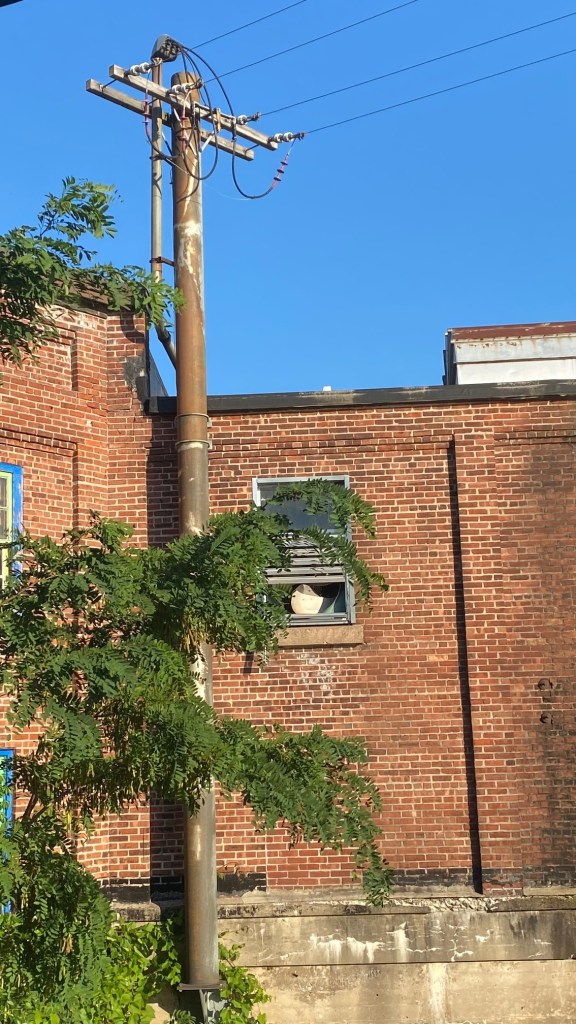
Dani and I went to Cactus Grill and asked to be seated on the outdoor, riverside deck. I enjoy this sunny spot, sheltered from the street and with views of the waterfalls on either side of Fall Island. We also glimpsed the remarkable view in the photo: a powerline that simply ends. Or starts. In fact, this powerline post is connected to the structure that houses Potsdam’s East Dam hydroelectric facility, and the powerline introduces power onto NY’s electric grid! Inside this unpretentious brick building are housed two turbines that turn as riverwater cascades past, spinning a coil inside a magnet to generate electricity! The electricity thus generated is fed into the power grid via those cables in the photo!
Initially constructed in 1926 with a single turbine, Potsdam’s hydrodam produced around 150 kW for 45 years before being retired in 1971. But interest in environmentally-friendly hydropower grew after the 1973 oil crisis, and in 1976 the VoP contracted with an engineering firm to reactivate the dormant hydroelectric facility. After 7 years of testing, design and construction efforts, the old east-dam powerhouse, completely renovated and upgraded, started generating up to 800 kW, and did so for over 30 years. The revenue generated by the sale of electricity offset operating costs for street lighting, the water treatment plant, the waste water treatment plant, the civic center and the Pine St. arena.
But in mid-2014 the gearbox serving one turbine failed and in early 2015 the gearbox serving the second unit failed as well. Once funding sources for repairs were identified, the VoP reached out to NY’s illustrious New York Power Authority for guidance. Having financed and supervised the construction of some of the largest hydroelectric facilities in the world, namely the Edward Moses Saunders Power Dam and the Niagara Mohawk Power Dam, no higher authority would seem to exist to help Potsdam repair its aging and ailing hydrofacility.
NYPA’s engineers worked with engineering firm, HATCH, to study and develop design specifications. HATCH in turn provided two contractors, Eaton and Hydrotech, with plans. They in turn subcontracted with Bancroft Mechanics and S&L Electric to refurbish and bring to operation the East Hydrodam powerhouse. With so much expertise, what could go wrong?
Repairs were slated to begin January 27, 2020 and expected to conclude by July 17, 2020. Then Covid struck, wreaking havoc with shipping and construction efforts. Repairs concluded in June of 2021, when the East Powerdam came back online, generating power again after a 7 year hiatus. Unfortunately, it soon became clear that all was not as hoped.
During tests, it became apparent that the turbines oversped during power outages. How to remedy that problem was not part of the $4 million contract with NYPA, so instead they placed a lock on the turbines to prevent them from spinning faster than 44% of their maximum rated rotational speeds. Energy production halved, as did the village’s revenue stream from this hydro facility, while our debt payments on the loan to cover NYPA’s work ballooned. It’s a frustrating situation. Discussions are ongoing to develop an economical means of rapidly quenching the rotor spins during blackouts.
Most of us in North Country pay National Grid for our electricity without further thought. However, National Grid does not generate the electricity we use: National Grid’s business in the USA is only the transmittance and delivery of power to customers. It purchases the electricity it needs to deliver to customers from the electricity wholesale market known as NYISO. More than 400 power-generating businesses, from hydrodams, nuclear power plants, natural gas/fossil-fuel plants, to wind and solar farms, sell their power to this wholesale market (1). Utilities like National Grid, Central Hudson, NYSEG, Con Edison and RG&E buy their electricity here and transmit and deliver this power to our homes. For a few fees.
Since the deregulation of the energy market in 1998, every NYer has been free to purchase her/his electricity from any supplier. Few have exercised this freedom, as the energy market is very confusing. Occasionally we receive in the mail invitations to use local suppliers but few feel emboldened to accept such invites, with the result that the hoped-for competition in the “retail” energy-market never materialized. Yet the government of NY is committed to a zero-emissions electricity sector by 2040 and a 70% renewable energy generation portfolio by 2030 (2). How to reconcile these two opposing trends: a retail market that does not encourage competition and a mandate that requires the entry of lots of renewable resources into our energy grid? The latest effort is Community Choice Aggregation or CCA.
Community choice aggregation permits a community (village, town or city but not a county) to negotiate, as a group, directly with energy suppliers instead of accepting the utility’s pricing scheme. National Grid, not being in the power-purchasing business, buys and sells its electricity with no markup: National Grid does not make a profit on the purchase and sale of electricity. However, if our electricity is said to come from Niagara’s hydropower dam and not from Massena’s hydropower dam, then we suddenly pay quite a bit for transport fees, as Massena Electric Department can attest (3). Or if a utility makes unwise purchase agreements with suppliers, then customers can suddenly see a 10-fold increase in the cost of electricity, as Central Hudson customers recently discovered in the Hudson Valley region (4). Choice in suppliers and fixed, agreed-upon rates extending over agreed-upon time-periods (1-3 years typically) are the primary reasons to switch to a CCA.
To adopt a CCA format, our village would have to pass a local law permitting such activity. The adoption of this law permits, but does not require, the municipality to adopt a CCA format. If adopted, the municipality would solicit offers from companies that specialize in implementation of CCAs, like Joule Assets or Good Energy. These professional administrators would provide the village with contract-offers of so many cents/kWh over the term of the contract. The rate will depend on the type of restrictions requested: How much power should be sourced locally or derive from renewables or from legacy sources like hydro? If the village board accepts one of the offers, everyone in the municipality (with a few exceptions) will be enrolled in the CCA. Everyone has the choice to opt out…or to opt back in if they change their minds.
Would customers notice any change in their service or prices? Not unless they’re very attentive. All billing continues to come from National Grid, with one additional line to source electric-usage. What about the municipalities? Will they have to hire specialists or ask their staff to learn new skills or even answer the phone from customers? No, the administrator-agency replies to customers and files all paperwork. For their service, the administrator- agency receives a small cut on the total energy supplied to the community (in March of 2021 Joule charged communities at the rate of $0.0008/kWh (5)). Line breaks and other service interruptions continue to be serviced by National Grid. So far, most municipalities that have adopted this format report satisfaction and some have already renewed their contracts.
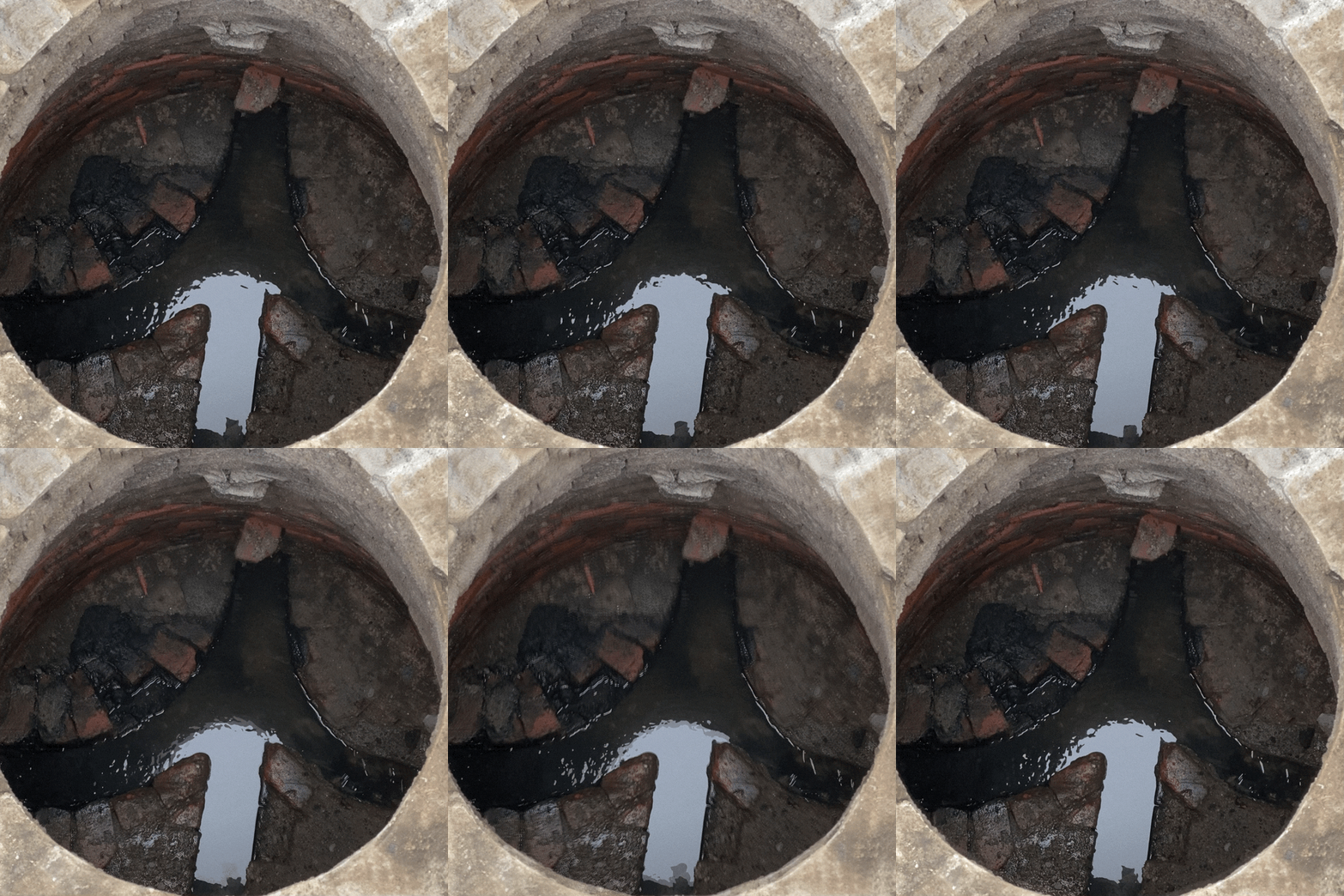
In the 1850s and 1860s a series of open ditches protected Potsdam from flooding. By the 1890s these ditches were covered with sandstone or with wooden troughs or with different sorts of pipes, becoming the “crosstown canal system” and quickly forgotten. Now, over a hundred years later, extensive parking pavements, as at the high school and hospital, are flooding the canal system itself so repairs are needed. Clarkson students are mapping out the location of the old drainage system and guiding village efforts to improve this old hand-me-down.
This photo taken on Depot St near its intersection with Constitution St.
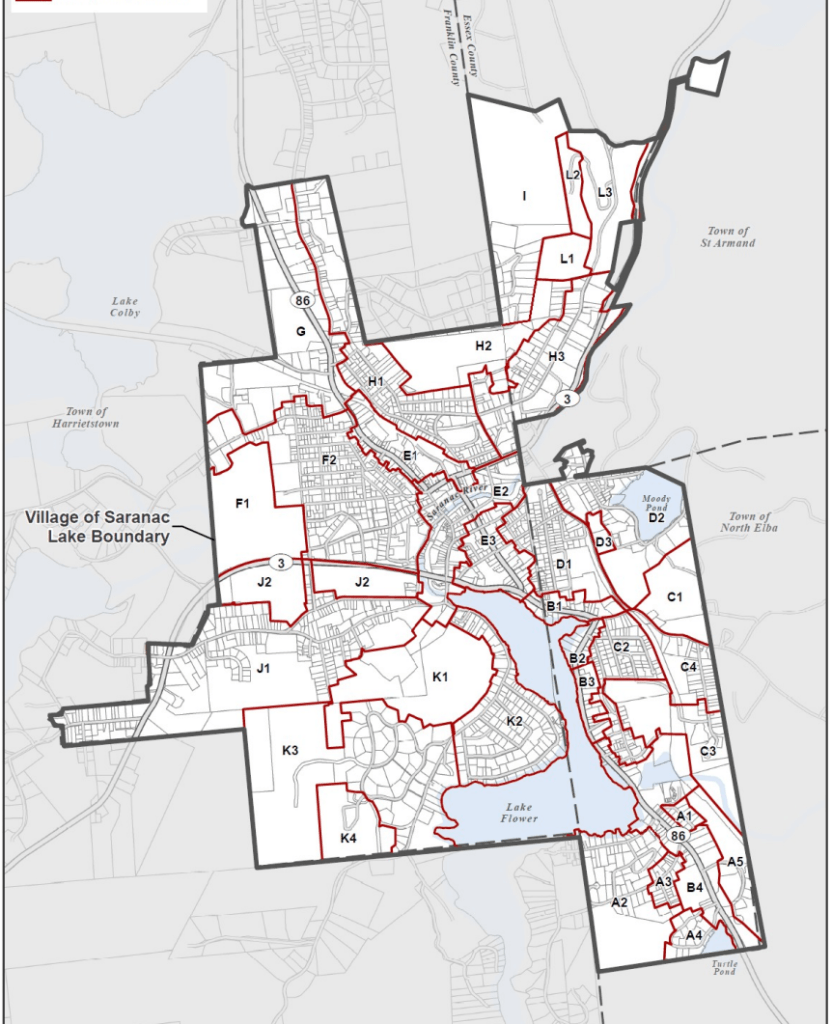
The state of NY contains 534 villages, each a legally prescribed “municipal corporation,” with all the concomitant duties and priveleges. Villages seldom occupy two counties and also rarely sit in more than one town. Three villages in NYS however are situated in 3 towns, but all of those are confined to one county. One village even occupies two counties and sits in two towns. However, the undisputed winner of most overlapping municipal corporations is Saranac Lake! This village sits in two counties (Franklin and Essex) AND 3 towns (Harrietstown, North Elba and St Armand)!! Can you imagine coordinating snow plowing, street maintenance and property assessments/tax rates? Bravo to the residents of Saranac Lake for demonstrating that multi-level, cooperative administration can work very well.
And thanks to Rich Shapiro and Peggy Wiltberger for drawing my attention to this nugget

 Local Government Matters