Dismantling Lives

I am truly sorry the abductions have begun in the North Country. The incursion of unnamed agents with unspecified warrants removing unnamed individuals from the fabric of our lives will create endless misery for some and a great deal of harm for everyone else.  I cannot imagine the agony of those with no legal standing and few financial resources as they may be detained indefinitely or may be deported to who-knows-where, so I won’t try.  My heart goes out to them and I pray that in time the legal system can come to their rescue. 

Let us consider what else will be lost.

The absconded individuals will no longer be able to provide the services they provided. They will also no longer be able to pay rent, property taxes or taxes and fees on their businesses. In order to process this loss, credit card firms, lien holders, landlords, and taxing agencies will require information: the names and disposition of the individuals that no longer pay their bills. This information, however, is not forthcoming. If and when it does, the legality of the current actions will drag out in courts. Landlords and other debt holders will suffer both the loss of income as well as the inability to move on as homes, apartments and businesses stand idle.

Are there other negatives?  In 1976  an INS agent informed my mother: “You have outstayed your VISA. You are not eligible to remain in this country.” He proceeded to stamp her passport with a stamp reading “Final VISA” and informed her she had 3 months to leave the country, or become illegal. She was able then, with help of friends and her partner, to close up, transfer, and depart in an orderly manner. She left (and after a year was able to marry her American partner and so return to the USA).  Today, however, without those slim 3 or 6 months to organize a departure and with the threat of imminent arrest, indefinite detention and likely deportation to god knows where, any number of VISA  and green card holders may  decide to cut their losses and return to Vietnam, India or China, or Uganda, Uruguay or Canada, again leaving behind irreparable holes, which along with the uncertainties surrounding tariffs, the shrinking demographic as well as the financial shackles being placed on universities and hospitals, will negatively affect the local economy. Stay tuned.

What can be done?  I will invest my time in writing polite emails to center-leaning Republican Senators to not vote for the proposed BBB budget… as well as in prayer for an end to the raids.

The Federal 2026 Budget Proposal

We the people may study the proposed federal 2026 Budget, linked below. The first item: Fiscal Year 2026 Discretionary Budget Request, is the budget document in its entirety. It makes very interesting reading: It seems to unfund every single existing agency, and move all freed funds into two discretionary categories: a new, America First Opportunity fund as well as the Development Finance Corporation which includes a new “$3 billion for a new revolving fund to allow DFC [to spend funds] without further appropriation.” Very conveniently, both items disempower Congress to set and oversee appropriations. However, I do not see any references to fiddling with elections or disempowering the legal system; please point out where, if I missed that.
https://www.whitehouse.gov/omb/information-resources/budget/the-presidents-fy-2026-discretionary-budget-request/

Meanwhile, Elsewhere…

From Albany’s Times Union daily newspaper, an article dated May 20, 2025 by Nora Mishanec demonstrates the troubles local municipalities get into. While this article pertains to a town of 9,800 in the mid-Hudson valley, the details sound very familiar:

PLEASANT VALLEY — Residents of Pleasant Valley may have overpaid in taxes for years after a state audit of town finances found that the town’s board did not develop realistic budgets or properly manage its money.

The audit of the Dutchess County town of 9,800, released this month by the state comptroller’s office, determined that Pleasant Valley’s five-member town board consistently underestimated tax revenue and overestimated expenses from 2019 to 2023, resulting in a $6.4 million budget surplus.

The budgeting flaws over that period “may have placed a higher tax burden on taxpayers than necessary to provide services,” according to the report.

The report noted that town officials “generally agreed” with the findings and would take steps to correct the imbalances noted in the audit. Supervisor Mary Albrecht, the chief executive and financial officer responsible for the town’s day-to-day financial operations, did not respond to a request for comment. Albrecht was appointed to the board in 2019. 

“While the audit focuses on past practices, I believe the steps we’ve taken demonstrate a clear course correction and commitment to continual improvement,” Deputy Supervisor Michael Rifenburgh, who joined the board in 2022, said in an email.  

New board members had “worked diligently to deliver responsible and transparent fiscal planning” in the three budget cycles since the audit, Rifenburgh said. Under new leadership, the town tax rate “decreased by approximately 17% and total budgeted expenses have dropped to 2022 levels — despite inflationary pressures, rising personnel costs, and the lingering impacts of the COVID-19 pandemic.”

The largest budgeting errors appeared to have occurred during the 2021 fiscal year, when town officials estimated they would receive about $400,000 in sales tax but brought in more than $1 million. That same year, officials estimated collecting about $100,000 in mortgage tax but received quadruple that amount. The discrepancies, auditors noted, reflected that the board “did not consider historical or known revenues and expenditure trends when preparing annual budgets.”

The town’s two main operating funds each accumulated millions in budget surpluses. Property and sales taxes collectively generated an operating surplus of $5.1 million for the town’s general fund, while the highway fund’s surplus exceeded $1.2 million. Town officials “lacked a plan on how the funds (would) be used,” auditors said, adding that “there was no rationale” for accumulating such significant sums.

“As a result, the board maintained real property taxes at a level higher than necessary for operations and missed opportunities to lower real property taxes,” according to the report.

Town officials told auditors that they had not updated their budgeting practices from prior years and agreed to improve budget estimates by considering historical trends.

Our Taxes Just Went Over the Top

In the previous posts we discussed the Water and Sewer tax/fee rates and reported that the rates adopted by the Treasury department do not match the stated Appropriation requests. The rates quoted in the budget report will bring the Treasury a combined $400,000 excess revenue. Unfortunately, I cannot find an updated, corrected Budget document.

In another post, we discussed how the Hydro Fund expenses are almost completely borne by local property tax dollars, in violation of the “Less Non-property Tax Estimated Revenues” column on page 30 of the budget report.

Before commenting on the proposed General Fund portion of the Mayor’s budget, I had hoped to hear the Mayor’s comments, as that important document is full of pain and promise. Unfortunately, I was unable to access the village board’s live-stream of the board meeting last night, and have seen no written comments by anyone in the administration on why the General Fund appropriation ballooned this year.

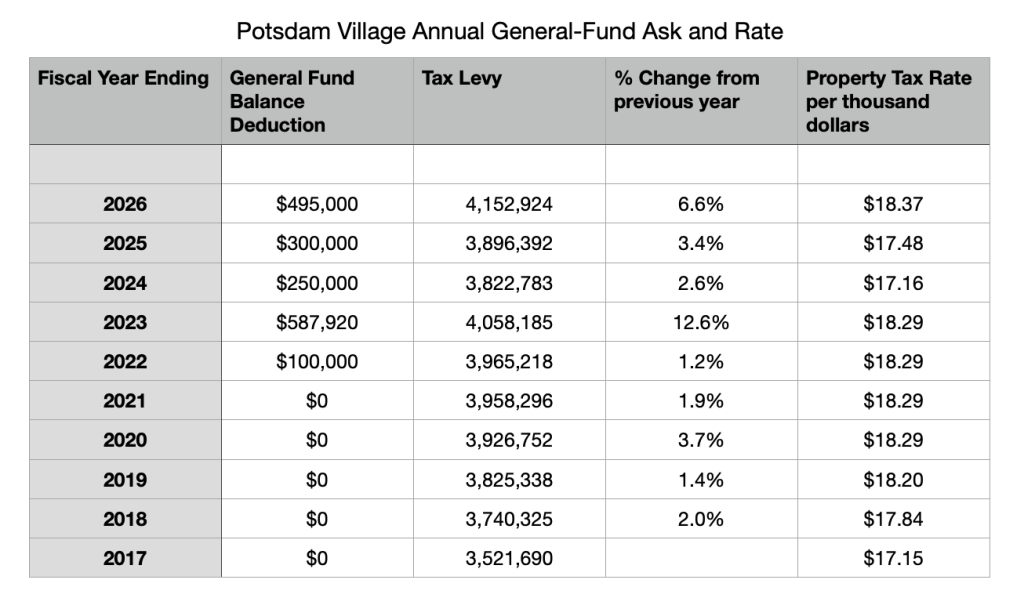
For the sake of historical context, I therefore post two data sets today.  The first  lists the Tax Levies by village boards for fiscal years dating back to 2017.  Note that before 2021, Village Boards did not withdraw funds from any “left-over” moneys (General Fund Balance Deduction) remaining in the fund balance at the end of each fiscal year.  The Covid pandemic changed this habit, with boards dipping into village savings accounts to cover expenses.

Note that the tax rate stayed steady at $18.29 for many years.  During my time on the board, I urged the board to lower the tax rate in 2024, as we were clearly receiving more revenue than appropriations required. That brief respite was immediately turned around, and this year, the Village of Potsdam proposes to charge the highest tax rate it has ever charged! $18.37 per thousand dollars in property value! This in spite of the fact that they will take half a million dollars out of  savings to lower the levy! And that huge savings-withdrawal, in spite of not knowing the actual amount in savings.  (The promised external audit reports for the past few years did not arrive, and our Treasury cannot ascertain how much of the moneys in our investment account has already been committed to the many projects that are underway.)

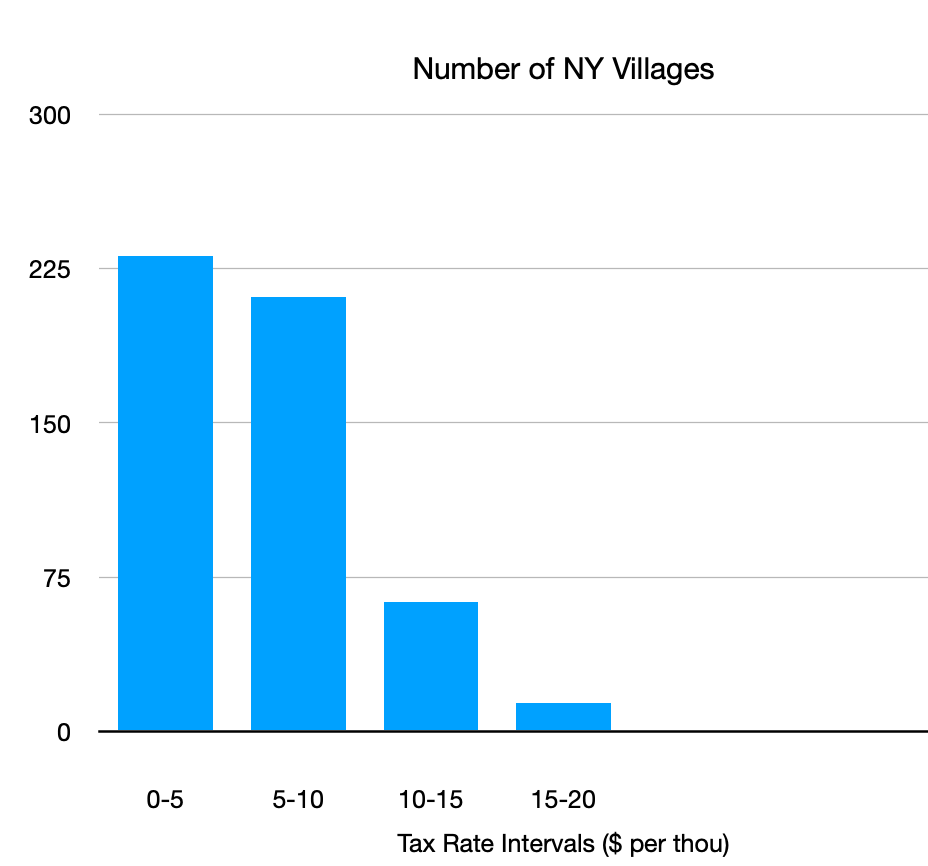
Looking at the latest (2024) published tax rates across all villages in the State we see that our municipality will have the dubious distinction of having the second highest tax rate of any of the 520 villages in NYS.  Only Herkimer in Herkimer County pays a higher tax rate, at $18.61. The average tax rate across all villages in the state, in 2024, was $6.14. Ours is almost exactly three times higher than the State average. To see where we stand relative to other villages, I plot a histogram of tax-rates binned in $5 dollar intervals; so for example, in 2024, 231 villages had tax rates under $5.00, and merely 14 villages had tax rates over $15.00.  Potsdam’s is right up there, almost at the top.

In the interest of full disclosure I must report one indiscretion: the phrase “our municipality” will no longer apply to me after today.  Today, we closed on our beautiful village home of the past 3 decades, and have moved downstate to be close to family. I have requested access to any external Audit report(s) that might come out, and would be happy to comment on those reports, in view of the grim finances implied by the current budget document.  I hope to continue hearing from many of you and also hope to enjoy visits from and to you. Best to all.

Budget Woes: HydroElectric Folly

Politics is not a spectator sport: Everyone is responsible for the success of government operations. Here another dive into the proposed 2025-2026 budget, to ascertain if the numbers reported there make any sense. https://vi.potsdam.ny.us/wp-content/uploads/2025/03/Budget-25-26-V2.pdf

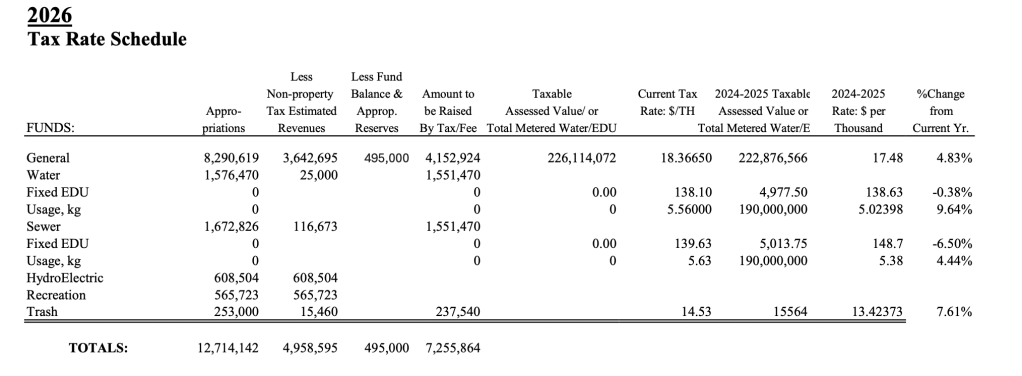
The first column on the Tax Rate Schedule on page 30 (reproduced below) lists how much money each department needs to run its operations. So for example the HydroElectric plant requires a $608,504 appropriation for the next fiscal year.  (If the magnitude of this number shocks you and you wish to know why  it costs so much to run a couple of hydroelectric power generation plants, then look at pages 24 and 25.)

The column after Appropriations is titled “Less Non-property Tax Estimated Revenues”. In other words,  not all revenue for the appropriations need come from property taxes! And for the HydroElectric Fund, the “non-property tax estimated revenue” happens to be exactly equal to the department’s appropriation of $608,504 (a very precise estimate!).  This is so misleading!

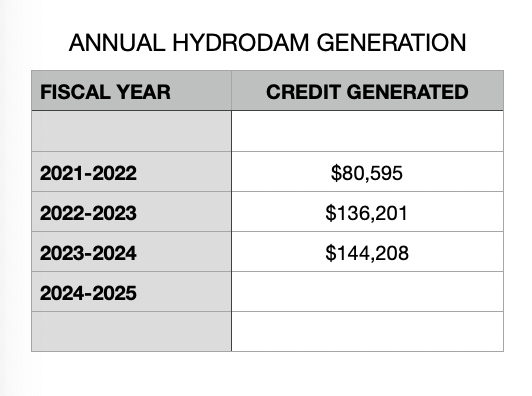
Where, if not property taxes, does the revenue to the HydroElectric Fund come from?!?  Well, it is coming from the power and credit generated by the hydroelectric dams.  And herein lies the problem that no administration will discuss: the credit generated by the two dams is tiny compared to the cost of running the plants! In all of fiscal year 2021-2022, the dams generated $80,595. In all of fiscal year 2022-2023 they generated $136,201. And in all of fiscal year 2023-2024 they generated $144,208.

But the Hydrolectric Plant requires $608,504 the next fiscal year! So there will be another shortfall of $500,000 that will be paid by our property tax dollars! Is that even permitted? Quoting from an Office of the New York State Comptroller’s Division of Local Government Report entitled “Examination on the Village of Potsdam Financial Condition” from May 2017: “the general fund has been loaning money to the hydroelectric fund to help subsidize its operations. As of May 31, 2016 the hydroelectric fund owed the general fund about $222,000, and it had no cash available to repay the loan…While General Municipal Law allows the Village to temporarily advance (loan) moneys from one fund to another, the borrowed cash must be repaid by the close of the fiscal year in which the advance was made. The use of interfund advances is a permissible form of short-term borrowing to meet current cash flow needs, but it is not intended to be used as a long-term approach to provide financial resources from one fund to another fund”.  No administration wishes to discuss this problem as there is no obvious solution, but the Treasury department has been bailing out the HydroElectric plant for 10 years, illegally to my understanding. As the Treasury department has not released audit reports since May 31, 2022, we do not know exactly how much the HydroElectric Fund owes the General Fund, but I estimate it to be well over $1,000,000.  

So I would encourage every village resident to question why the Treasury Department misguides us into a false belief that the dams pay their own way. They do not. Is it not time to sell the dams, or to simply shut them down? At the start of the village 2021 administration, Steve Warr and myself were seated on a Hydro Committee in an effort to find a way out of this financial millstone drowning our finances. Unfortunately, the Mayor dissolved that committee and attempted to resolve the problem on her own, apparently to no effect. Had I a vote, I would have voted to shut both dams down.

The 2026 Budget, comment on Water and Sewer rates

Politics is not a spectator sport: everyone is responsible for the success of government operations. And here is a chance for all villagers to delve into their new budget document deposited on the village website a few days ago, to ascertain if the numbers reported there make sense. https://vi.potsdam.ny.us/wp-content/uploads/2025/03/Budget-25-26-V2.pdf

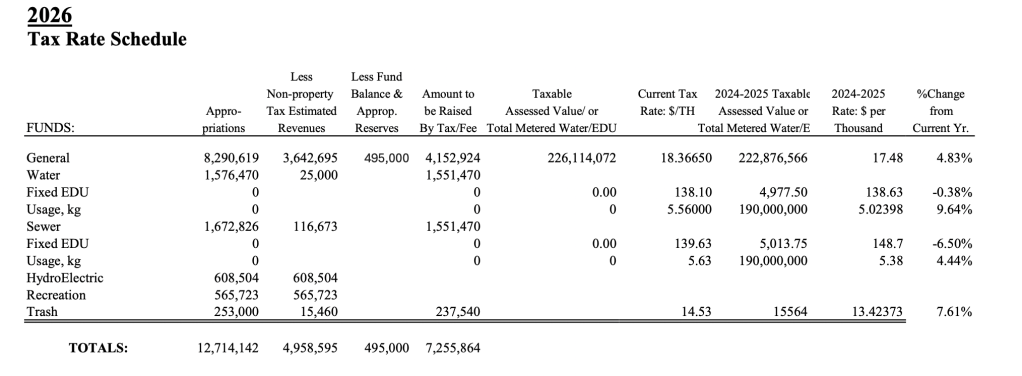
So, for example, on the last page of the budget document (page 30, reproduced in image below), we see that the new cost per water EDU will be $138.10 and the cost per 1000 gallons of water will be $5.56 (quite a large increase for usage compared to last year).  How much money will these rates generate for the water plant? Well, the budget document assumes that 190 million gallons of water will be delivered by the water plant and used by consumers: this would raise $5.56 x 190,000kG = $1,056,400 for the usage part. And since there are 4977.50 water EDUs in total, the fixed portion will raise $687,392.75, for a total revenue income to the water plant of $1,056,400 + $687,392.75 = $1,743,793.

But the budget document reports that the water plant requires $1,551,470 to be raised by tax/fee. So why are the water rates set to bring in $192,323 more than that?  A similar computation shows that the sewer rates will bring in $1,769,770 which is $218,300 more than budgeted. Why? 

If the reported appropriations for water and sewer were used, the rates would be quite lower.  

Reval Assessment & Tax Burdens

This week everyone is concerned about the new assessments: “Will my taxes double if my assessment doubled?” Or: “The notice indicates that my taxes are going down, even though my assessment went up? Is that correct?

So how will the new assessments affect your future property taxes?  Assessments of and by themselves cannot increase the taxes collected by any municipality (village, town, school and county).  Only municipalities have the taxing authority to decide how much property owners will be required to pay. How does this play out?  

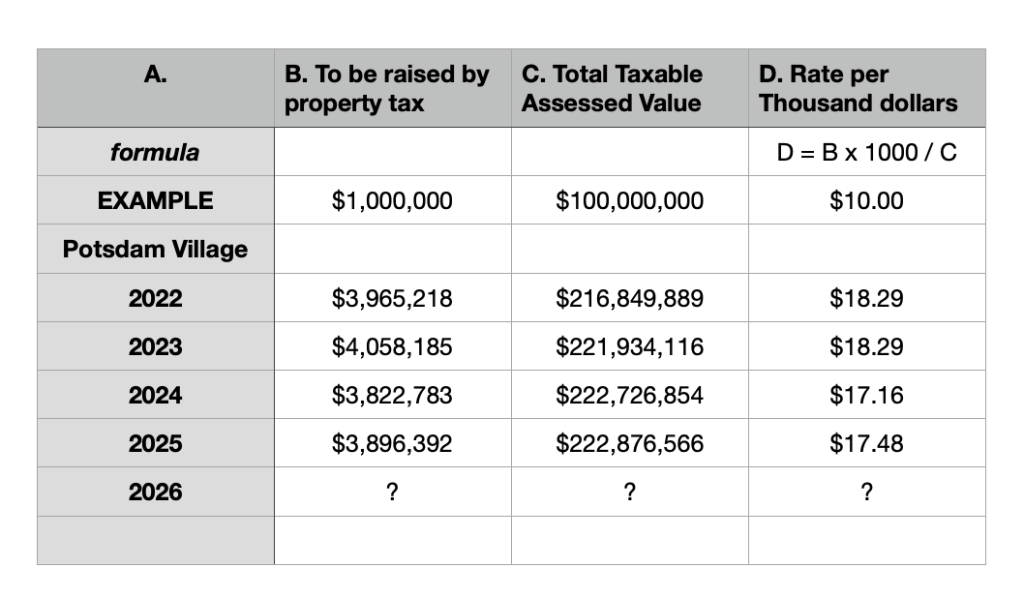
Let’s say a municipality needs to raise $1 million this year in order to run their operations. Let’s say the sum of all the taxable properties in that municipality comes to $100 million. As indicated in the EXAMPLE row in the first Table, the municipality would have to charge a tax Rate of $10 for every thousand dollars of property value in order to raise the required $1,000,000 levy.

How does this example compare to the actual numbers used by the village of Potsdam? Looking at the published village budgets found at: https://vi.potsdam.ny.us/category/news/budgets/ from 2022 through 2025, we see that the amount “To be raised by property tax” in the village has been around $4 million since 2022.  The Total Taxable Assessed Value of all properties in the village was $217 million in 2022 and rose to $223 million by 2025; and the resultant tax rate went from $18.29 in 2022 to $17.48 in 2025.  (This information is on the second-to-last page of each year’s budget document, under “Tax Rate Schedule”)

The assessment agency, using their new assessment information, and rightly trying to steer clear of any responsibility for future tax burdens, poses the simple question: “IF the levy imposed by your municipality stays the same ($1 million for example), WHILE the total taxable value went up to, say, $200 million dollars from $100 million, THEN the tax rate would have decreased to 1,000,000 * 1000 / 200,000,000 = $5 per thousand dollars of property value: i.e. halve as high as the previous rate when the total property value was $100 million.  Using that hypothetical, the assessment agency then multiplied your actual new property value by this new hypothetical rate to give you an ESTIMATE of how your tax burden would have changed from last year’s.  At best, this gives  a sense of whether your property value increased more or less than the average.

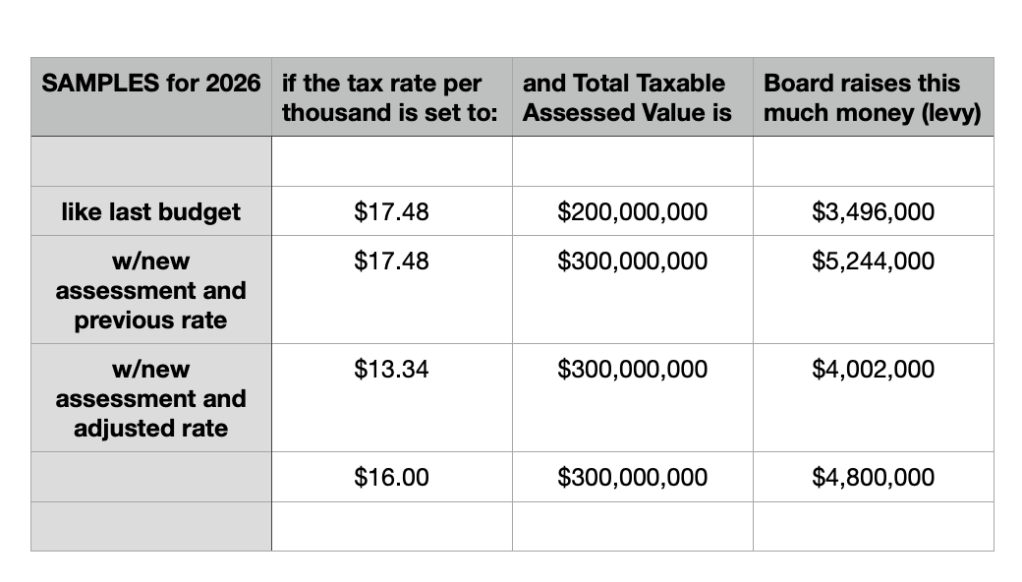
What options exist for the village board as they construct the new budget due June 1, 2025?  In the second Table, I illustrate with a few extreme examples. Everything depends on the new Total Taxable Assessed Value, a value that has not yet been made public (though I did not try to ask the Town’s assessor for this value; it will be available once the village board decides to release the new “Preliminary” budget document. It will also be published by the county government at stlawco.gov under Tax Rolls for 2026). For the sake of a concrete example, let’s say the new total assessed value rises from around $200 million to $300 million. If the village board keeps the same tax rate as last year’s, i.e. of $17.48 per thousand dollars of property value, then they would raise a whopping $5.2 million instead of $3.5 million.  That might be fun for the village board and staff, but obviously that would double the tax burden on everyone. At the other extreme, if the board decides to requisition the same levy as always, around $4 million, THEN the tax rate would decrease to $13.34 per thousand dollars of property value. Most municipalities compromise: lower the tax rate a bit, perhaps to $16.00/thousand in this example, and thereby still increase the levy significantly, from $3.5 million to $4.8 million. In sum, it is not the tax rate nor the assessments that determine your tax burden, but the LEVY that the municipality imposes. 

So under the header “caveat emptor,”  it behooves everyone to keep a close eye on the “Amount to be Raised by Tax” column of the Preliminary budget document that should be made public any day now.  As indicated, the village has requisitioned around $4 million each year since 2022. NY state law requires that municipalities not increase their annual levy by more than 2%.  Unfortunately, this law may be overwritten by a simple agenda resolution. Such a resolution is on the village board’s agenda for Monday April 7, 2025 at 5:45pm: at that time the public is invited to provide comments to the board about the board’s intention to override the state’s tax levy limit.

By simply asking “What amount of money is to be raised by property taxes next year?” And “How does that compare with last year’s $3.9 million?” And if the levy is set to increase by more than 2%, then ask: “Why is that?”  Everyone should be on board in developing a fair and equitable village budget.

The Perks and Costs of Village Life

A long-time village resident recently challenged the suggestion that village taxes are excessive. First in person and later via emails she stated emphatically: “My figures show that for [around $200] a month…I get 24 hours police protection; 24 hour fire protection; 24 hour rescue squad availability; Museum; Library;  Streets plowed; Sidewalks cleared; Summer and Fall yard debris pick-up; DPW work crew response to road, water, sewer [issues]; Access to water, sewer, and … trash and recycling services; Recreation program; Maintained parks…Compared to what I pay for television viewing monthly, I think the village gives me much for [around $200] a month”. I thanked her whole-heartedly for the clear-headed numeric analysis, and for reminding me why we live in the village.  

Needless to say, I checked her figures and then applied the same analysis to my own finances for comparison and verification. I responded with a few provisos: The Potsdam public library is an independent institution run by its own elected board that sets its own tax rate and manages its own budget. Likewise, the Potsdam Volunteer Rescue Squad   operates 100% independently: The PVRS owns its rescue squad building and all vehicles.

I also pointed out that the Potsdam Volunteer Fire Department mostly pays and operates on its own-the village does pay for the 4 fire drivers, who may only drive vehicles within village boundaries and who may not fight fires.  In other words, we enjoy library books, rescue-squad/EMS and fire-fighting services largely thanks to volunteers.  My new friend thanked me for the clarifications, saying “I did not realize that these organizations / services are so independent. I guess I will think of them as ‘soft’ advantages of village living…[including] access to natural gas for heat and hot water which is said to be less expensive than the oil, propane, or electric that non village residents are left with.” 

I added one final proviso:  the village does not operate municipal trash services. Instead, the village contracts with the Vermont based company, Casella Waste Systems, Inc. to collect all residential trash in the village using a fee structure set by Casella. The village does operate municipal Police, Public Works, Water, Sewer, as well as Parks and Recreation Departments, which provide many of the services she listed and more.  Not only do we enjoy clean drinking water, a state of the art waste water recycling plant, around the clock police protection and street maintenance, but also the little perks of canoe launches, lively summertime beach and wintertime ice skating activities; pickleball courts,  and an expanding municipal airport.  And yes, we also own and operate two municipal hydroelectric plants that for the past 10 years have been operating at enormous losses.

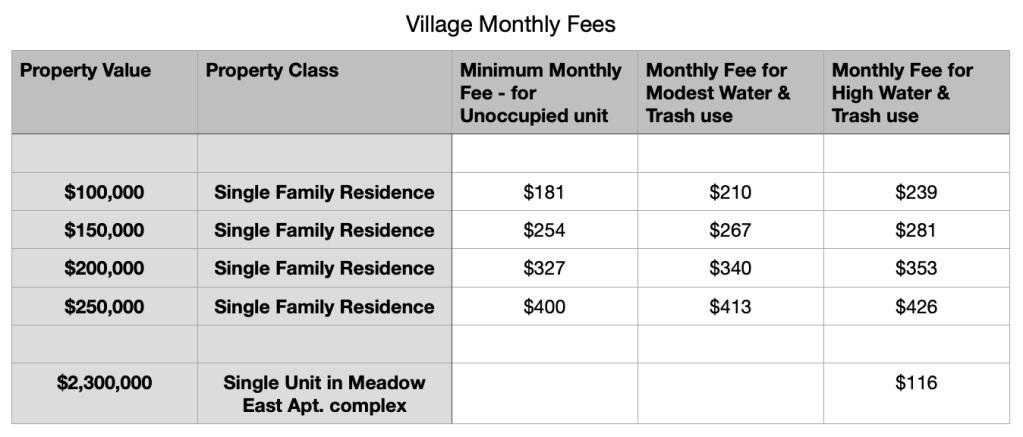
She and I then checked our respective costs of village living; after correcting for a few matters, we discovered that she paid $237/mo and I paid $335/mo for the combined costs of village property taxes plus water, sewer and trash fees. 

Generally, we cannot determine these costs for commercial enterprises within the village, including apartment complexes, due to the manner in which commercial water and sewer services and trash services are billed. By chance, however, I am familiar with the water and sewer billing at the Meadow East Apartment complex and the owners kindly shared their trash and recycling expenses with me; hence I could compute the cost burden shared by each unit in the Meadow East complex. It came to $116/mo per unit.  Why is the cost burden amongst apartment renters significantly lower? Due to the economy of scale of living in a shared community: an apartment complex with 100 units cost far less than 100 separate homes. 

If you’re curious how your situation compares, I include the following graph that breaks down the monthly cost of village life according to property value and whether water use is zero (for unoccupied dwellings), modest  (6000 gallons / quarter), or high (12000 gallons / quarter); plus whether the number of trash bags used is  zero (unoccupied dwelling), modest (4 per month) or high (8 per month):

Fees or Taxes, What’s the Difference?

As the time nears for developing a new village budget, let’s compare the tax rates the village board imposes.

By state law, water departments must charge “user fees” or “rents” to cover their costs, not taxes. Similarly, sewer departments must charge user fees, not taxes, to cover their costs of operations. And this is extremely helpful: by naming the water and sewer rents “fees” rather than “taxes”, everyone pays for these services; no-one is exempt.

Let’s see how that translates for us in Potsdam.

Rounding to the nearest dollar, I paid $525 in total in 2024 for water and for sewer fees. The final budget document on the village website shows that for 2023-2024, the water and sewer departments cost $3.3 million to operate.  So I personally contributed 16 cents to every thousand dollars those two departments needed. Keep in mind that homeowners, businesses as well as nonprofits contribute to water and sewer fees. Let’s compare this to our property taxes that run the General Fund.

I paid $2,500 in village property taxes last year.  The final 2024 budget document (posted on the village website) shows that the village board needed to raise $3.8 million in property taxes to operate its General Fund (i.e. DPW, the police department, civic center, parks & recreation etc). So I contributed 64 cents to every thousand dollars for village operations, a 4.0-fold increase compared to the water and sewer costs.  

Why? Yes indeed, because in the village fewer than 1/3 of all property owners contribute to taxes. The total property value in the village, currently, before the new valuation kicks in, is listed by the county as $684 million. The total taxable property value in the village, however, stood at $222 million, or or 32% of the total.  

Currently DPW, the second most expensive department within the General Fund, covers the cost of building, maintaining and repairing water and sewer lines.  If those costs were instead carried by the water and sewer departments, everyone would end up contributing to the upkeep of our infrastructure, not just the property tax payers. A quick phone call or email to NYCOM counsel would quickly inform us of the legality of such an adjustment, which has the potential to significantly lower the tax burden on village residents.  Join me in urging the Mayor and village staff to pursue this possibility, via emails, phone calls or attendance at village board meetings.

Who Butters our Bread?

Who pays the highest property taxes in the village?

I ask this question not in order to point fingers at any particular institution, but in order that our administration might confer recognition and perhaps better support for this sector of our community. Currently, this sector labors under the most onerous local tax burden, which might discourage further investments.

Two facts determine the property-tax burden within the village. The first is whether a property belongs on the tax-exempt roll (tax roll 8) or not.  Institutions that are on tax roll 8, like  hospitals, colleges & public schools and churches, pay no property taxes (and their property values tend to be asymmetrically high).  The second fact is the property’s assessed value. If the property is not on tax roll 8, its owner will be required to pay her share of the village-board’s mandated tax levy. Currently, our tax rate is about $18 for each thousand dollars of assessed value. If the property, for example, is assessed at $100,000 its owner must pay $1,800 in property taxes. If the property is worth 10 times as much, one million dollars, its local property tax will be $18,000. Everyone who owns property in the village and is not operating a tax-exempt business, pays the same tax rate of $18 per thousand dollars of assessed value (barring a few  tax exemptions for some).

So then the question of who pays the highest property tax in the village turns into the question of which property within the village has the highest assessed value?  Is it the Price Chopper Plaza? No. Is it a bank or a car dealership? No.  When you ask around, I find it surprising how laws get enacted and local tax-rates set, without this being common knowledge.  In fact, the highest property tax is paid not by a commerce business at all, but an apartment complex. In fact, in the top ten most valued properties within the village, there are several apartment complexes, as well as a commercial enterprise, a tourism enterprise, and, surprisingly, a green energy enterprise.

The point I hope to stress here, is that we should all have the good sense to know who butters our bread. As I have discussed in an earlier blog post, when the village switched to an EDU-based water and sewer fee system, the tax burden on apartment owners increased disproportionately. Why? Because each apartment in the complex now pays a hefty water and sewer rent, whether the apartment is occupied or empty.  So apartment complex owners pay both higher property taxes since apartment complexes are expensive and then in addition they pay a greater fixed share of the water and sewer tax fees.  

We need apartments. My husband moved into Meadow East in 1987 upon arriving in Potsdam, before we found our house.  Now, we would like to downsize again, to a high-end apartment. But as has been pointed out to me by several friends, and I now discover for myself, there are no high-end apartment complexes in the village-most apartment complexes are in the tax-exempt category that may not accept individuals in higher income brackets. Others are geared towards students or temporary laborers, whether nurses or teaching associates.  At this time there is nary an option for retiring boomers who prefer to live in town. Creating a more tax-friendly environment for apartment complex owners strikes me as an important objective for the village.