Hydrodam Woes

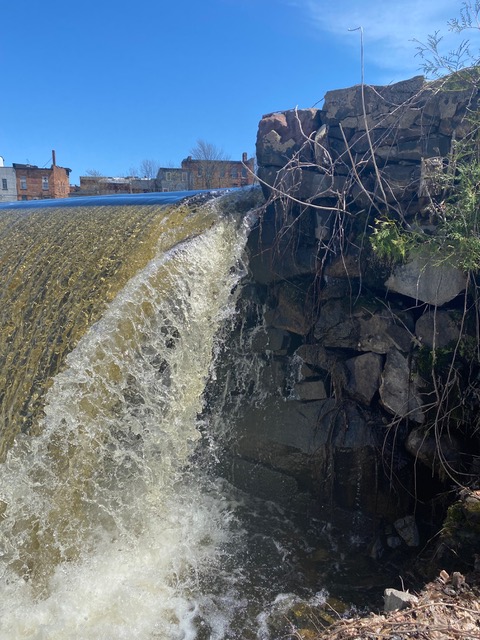
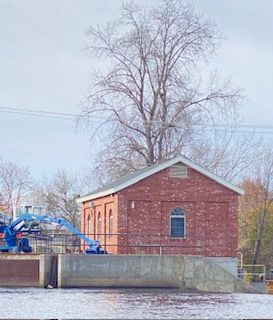
During the last Fiscal Year (June 1, 2022 – May 31, 2023) the village’s two municipal dams generated $136,201.33 worth of (electric) credit. That sounds like a lot, but the Fiscal Report of 5/31/2023 states that the municipal dams cost the village $533,183.06 during that same FY.  The two dams, therefore, generated a revenue shortfall of $396,981.73 during FY23. This nearly $400,000 shortfall is paid for by tax dollars from the General Fund.

By how much do Trustees have to raise the village tax rate to cover a shortfall of $400,000? The village’s total taxable property-value in FY23 was  $210,000,000 and the tax rate  was $17.16 per thousand dollars of property value. For every $100,000 reduction in appropriation requests (expected expenses), therefore, the board can lower the village tax rate by $0.48 per $1000 of property value.  To pay for the shortfall generated by the hydrodams, the board increased the village tax rate by $1.90 per $1000 in property value.  For the average village home valued at $104,000 this corresponds to an increased property-tax levy of $198.00 to the homeowner.

The municipal dams have been operating at a loss since at least 2014 in spite of repeated and generous infusions of funds to upgrade performance.  In fact, the losses reported by the Hydro Fund have been growing bigger year after year, as new and growing debt payments come due. As of the end of last year, the municipal dams owed the general fund approximately $1,052,122.95.  Is it time to try to transfer responsibility and ownership of the municipal dams to an agency specialized in operating these complex machines?  

Equity with Taxation

Village homeowners pay taxes that people living in the Town do not:

• A tax based on assessed property value, termed the village tax

• Taxes for the use of water and sewer, termed water and sewer rents

In fiscal year 2022-2023, the village received $4.6 million from property taxes and $3.2 million from water and sewer rents.  Together these accounted for 62% of the village’s operating budget of $12.6 million.  (A big chunk of the remaining revenue comes from sales-tax revenue.)

As property tax levies are independent of income, they are considered regressive, not progressive. However, insofar as higher income earners live in properties with higher property values, they somewhat scale with income.  This is not true for the sewer and water taxes. Everyone pays the same for those, regardless of income and regardless of the total assessed value of a property. This led me to wonder how property values are distributed in the village.

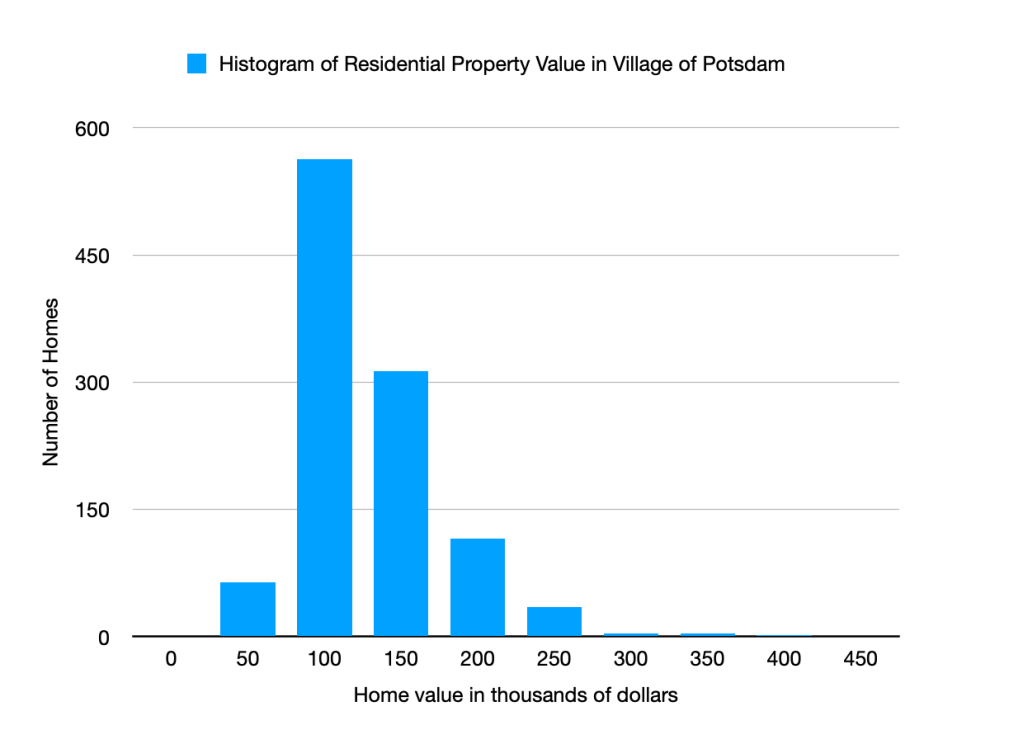
I asked the Town Assessor for a listing of all residential property values and made the following histogram. There are 1,102 taxable residential parcels in the village, ranging in value from $9,300 to $419,100.  The average residential property value is $104,259 while the median home value (the 551st entry of the listing of lowest to highest of all 1,102 entries) is $91,400.  

A home with a total assessed value of $75,000 paid $1,371 in village taxes in 2022-2023.  If this home stood idle and used no water, the homeowner would still pay $317 in combined water and sewer taxes, which is  nearly 1/4 of the village tax amount. In contrast, a home with an assessed value of $220,000 pays $4023 in village taxes and would pay the same $317 for water and sewer rents if no water was used, which represents less than 8% of that homeowner’s village tax.  

As trustee, I am asked to supervise the tax levies on village residents.  Are the water and the sewer taxes effective and equitable?   The taxes were far more equitable pre-2018 when the water and sewer rents were tied to water-usage amounts.  Due to the large number of snowbirders and empty apartments, the village often suffered unexpected revenue shortfalls, so the administrator would say the pre-2018 tax structure was not effective.  Currently, post-2018, the income stream is stable and effective in that sense, but the tax burden is not distributed equitably.  Homeowners who use 5 EDU worth of water, because they empty and fill swimming pools or hot tubs several times a year, pay the same fixed fee as homeowners who use 0.5 EDU worth of water.  People who conserve water pay for the profligate users.  

Simultaneously, a different burden has been placed on apartment owners.  One retiree explained to me that he could not make ends meet financially on his retirement savings and decided to rent out his second floor. This changed his home’s status from a “one-family year-round residence”  to a “one-family year-round residence with accessory apartment” and resulted in a 2 EDU-tax for his water and sewer rents (instead of the 1 EDU tax for a one-family residences like mine). Even when his upstairs is unrented, he must pay 2x$317 or $634 in sewer and water taxes annually: over 50% of his village tax. He has been lobbying for a reprieve on this tax burden since 2018.

An apartment complex with 100 units, like Meadow East, uses about 500,000 gallons of water per quarter, or about 2 million gallons per year. Pre-2018 these 2 million gallons cost the owner of the complex $32,040.  Post-2018, these same 2 million gallons cost the owner $48,466, a $16,426  or 50% increase. If apartment complexes are set up so each unit is individually metered, as at Swan Landing, this cost is distributed to every renter.  In older complexes like Meadow East the apartments are not individually metered, and the owner pays the entire bill. Whether renting out a portion of one’s home as an accessory unit or renting a hundred apartments in a complex, each empty unit costs the owner $317 per year for the water and sewer tax.

In order to create effective, steady income streams for the water and sewer departments, some type of EDU-based billing will be necessary. However, the cost burden should be distributed more equitably so that private and commercial residences do not carry a disproportionate share of the costs. 

Progress!

Several new and positive developments occurred since the Annual Board meeting that introduced the new Mayor, Ms. Jacobs-Wilke, and two new board members, Trustees Schulte and Williams. First, the board received the end-of-year Budget Reports for all previous years going back to 2017-2018. These reports provide the board the ability to reveal spending trends as well as revenue patterns.  In addition, the board has begun to receive monthly budget reports. These current reports will permit the board to ascertain which departments do and do not manage to stay within budget.  I thank the Treasurer, Ms Gates-Shult, for both developments.

In addition, the board passed a resolution to update the EDU assignments of all village water and sewer accounts that use a “based on prior year consumption” rating. Once this update is complete, by March 1, it will be possible to adjust the water and sewer rates, and possibly the fee structure, to more accurately reflect usage trends.  

Fiscal Stress

As recently as 2015 the NY Office of the State Comptroller named Potsdam the most fiscally stressed village in NYS.  How did this happen and can it happen again? Fiscal stress typically occurs when revenue plummets and/or expenditures balloon.  

Revenues derived from property taxes are steady and predictable but account for about 25% of all village revenue. The remaining revenue sources are far less predictable. For example, our revenue decreases if sales taxes decrease. As recently as October 24, 2023 an article headlined “September tri-county sales tax receipts down significantly from 2022” stated that St. Lawrence County receipts were down $1.36 million from a year ago, a significant 6% drop (1). During the previous budget year of 2021-2022, for example, the village received $1.8 million in sales tax revenue, so every 1% reduction in sales tax revenue amounts to a loss of nearly $20,000 to the village.  If sales do not pick up, the village could face a revenue shortfall of around $100,000 this budget year.

The village opted in the summer of 2021 to dissolve its recreation partnership with the town which resulted in a  yearly loss of $160,000 to the village (2).  While the village expected to reduce its recreation budget  without the responsibility of Postwood park, the opposite is true:  Recreation appropriations went up, not down, by over $20,000 in FY23 and FY24, from an appropriation of $500,000 in 2022 to over $520,000 each of the next two years.

Revenues also decrease if anticipated fee incomes decline. Last year, for example, the village received around $500,000 for building permits associated with the CPH addition.  The village also received a non-recurring payment of $425,000 for the sale of a portion of Cottage St. These non-recurring boosts to the budget are wonderful but atypical (The sale of Cottage St. provided most of the funding for the new pickleball courts).

State and Federal funding for village projects are also highly variable. The recent generous pandemic funding is drying up as State and Federal governments adjust to massive debt burdens combined with higher interest rates.

Finally, village income decreases if actual expenditures exceed budgeted expenditures or appropriations, as this results in a loss of interest income.  At the end of May 2022 the village held over $6 million in the bank, earning an interest in excess of 5%, or over $25,000 per month.   Hence for every $100,000 reduction at the bank (due to expenses exceeding appropriations), the village loses around $5500 income annually. Overspending our allotted budget by $1 million equates to a revenue loss from interest of around $55,000.

How might actual expenses exceed budgeted expenses? The budget is designed to withstand some surprises, as when trucks break down or medical coverage is required for an employee.  The Treasurer might reallocate moneys from various “contingency” lines to the line-items needing additional funds. This works well until the contingency sources run dry, at which point funding the un-anticipated or non-budgeted would require dipping into the village cash reserves or savings.  

This has happened before: the village’s general fund balance decreased from over a $1 million excess at the end of the 2011-2012 budget year to a  $15,911 deficit at the end of 2014-2015. That’s when the office of the state comptroller named  Potsdam the most fiscally  stressed village in NYS (there are 530 villages in NYS). The village had to borrow $500,000 to pay employees. To reduce expenditures, the board abolished the village justice court and increased village tax rates from $15.06 per thousand dollars in property value in 2013-2014 to $18.29 per thousand since 2018-2019. (At the end of May 2022, village cash holdings stood at an impressive $6.3 million. As the emergency requiring the elevated village tax rates ended, the board opted to use $250,000 of these savings to reduce this year’s village tax rate to $17.16).

Why did our savings vanish in 2015? One can read the details in a NCPR article by Lauren Rosenthal dated 3/10/2016, but the bottom line seems to be that the village board voted to use $1.6 million in cash reserves to pay for the many cost-deficits associated with its municipal hydrodams(3). Unfortunately, that danger persists today.  For budget year 2021-2022 (the latest published), the hydrodams earned a combined $76,000.  That income is likely to decrease this year as the Village Administrator recently informed the board that the blades on the East Dam rotors (the only functioning hydroelectric facility) can no longer be adjusted, leading to significant loss of power production.  But the 2023-2024 budget did have to allocate $570,000 towards its Hydro Fund ($430,000 towards debt payments, $90,000 towards operating expenses, $30,000 towards fringe benefits for workers, plus a $20,000 contingency).  The difference between the overall cost to the village to run its municipal hydrodams, $570,000,  less the revenue generated by those dams, maybe $50,000, equal to $520,000, will be paid for by village tax dollars.  

And so, yes, I think it is possible for a not-so-perfect storm of lower-than-anticipated sales tax revenue, fees and reduced federal and state funds might lead to a reduction in our cash holdings and interest earnings. Combine these income reductions with increasing costs for workman comps (an annual increase of $40,000 is anticipated), salary and fringe benefits, materials, labor and IT services, we could well run into fiscal stress once again.  Without expenditure sheets to guide the board, only appropriation requests as explained in a previous post (4), it is impossible to extrapolate future spending trends based on past expense patterns.

Sources:

(1) nny360.com/news/stlawrencecounty/september-tri-county-sales-tax-receipts-down-significantly-from-2022/article_6dac9881-7435-5b05-a715-783b0e153a31.html

(2) nny360.com/opinion/editorials/editorial-diving-in-town-of-potsdam-will-assume-all-control-of-postwood-beach/article_1436bbf5-225e-5991-921e-f47493df0861.html

(3) northcountrypublicradio.org/news/story/31231/20160310/how-did-potsdam-become-the-most-fiscally-stressed-village-in-the-state

(4) villagemusings.org/2023/10/13/the-mystery-of-6-years-of-missing-expenses/

The Mystery of 6 Years of Missing Expenses

The village board has been asked to ok salary increases for several employees.   I do not doubt the value of staff’s contributions in keeping the village operational. It seems prudent however to see whether the percentage of our property tax revenue going towards salaries is increasing or decreasing over time. Salaries increase at least 2% every year by union rules, as I understand, but property tax revenue also increases as the net worth of land and buildings typically increases every year. As the number of employees also varies, where the balance between salaries and revenue lies is unclear.   I therefore asked staff to please provide graphics to illustrate how the share of property taxes going towards salaries has changed over the past 5 years. Unfortunately, staff is swamped paying & recording bills, balancing & reconciling accounts and providing endless reams of data to the external auditor.

As municipal budgets are open access, I decided to download and decipher the salary data manually, from online pdf budget reports rather than from the more convenient Excel-type budget worksheets that staff presumably have access to.

In budget reports, actual amounts of money spent in previous years are compared with on-going expenses in the current year to make forecasts for next year’s monetary needs.  Realistic forecasts of future spending, termed appropriations, permit municipalities to set appropriate tax rates. 

And indeed, these accounting basics were maintained by the village of Potsdam. Until 2018.

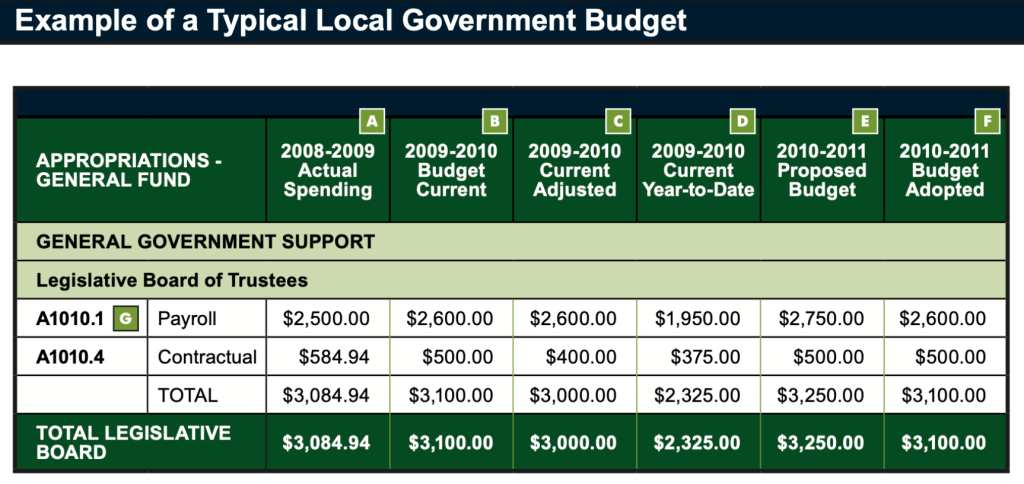
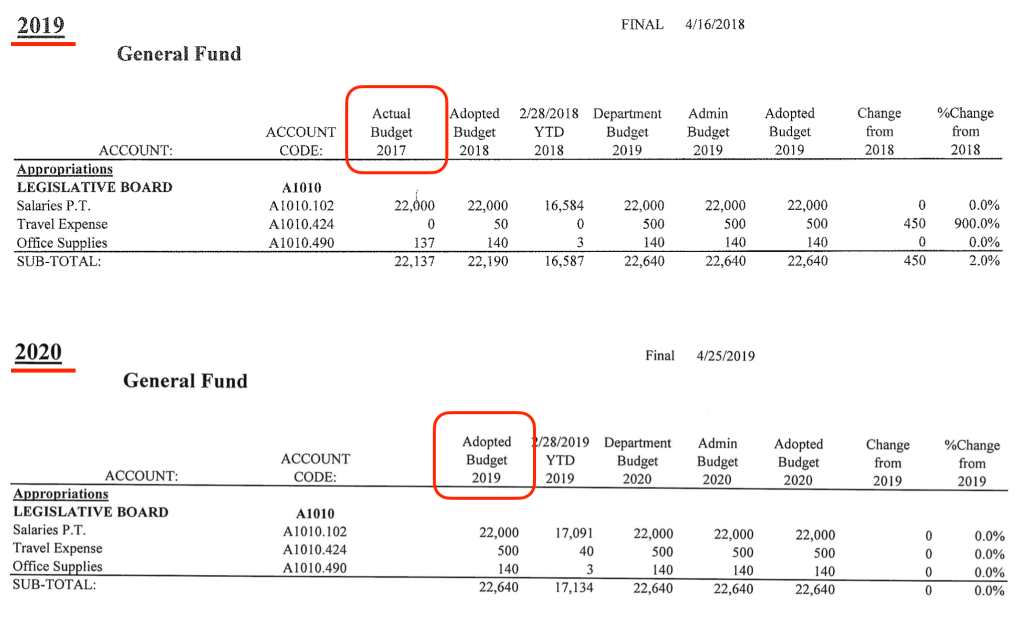
Before 2019, as you can see in the screenshot of the first items in the Budget Report below, the column “Actual Budget 2017” reported the actual, to the dollar, expenditures for all items and all departments.  So during the budget preparation time (April) for fiscal year 2018-2019, Potsdam’s budget report presented the board with the actual expenses for each item during the previous budget year (2016-2017) in the first Budget column. The next column presented how much was allocated for each item in the then-current budget year (2017-2018), followed by the year-to-date (YTD) expenses as of 2/28/2018, to provide a sense of whether each budget item remains in line with expectations. The remaining columns report on the future budget (2018-2019) requests: a column presenting the amounts requested by each department (police, parks, DPW, code enforcement etc), followed by a column presenting the administration’s counter-offer and then a final, board approved “adopted budget” column. In order to draw attention to any aberrations, the final two columns list the changes in future spending requests compared to current amounts, both in terms of dollar amounts as well as a percentage change. Any items with big changes can be quickly detected and discussed. 

But note what happened in the following budget of 2020. The first  column, reporting the actual expenses of the previous year, is absent, blank.  And has remained so: Are Actual Budget expenditures reported in

FY 2016-2017: Yes 

FY 2017-2018: No 

FY 2018-2019: No 

FY 2019-2020: No

FY 2020-2021: No

FY 2021-2022: No

FY 2022-2023: No

FY 2023-2024: ?

Actual expenditures have not been reported on for six budget cycles!  So while I, as Trustee, have both the time and wish to analyze our spending patterns, I cannot. I have no data to make plots comparing actual expenses across the years and comparing them to actual revenues (which are available).  Is this ok?

From NYOSC Local Government Management Guide: Fiscal Oversight Responsibilities of the Governing Board:

Once the financial course has been set through the adoption of key policies and plans, board members have the equally important task of keeping local government operations on course. This oversight responsibility requires continued diligence. Governing board members should compare actual results to plans, policies, and directives. 

It is essential that the governing board receives regular financial reports from the CFO, treasurer, or business manager to fulfill its responsibility of monitoring financial operations. Generally, corrective action is easier to initiate when the need is identified early. Interim reports should provide the board with timely information on such issues as: financial position, results of operations, budget status, policy compliance, service or project costs, performance measures, and legal compliance matters. 

To help meet these objectives, the CFO, designated budget officer, and department heads should regularly monitor actual revenues and expenditures and report these figures to the governing board.  Budget status reports provide the governing board and other decision makers with information about year-to-date revenues and expenditures compared to budget estimates. At a minimum, these reports should identify unfavorable variances that require timely budget amendments

Potsdam trustees have not received regular financial reports, and so I am unable to fulfill my obligations as trustee. I am unable to monitor spending patterns and report back to  residents whether the village’s financial standing can absorb requested salary increases and other budget modifications, or comment more generally on how sound village finances seem to be.

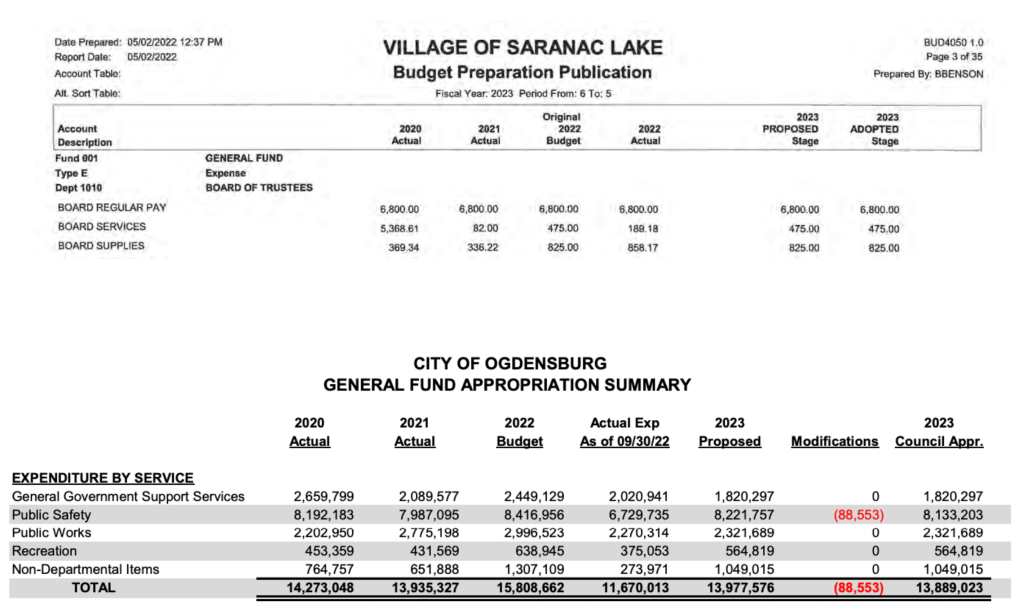
Do neighboring municipalities provide the mandated expense information?  Two nearby, similar GDP-sized municipalities, the Village of Saranac Lake and the City of Ogdensburg, provide online budget reports going back many years and include the actual expenses for not one, but two earlier budget years. In the screenshot below, for example,  for  FY2022-23, the actual expenditures of both FY 2020-21 as well as FY 2021-22 are reported.

I do not know how to correct this situation. Requests to amend this omission going forward have not been acknowledged. I worry that this error permits sizable budget indiscretions that will not be detectable. As I understand due diligence, I will refrain from accepting future budget modifications without further data.

Revenues & Expenses Continued…

Continuing the previous blog post as to why, how and where village recurring-charge patterns obtain too little oversight…

When operating as intended, the forces pushing for increased funding encounter equally strong forces seeking to minimize the cost-burdens on tax payers.  

Department heads know the costs associated with running their departments and also know the costs associated with replacing or upgrading equipment and the changing supply-costs, for example. A good department head lobbies for generous funding requests to keep her/his department as strong and reliable as possible.  But increases in funding requests should encounter equally strong advocates for fiscal prudence. 

Each funding-increase request must be examined and evaluated on a case by case basis. Currently those discussions occur between the Mayor, Administrator, Treasurer and each Department head: neither the public nor the trustees are privy to the reasons that department heads request particular funding amounts nor to the reasoning behind whether to grant, postpone or decline requests. When I ask why, the usual response has been: “This is the Mayor’s budget”. This lack of transparency is both unfortunate and atypical. Unfortunate because trustees and residents are the primary defenders of tax-payers’ interests. It is also atypical, as  local news sources announce the open budget discussion dates with department heads for surrounding municipalities.

While increases in funding requests are examined, discussed, and decided upon by the Mayor and Administrator, level funding requests are not likewise scrutinized. This is also unfortunate as costs of doing business sometimes drop, as when work is automated and employee numbers decline.  A non-reduction in the appropriation request could then result in a net positive cash balance at the end of the fiscal year. This value, the total amount appropriated for a department at the start of a fiscal year minus the actual amount  spent by the department at year’s end, is reported in the external  audit report (called the Financial Statement, available from the village clerk).  The Financial Statement reports of the past few years show that some Fund Balances do grow year after year and now have a total fund balances in excess of their entire annual operating budgets.  

One may argue that positive fund balances are the “money in the bank” that buffer the village against the cost of future infrastructure projects. But these excess funds can also be argued to place an unnecessary burden on tax payers. The New York Office of the State Comptroller suggests that no fund should grow by more than 10% of its operating budget annually, and also suggests the accrued fund balances be tied to objectives listed in either 10 year Comprehensive Plan or other fiscal goal document.

What constitutes a successful fiscal year? If books balance and expenses do not exceed appropriated amounts so no additional debt is incurred, it is considered a successful fiscal year. But that ought not to be enough.  How much of our revenue is spent on debt payments?  How high should we let that share go?  Our village property tax rate, at over $18.00 per thousand dollars of property value, is nearly triple the state average of $6.65 per thousand dollars.  Is that necessary or adviseable?  

NY’s longtime state comptroller, Thomas DiNapoli, says “New Yorkers pay among the highest taxes in the country. It’s important to have transparency so citizens are empowered with information they need to hold their elected officials accountable.”  I am an elected official and have tried to understand, explain and coax budget matters toward greater transparency and clarity and fiscal responsibility. It takes a village however.  I understand the appeal of enacting and accomplishing without a great deal of arguing and possibly heated discussions. But it also convenient that a lack of discussion obscures questionable fiscal policies.  It is a struggle to overcome the forces that aim to obscure and befuddle, but NYS has the nation’s strongest and best FOIL (freedom of information laws) permitting access to any and every financial decision made by any municipal employee or elected official. With effort, might we regain some control over the processes that govern our lives?

Revenues and Expenses

As I near the 1/2 way mark of my term, I offer a few observations.

Running a village involves spending money and earning money. 

It is easier, and a lot more fun, to spend money than to analyze income streams, compute returns on investments, and estimate break-even times.  These two trends, spending and earning, should be inseparable partners but unfortunately, they sometimes drift apart or  divorce completely.

In general, the village spends money either on one-off efforts, such as skateparks and new water filtration plants, or on recurring services, such as police protection and sewer services.  The one-time expenses associated with building a new plant or buying a front-loader normally have a specific price tag and well-defined list of contributors, with the village and potential state, federal, county or private agencies paying pre-determined shares of the total. Usually these one-off arrangements work as planned, with the village mostly better off with some new infrastructure at a relatively minor cost to the village tax-payers. (Tho projects may introduce longer-term debt payments on loans.)

In contrast to one-off projects, the village’s recurring expenses, the larger share of the total expenses by far, are paid for in a very different manner, and with, unfortunately, little oversight.  

Recurring expenses are paid for by village residents in one of two ways: either via property and sales taxes, or via user-fees (sometimes referred to as rents puzzlingly).  The State of NY narrowly defines which municipal expenses are paid for by property and sales taxes and which expenses are paid for by user-fees. Road maintenance and underground water and sewer pipe maintenance and police and zoning enforcement as well as clerical services, among others, are paid for by property and sales taxes. All expenses paid for by property and sales taxes are grouped into a so-called General Fund. 

Services funded by user-fees include water, sewer and trash services. Each of these departments maintains their own fund;  the Water Fund,  Sewer Fund and Trash Fund, independent of the General Fund. (The village of Potsdam also maintains a Hydroelectric Fund, but this beast is so out-of-whack that I will not discuss it further now.)

While funds are funded from different sources, all funds are subject to the same  ground rule: Determine the cost of keeping a fund operational for a year and divide that cost amongst all tax payers or users to determine a tax rate or a user fee.  Running a fund at a deficit is discouraged as that creates debt and therefore unnecessary additional expense for the tax payers. Running a fund at a profit is also disallowed:  municipalities may not set rates or fees so as to reap a profit. In short, both the general fund and the specialized funds should operate responsibly, covering their costs with the minimum cost burden to residents and users.

This sensible algorithm seems easy to implement.  Examine the total expense of each fund in previous years; extrapolate wage, goods and service cost increases and forecast next year’s total expense. For example, our treasurer reports that our general fund  requires roughly $6 million annually. The county reports that our municipality will likely receive around $3 million in sales tax revenue during the next year. Our assessor reports that the total assessed value of all taxable property in the village adds to $200 million. So our village tax rate is set so that $6 million in operating expenses = $3 million in sales taxes + property tax rate per thousand dollars times $200 million total assessed value divided by 1000.  (That gives a tax rate of $15 per thousand dollars).

Similar calculations determine the user fees for the specialized funds. Let’s say the water department head reports to the treasurer that his/her department/fund needs $1.6 million to operate next year.  The water-meter reader reports to the clerk the water usage at each meter throughout the year, and the village clerk sums all those usages to report a total, village-wide water-usage of 120 millions of gallons.  One might then simply compute a user-cost per thousand gallons of water by dividing the $1.6 million in costs by 120 million in usage divided by a thousand gallons (giving a water rate fee of $13.33 per thousand gallons in this example). In fact, the village abandoned this fee structure for a more complex one including the infamous “equivalent dwelling units” or EDUs, but that is the subject of earlier and future entries.

So how, where and why can this protocol go awry? This is the subject of the next blog post

Special village board meeting

Due to the absence of most board members on the scheduled 17 July 2023 board meeting, the board meeting has been cancelled. As several funding matters (grant applications, hires etc) do need board approval in order to proceed, a special meeting has been called for 4:00 pm Wednesday 5 July. 

The agenda for the special meeting will be available on the village website, and will not include presentations of department heads and comments by board members.

The next regular meeting of the village board will occur on Monday August 21, 2023

Happy 247th Birthday USA!

Confessions

Two years ago I was nominated at the Democratic Caucus to run for the position being vacated by Trustee McKenna.  I accepted the nomination, was voted in during the November election, and joined the village board in December of 2021. But even two years later, I feel less a politician and more an investigative reporter trying to elucidate village finances.

It is a great privilege to be part of the small legislative body that tries to oversee spending habits and the development of local laws.  I feel fortunate to have the right to ask questions, to access historical and financial records, and to then report back to the community that asked me to step up.  

But no one person runs the show. The village of Potsdam operates on an annual budget of  $11.5 million and employs around 60 people.  Those employees maintain roads, underground water and sewer pipes, recreational opportunities at parks and the beach, maintain our museum and provide emergency response and police protection, as well as documentation and maintain the village ledger, none of it easy.  All parts work together remarkably well, even during the occasional hiccups when workers or board members transfer out, a vital piece of hardware equipment or service fails and staff must scramble to maintain operations.

Today is a day when community members may opt to join the village board at the local caucus. Three out of the five seats are up for election; both Mayor Tischler and Trustee Lee have announced their retirements, while Trustee Jacobs-Wilke has announced her desire to run for Mayor.  New faces will therefore join the board where they will face confusing and conflicting demands requiring careful deliberations and pragmatic decisions. I urge everyone to consider joining the effort to improve village finances and functions.

Memorial Day

Last week Dani and I enjoyed lunch with a friend on a sunny Maxfield deck. I knew the friend to be a Viet Nam war veteran but had not considered what that meant until, lulled perhaps by the warm sun, flowing waters and the upcoming Memorial Day weekend, he described the difficulties he battled after the war.  Describing life in a war zone, with munitions erupting near and far at random times of the night and day,  safeguarding the unit during guard duty, witnessing enemy casualties and urgent evacs of wounded fellow soldiers left the veteran dazed even after 50 years.  He seemed unsure that he would be able to attend the Memorial Day service, so I was happy to see him at Ives park during this morning’s moving service.

“I can’t believe how many attended!” he beamed afterwards.  “I can’t believe it! They care! People really do care!”  I wondered why he had not named the two friends from his unit who died, but even the question pained him.  “I tried to name them during the last Memorial Day service, but I choked up, I couldn’t say the words.” Witnessing the crowd disperse, he smiled again, placed a hand on his chest and said: “This warms my heart.”