The May 15 Board Meeting agenda

Just prior to today’s regular board meeting, at 4:15 p.m., the public is invited to contribute comments to proposed changes to the local laws that set the water and sewer rents in the village.  The proposed changes will permit the board to lower the water and sewer EDU rates below their current valuations.  The current law stipulates that the water EDU rate is equal to half the annual operation-cost of the water treatment plant divided by the total water EDUs in the village. (The other half of the operation costs comes from usage) A similar definition sets the sewer EDU rate based on the annual cost of operating the waste water treatment plant.  The proposed amendments allow the board to lower the water and sewer EDU rates below these levels.  By how much the rates will decrease depends on the final figures released by the independent Auditor’s report of the village’s finances for the fiscal year 2021-2022. The auditor’s report is expected to become available towards the end of May and will confirm the growth rates of  the water fund balance and the sewer fund balance. The fund balance-growths since implementation of the DANC policy suggestions (in November 2018) will determine by how much the EDU rates can be lowered and still maintain positive fund-growths. This discussion is independent of possible future discussions of EDU valuations for accessory units etc.

Then at 4:25 there will be a Public Hearing to incorporate a local Cannabis Law to better guide the development of that industry throughout the village. The local law must conform in every respect with the state-wide laws, but may add further stipulations to suit the particulars of our village. The current proposed local law was designed primarily by the Planning Board with assistance from the Code Enforcement  and the Planning & Development offices, who advise the village board to accept this new local law.

The regular meeting of the village board then follows right after, at 4:30 p.m. or a little earlier if the Public Hearings conclude early. During the regular portion, the public has the opportunity to contribute comments on any other matters of concern.

During the summer, the village board meets once a month, not twice a month as during the academic year.

Support for Potsdam

Current opportunities to contribute to the operation of our village:

The Zoning board needs new members to consider Code Enforcement matters: Is this garage placed too close to a neighbor’s lot? Is this structure too tall? May a second structure be built on this parcel? 

The Planning board needs members to develop and advise the village board on zoning changes and variance requests and to review applications, grant special use permits etc: Should parcels be rezoned to nonprofit? Would parking lot help development? What should be the long term Comprehensive Plan goals? 

The Potsdam Public Library is looking for new members 

The Potsdam Museum board is looking for new members

Friends of the Potsdam Public Library are looking for volunteers, also during the Potsdam Summer Festival, to help with book sales

Three school board members will be elected on Tuesday May 16 and three village board members will be elected in November

And those who prefer action over discussions,  the Potsdam Fire Department and the Potsdam Volunteer Rescue Squad always offer opportunities to join ranks of fire fighters and EMT rescue personnel

All Roads Lead to Potsdam’s Bowl?

MM Tirion

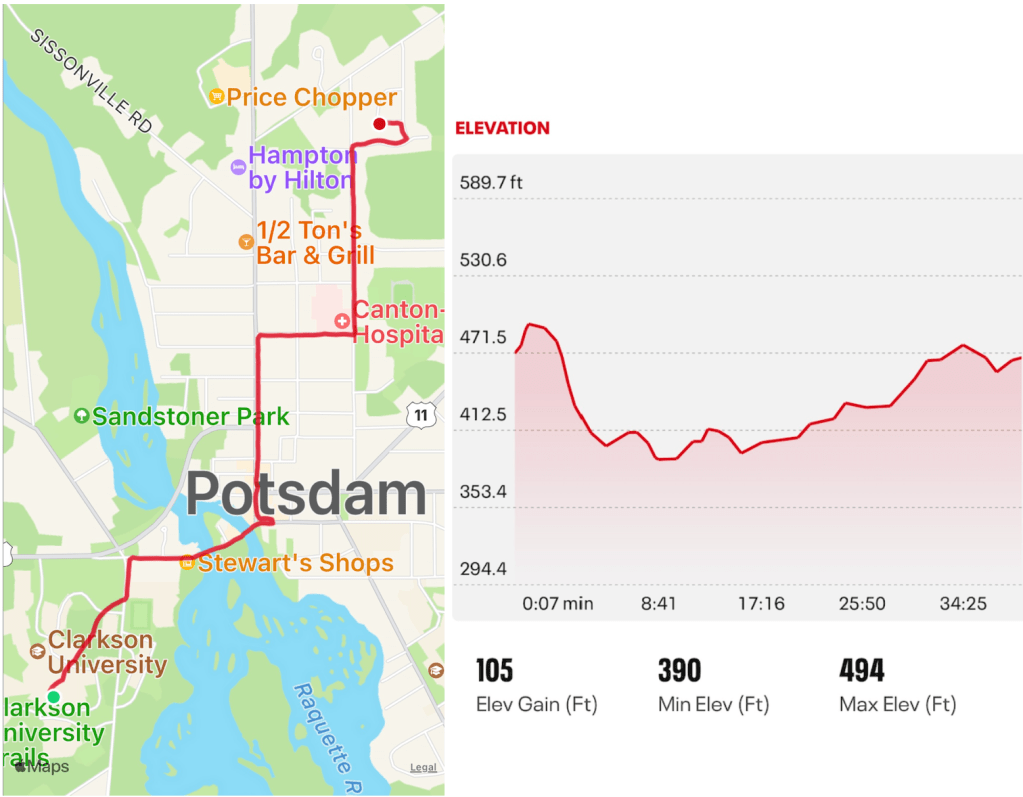
Someone suggested that the village of Potsdam lies in a bowl, i.e. is more low-lying than surrounding regions. I could find no interactive online tools to confirm this, either as 3d maps or 2d contour maps.  But nifty phone apps that map our walks do! In these two screen shots, for example, is the walk from the Science Center on Clarkson Hill to Circle Dr, both as a street map as well as an elevation map.  The highest points on the hill campus are at over 470 feet elevation, with a quick descend to the bottom of the bowl at around 400 ft elevation along the river.  Walking along Market St to Cottage, the elevation remains at a depressing 410 ft, before beginning a slow ascent along Leroy St towards the edge of the village. It would be fun to see other cross-sections posted, perhaps along Canal St to Stevie’s Trail, which I discovered yesterday to be a lake before the stadium was constructed.  

These low-lying regions create problems during rainy and snow melt seasons, as yards turn into swamps and sometimes basements too in the lowest-lying areas.  Another surprising consequence of this bowl is that our police cars need to be outfitted with repeaters to strengthen radio signals from more distant points in the village. That is on top of the regional challenge of providing reliable emergency radio communication throughout the county. In fact, SLC legislators just finalized a contract with Motorola to built 19 towers in SLC to provide 95% portable coverage for emergency services throughout the county, with one of those towers to be placed in Potsdam’s bowl, in the lot adjacent to the Lowes.

How the Electricity Price is Set and Why that Maximizes Green Energy Production 

MM Tirion

Electricity providers like National Grid sell customers electricity at cost. NG buys their supply of electricity from the regional wholesale electricity market and charges customers exactly the same as what they paid for it, without profit (don’t worry, they make their profit from their Delivery Services!)

Who sets the price of electricity?   The wholesale electricity market.  How do they set it? Very pragmatically. Each day the wholesale market monitors the electricity demand within its jurisdiction and extrapolates the demand for the next day.  Based on the anticipated demand, the wholesale market invites generators of electricity to contribute their commodity to the “electricity-pool” for the next day. The wholesale market accepts bids until the “electricity-holding-pool” is filled to meet the next day’s anticipated demand.

Which bids do they accept? They accept the cheapest.  Bob, for example, may own three acres of solar panels, and anticipates that tomorrow’s sunny weather will generate 1 MWh during the day-light hours. He offers the wholesale market his 1 MWh of energy for $1, which the wholesale market must accept, as it’s very cheap.  Windy Acres owns a field of wind turbines. Based on the anticipated wind patterns over the next 24 hours, they expect to have no less than 10 MWh available to sell tomorrow. They offer this energy to the wholesale market for $5.0 per MWh, which is still very cheap and the wholesale market accepts the full 10 MWh from Windy Acres.  The wholesale market keeps accepting the cheapest bids and its “electricity-pool” for the next day continues to fill. 

Let’s say the wholesale market expects tomorrow’s demand for electricity to be slightly in excess of 1000 MWh. All participating solar and wind farms together expect to contribute 300 MWh to this pool, not enough to meet tomorrow’s anticipated demand. So the wholesale market must continue to accept additional bids.  Several hydroelectric facilities, having examined their water flow numbers, are able to offer an additional 200 MWh to tomorrow’s electricity-pool; they must charge  $15 per MWh, as their maintenance costs are quite higher than for solar fields. The wholesale market accepts all 200 MWh bid by the hydroelectric power providers.

The wholesale electricity market still needs an additional 500 MWh to meet the anticipated electricity-demand for the following day.  A nuclear plant offers the wholesale market 200 MWh of electricity at the cost of $50 per MWh.  As this now represents the cheapest juice available, the wholesale market accepts all 200 MWh from the nuclear power plant.  They still need to find those last 300 MWh.  

And so the wholesale market looks at a bid of $75 per MWh for 200 MWh of electricity produced by FossilDudes who buy and burn natural gas to turn combustion turbines to generate  electricity. As this offer is currently the cheapest, and since the wholesale market must fill the anticipated demand of 1000 MWh, they accept the full offer of 200 MWh from FossilDudes.  For that last 100 MWh, the only supplier remaining is DirtyDan who continues to burn coal in a boiler to produce steam that turns turbines to generate electricity. DirtyDan has a lot of overhead costs associated with this form of energy production: digging for and transporting coal, operating aging and manpower-intensive equipment and as such, DirtyDan must charge $100 per kWh. DirtyDan offers the wholesale market 200 MWh of electricity for the next day.  The wholesale market, looking at their expected demand of 1000 MWh and their current next-day “electricity pool” of 900 MWh, accepts only 100 MWh of juice from DirtyDan.

And now the punch line!  DirtyDan’s bid, the last accepted by the wholesale electricity market, sets the price for everyone!! Everyone of the contributors to tomorrow’s pool: Bob, Windy Acres, FossilDudes, DirtyDan and everyone whose bids were accepted will receive $100 for every MWh that they contributed! Needless to point out, Bob and the others who own solar fields generate the highest profit margins, followed by wind turbine generators, then hydro and nuclear plant owners, while the smallest profit margins are generated by those generators who must first buy or extract fossil fuels from the ground. I suspect that Bob and WindyAcres and the nuclear and hydro facility operators are very relieved that DirtyDan continues to supply a modicum of dirty energy to wholesale market each day, to keep everyone’s else’s profit margins sky-high! 

The next day National Grid buys the juice from the wholesale market at the market price of $100/MWh, and resells it to their customers, at cost, for 10c/kWh in this example.  And that, more or less, is how the wholesale price of electricity is created each day!  This description pertains to the wholesale market’s Day Ahead market, not to the Real Time market dealing with the last minute buying and selling of the electricity commodity. You can follow all the excitement at our very own wholesale electricity market, NYISO, every moment of every day, live: http://www.nyiso.com/real-time-dashboard

The Proposed Budget for 2023-2024

M.M. Tirion

At this evening’s village board meeting, the public has an opportunity to input comments on the Mayor’s proposed budget for fiscal year 2023-2024 (see: vi.potsdam.ny.us/content/News ).  It may be of interest to bring attention to two trends.

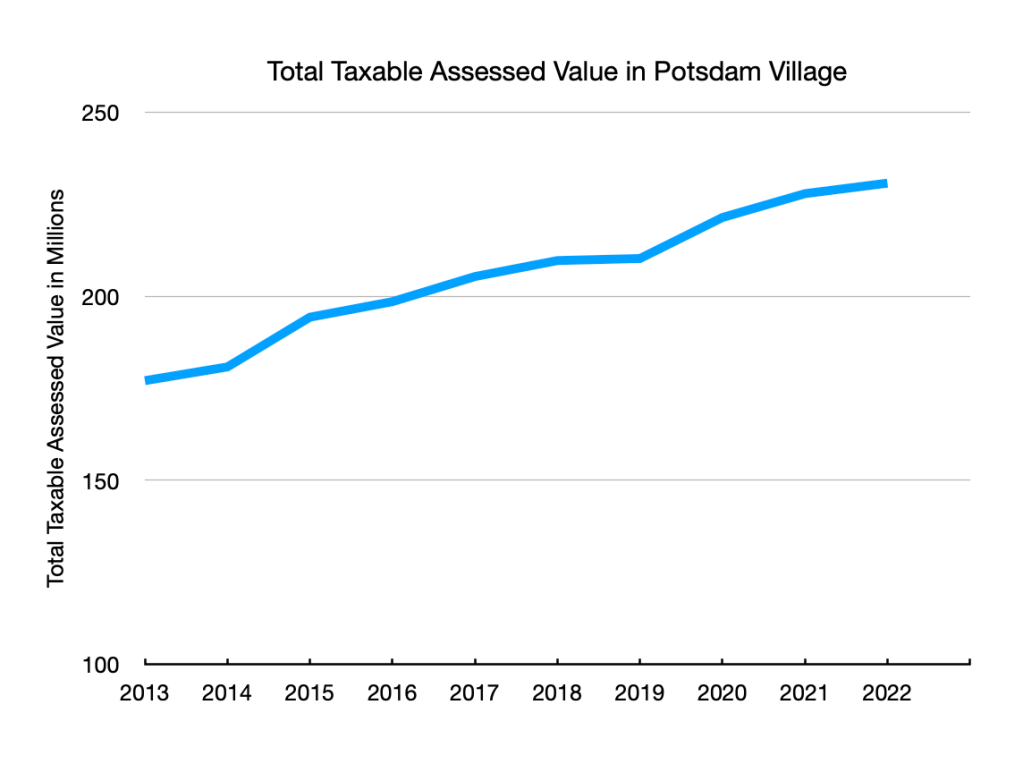
The first plot shows the total taxable assessed value of all nonprofit-properties in the village of Potsdam, as reported by NY’s Office of the State Comptroller’s Open Book Local Government, available online. In 2013 the total taxable assessed value in the village was $177 million, and has grown by an average of 3.0% to $231 million in 2022. 

This means that in 2022, every $1.00 per $1000-of-property-value raised $231,000  revenue for the village.  For an actual tax rate of near $18.00, the revenue was $4.158 million. 

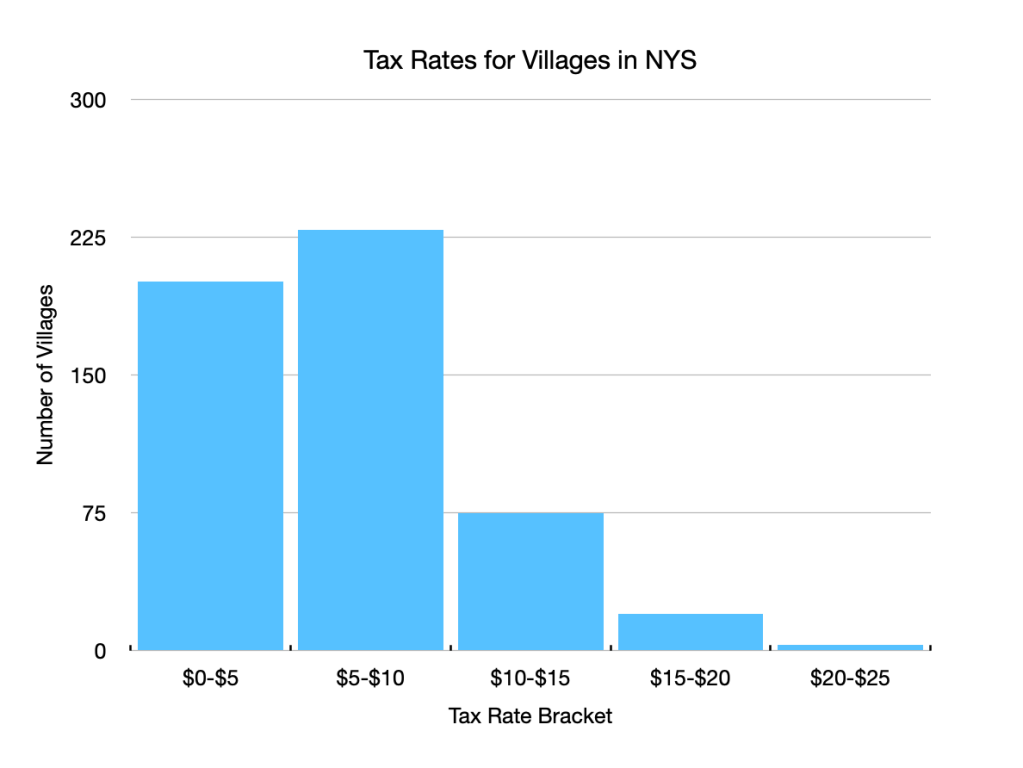
How does the village’s tax rate compare to the other villages in New York? The second graphic gives an impression of village tax rates in NY: The average tax rate for all 534 villages is $6.65 per $1000-of-property-value, with a median of $5.89/$1000. In 2022 Potsdam village, with a tax rate of $17.62, ranked as the 7th most expensive in New York.

For comparison, Ogdensburg’s city-tax rate was $15.89/$1000 in 2022, and Massena’s $16.35/$1000. The highest village tax rate is held by the village of Herkimer, at $21.21/$1000.  

Is this justified?  How does Potsdam’s total taxable assessed value (TAV) of $231 million compare to other villages? Is Potsdam’s tax base skewed due to the nontaxable universities, medical centers, and other nonprofits in the village? In fact while 80 villages obtain an enviable TAV of over $1 billion, the village of Potsdam has a higher TAV than 341 villages. Potsdam, even without contribution of its nonprofits, remains a rich municipality, based on comparative property values.  

So why is the tax rate the 7th highest in the state?  Perhaps it helps to remember that for each tax-rate dollar of taxable assessed value, the village raises $231,000 (in 2022).  Looking in the FY23-24 proposed budget, I see that the hydro budget expense this year is expected to be $568,446. In FY22-23 the east and west dams generated $76,938.65 in revenue for the village.  If the nearly $500,000 unpaid balance is to be covered by property taxes, this would add over $2.00 to the property tax rate (ie without the hydrofund, we could have a tax rate of $16/$1000 instead of $18/$1000).  In fact, the General Fund receives about 64% of its revenues from property taxes and another roughly 22% from sales taxes, and the TAV is expected to increase by 3% to $337 million at the end of FY24, implying that the portion of the tax-rate needed to cover the hydro fund is $1.12/$1000.  

Perhaps the thought that every $1.00 of the property tax-rate increases the village’s income by $330,000 motivates a more careful perusal of the Mayor’s proposed budget.

Property Taxes in Potsdam

M.M. Tirion

The St. Lawrence County government website provides data on local property values and tax rates.  Browsing through the numbers provided for the village of Potsdam, one notices that the total assessed value of all parcels in Potsdam is an impressive $670 million: Over half a billion dollars would be generated if every parcel in the village (nearly 1700) were sold at their current market values.  

If the tax rate within the village was $10 per $1000 of property value, applied uniformly across all property classes, it would raise $6.7 million annually for the general fund or GF. This amount is in fact very close to the actual number of dollars required annually for the GF. However, only around $4 million typically derives from property taxes with most of the rest coming from sales tax revenue. Naively one might think, therefore, that a  property tax rate of $6 per $1000 of assessed value would suffice to keep the general fund solvent. But in fact, the tax rate within the village is a bit over $18 per $1000. Why? Because properties owned by NYS and private non-profits are exempt from paying property taxes. The parcels within the village exempt from the property tax levy have a combined assessed value of $450 million. This leaves $670 million – $450 million or $220 million worth of property “free” to be taxed.

This peculiar situation, where less than one third of total property value within a municipality is taxable, not only strains the finances of non-exempt businesses and home owners, but has a second unfortunate consequence.  Sales tax revenue is collected at the county level and distributed to local municipalities  based on their total taxable assessed value (50%) as well as on their population (50%).  Potsdam village’s share of the sales tax distribution is based not on its total assessed value of $670 million but on the taxable $220 million, reducing our sales tax revenues accordingly and further straining the finances of non-exempt businesses and home owners.

Residences, businesses and nonprofits co-exist . They work synergystically: Nonprofits attract workers and visitors, who in turn seek dining, housing, shopping and support services supplied by the business-commercial sector, who in turn rely on the local government to maintain and develop the requisite infrastructure.  Optimally the three co-existing enterprises, non-profits, for-profits, and local government work together proactively to create a social-economic network both resilient and stable. 

The village is currently in the exciting business of ascertaining how much money needs to be allocated  to run services for another fiscal year, which runs from June 1 2023 through May 31 2024.  Once a total is obtained,  the tax rates and user fees need to be adjusted to cover expenses.  Now is the time to get involved, asking questions about user fees and tax rates, before those values are locked in for another FY.

Ongoing village board discussion: How to develop a new Comprehensive Plan?

M.M. Tirion

In 2011 the newly elected, then-Mayor Steve Yugartis began a lively campaign to update the  2001-20011 Comprehensive Development Plan, a list of suggestions to guide development in the village of Potsdam, with a new vision. After 18 months of consultations, discussions, inquiries and strategizing, an effective 37-page doc became the new beacon for village planning. That doc expired last year. It may be perused as the first item under documents at bottom of screen  vi.potsdam.ny.us/content/Boards/View/1

Having a Comprehensive Plan makes the business of running a local municipality that much less difficult, as it prioritizes the many issues facing a municipality and therefore enables more effective decision-making. It also helps municipalities to have an up-to-date Comprehensive Plan in order to receive funding: State and Federal agencies are reassured when a munis is able to point to effective long-term plans that guide their growths.

The 2012-2022 Potsdam Village Comprehensive Plan included 125 policy recommendations with respect to Municipal Government and Finance; Land Use; Public Facilities and Services (including General Policies, Sewer, Water, Storm-Water, Streets & Sidewalks, Police, Fire, Airfield, Civic Center, Museum, Hydrodams, and Forestry); Economic Development; Transportation; Housing; Recreation; and Environmental Remediation. Many suggestions have been effectively dealt with, many have not.

The question before the village board is how to craft a new Comprehensive Plan. One suggestion is to adapt the 2012-2022 document to fit today’s issues, a quick and inexpensive approach. Another would be to attempt another community-wide outreach effort, similar to 2011 when a 16-member commitee worked with village staff to draft a new set of guidelines for future planning.  Another option is to hire an outside firm to do this work for us, professionally, but at a higher cost. Professional firms have experience and might be able to organize better responses.

Personally, I wonder whether we should wait till a new Mayor is installed 1 December, who would bring a new vision for Potsdam?  Pubic comments always welcome at the Board Meetings; the next one being tonight Monday 20 March at 6 pm in the Civic Center Board room.

Elections 2023

M.M. Tirion

Of the five Village of Potsdam Board of Trustee positions, 3 will be up for election or re-election this November: the seats held by Mayor Tischler and Trustees Lee and Jacobs-Wilke.  Mayor Tischler and Trustee Lee have indicated they will not seek re-election.

For a candidate to get her/his name on the ballot, he/she normally attempts to win the Democratic or Republican primary caucus.  During a primary caucus, Party members assemble on an agreed upon date and nominate candidate(s) for Trustee and Mayor. Someone seconds the nominations, and nominees are asked whether they accept the nominations. One or more nominees may be named for each position. Candidates are then selected by vote, usually a show of hands, and the winners will have their names listed on the ballot under their party line in November.

In local elections such as ours, it is also not uncommon for candidates to run without a party designation.  For example, the Democratic caucus once did not complete the requisite paperwork on time, and the Democratic slate of candidates, including Mayor Ruth Garner, had to wage a write-in campaign.  More recently, a number of write-in campaigns have been waged and won, though usually for un-contested seats.

If like me, you’re concerned about the increasing control the two-party system wields in the candidate-selection process, you can vote for the candidate of your choice as an unaffiliated write-in option, rather than under a party line. 

But first: Who will run?

Property Tax Rate Reduction?

M.M. Tirion

How much of a property-tax break would I receive if the village could reduce annual expenses by $200,000.00?

Since the total taxable assessed value throughout the village is a bit over $200 million, the village tax rate would be reduced by $1 for every $1000 in property value. My home, with an assessed value of $142,000 would be spared $142 in annual village property taxes. (Our village tax rate is currently a bit over $18 per $1000 of assessed value)

FYI The west hydrodam requires annual debt payments of $265,000. In addition, even while idle, the west dam powerhouse requires maintenance and service costs; the village budget allocates roughly $120,000 for the maintenance, service and fringe benefits for both dams. If only $35,000 goes towards the service, fringe and maintenance costs at the west dam, the west dam incurs $300,000 in costs annually. These funds come from the general village budget as the west dam is moribund.

The village’s general fund gets roughly 62% of its revenue from property taxes and 20% of its revenue from sales tax proceeds. As two-thirds of $300,000 is $200,000 the absence of a west dam would reduce my annual property tax bill by almost $142.

What have we learned?

M.M. Tirion

The promise of free energy and the independence that provides has powerful allure.

Potsdam’s first hydroelectric plant began operating 1926.  Built on the eastern shore of the Raquette river, its wooden turbine could generate 125 kW of electric power, seemingly for free. After 45 years of service, this facility was decommissioned in 1971 as the plant’s operator closed the wooden gates, blocking the water’s flow to the turbine, one last time.  

For several years the plant remained idle. But the energy crisis of the 1970’s prompted the village board to consider reactivating the dormant powerhouse. In 1976 they  hired Rist-Frost Associates P.C. of Glens Falls, NY to design a new, more powerful plant in the same location. Even though the water’s fall-distance and the  river’s flow-volume had not changed, the engineers assured officials that they could quintuple energy production. By installing two turbines instead of one and  using massive blades on those turbines, the refurbished plant would be able to generate 800 kW.  Rist-Frost projected a revenue of $360,000 the first year.

With the promise of an abundant, local and green energy supply, the village board approved bonding for $3 million for the design and construction of a renewed municipal hydrodam. And in 1983 a vastly redesigned East Dam powerhouse started generating electricity.  Power generation, however, fell well below projections year after year: frustrated by their misleading promises, the village board filed suit against Rist-Frost in 1987. That same year, the board attempted to hire Adirondack Hydro Development Corporation to run its hydrodam operation, an effort derailed by then-Mayor Paul Claffey who firmly opposed a possible loss of revenue.  

This second east dam hydroplant operated for three decades when in August of 2014 the gearbox of one turbine broke. Within 6 months, the second gearbox failed as well. Once again the plant lay idle,  which was especially unfortunate as in December 2014 the village administrator had signed an expensive “remote net metering” contract with Niagara Mohawk that would have significantly increased the village income stream from generated power. 

In an effort to restart operations therefore, village officials sent the broken gearboxes out for repairs locally. Those (costly) repairs worked for a week or two before both gearboxes failed “catastrophically”.  This time the East Dam hydro plant would remain idle for nearly 6 years while repair plans and funding sources were sought. 

In 2016 the village partnered with the New York Power Authority for a financial feasibility study for repairs and necessary overhauls, and received an initial estimate of $1.8 million for the work.  By the time NYPA contracted with the village however, in January of 2020, the cost had risen to $4.2 million. By securing $1.0 million in grants, the village paid for the rest with a $3.1 million serial bond.   The third iteration of the east dam hydroelectric plant returned to operation in June 2021. In an eerie repeat of an earlier era, village staff and board were once again dismayed to discover that the power generated after the multimillion dollar upgrade was 60% lower than projected. Village board and staff once again began examining options to spend further funds to boost production, discussions currently on-going.

Meanwhile, talk of a second hydroplant, on the opposite or western shore of the Raquette, surfaced since at least the early 1980’s when Rist-Frost Associates discussed that option in  reports. In anticipation of a such plant, the village financed the replacement of the old wooden dam straddling Fall Island to the west bank with a concrete one in 1990.  By 2001 the village obtained the rights to have a west dam hydroplant licensed by FERC, with energy produced to be sold on the open  market.

In May 2007, the village board fatefully approved bonding for up to $3.5 million to construct the promised west dam powerplant.  In June the board signed a contract for $1.4 million with Canadian Turbines of Burlington Ontario, for parts. Presumably to eliminate the cost of principle on an insured serial bond, the administration decided to pay Canadian Turbines and its CEO Richard Kuiper, cash.  The fact that this company was being sued by the village of Bancroft, Ontario at the time did not dissuade the administration.   As is now well known, Canadian Turbines did not deliver the paid-for parts and the village sued Richard Kuiper for compensation. As he failed to show for court appearances, a Canadian court ruled in favor of the village with a generous $6 million settlement. Unfortunately the village administrator was told by Canadian lawyers that there is “virtually nothing to get from the guy”.  The village then paid a different supplier a second time for the same parts, draining its general fund. Once delivered, those parts were found to be defective and had to be replaced. When after many years all parts for the west dam powerplant were finally assembled, the result was described by one official as a chimaera with parts from every corner of the world.  

After seven tortuous years of uncertainties and delays and cost overruns, the west dam plant became operational in May 2014.   The financial complications from the mis-investments did not end once the west dam plant was switched on however, as debt payments continued to drain the general fund. Village finances became  even bleaker after the east dam plant stopped operating entirely in February 2015.  Once again, actual income streams for the hydro fund were far lower than anticipated, and in March of that year the administration had to take out an emergency loan of $500,000  to pay village staff.  In 2015 the NY Office of the State Comptroller designated the village as being under “Significant Fiscal Stress”  and  gave the village of Potsdam the dubious distinction of being the most fiscally stressed village in NYS. 

After restructuring its finances, including abolishing the village court and raising property taxes 32% from from 2013 to 2017, the village’s credit rating by Standard & Poor returned to a stable A.  But then, a mere five years after the West Dam plant started generating power, instabilities in turbine design led to both its units breaking “catastrophically”. Figures are hard to come by, but one news article quotes an average monthly power production of $20,000 at the west dam plant.  If so,  during its truncated lifetime of 60 months, the west dam plant raised around $1.2 million of revenue for an investment far in excess of $5 million when design, construction, principle, law suits, operational and maintenance costs are summed.  $1.8 million remains  due on the west dam serial bond as we enter FY2023-2024.

The allure of free energy has cost the village dearly with each upgrade and repair. As in 1983, the newly refurbished east dam plant generates 40% of projected power. The west dam plant generated generous revenue due to a favorable remote net metering contract negotiated with Clarkson University, but has not generated any power since 2020 and will not do so, indefinitely. The village budget projects expenses of $560,544 to finance the municipal dams during FY2022-2023, of which $430,000 is towards debt payments.  With a gross income stream at the east dam plant of perhaps $155,000 during calendar year 2022, the hydro fund likely must borrow on the order of $400,000 to pay its bills. The village has used general fund reserves to loan money to subsidize the hydro fund for years. General Municipal Law stipulates, however,  that each fund be self-sufficient: the sale of generated power finances hydro operations; water and sewer fees finance operations of water and sewer plants; and property- and sales-taxes finance the general fund. It seems imprudent, unfair and possibly against Municipal Law that the village continues to use General Fund moneys to cover the costs of its municipal hydroplants.

Rather than invest more money into complex future upgrades and repairs in the hope that power production may one day match costs, I would like to see any number informed discussions first, including whether we may legally default on the west dam loan and cede ownership of that parcel? Or could we transfer operation of the two plants to professional hydroelectric engineers, such as Boralex Hydro Operations who operate the Sissonville Hydroelectric facility downstream?  Is it time to invite the NYS Financial Restructuring Board for Local Governments (FRB) for financial guidance? Doing nothing or more of what hasn’t worked in the past seems inadvisable.