Windy Day

as reported by M. M. Tirion

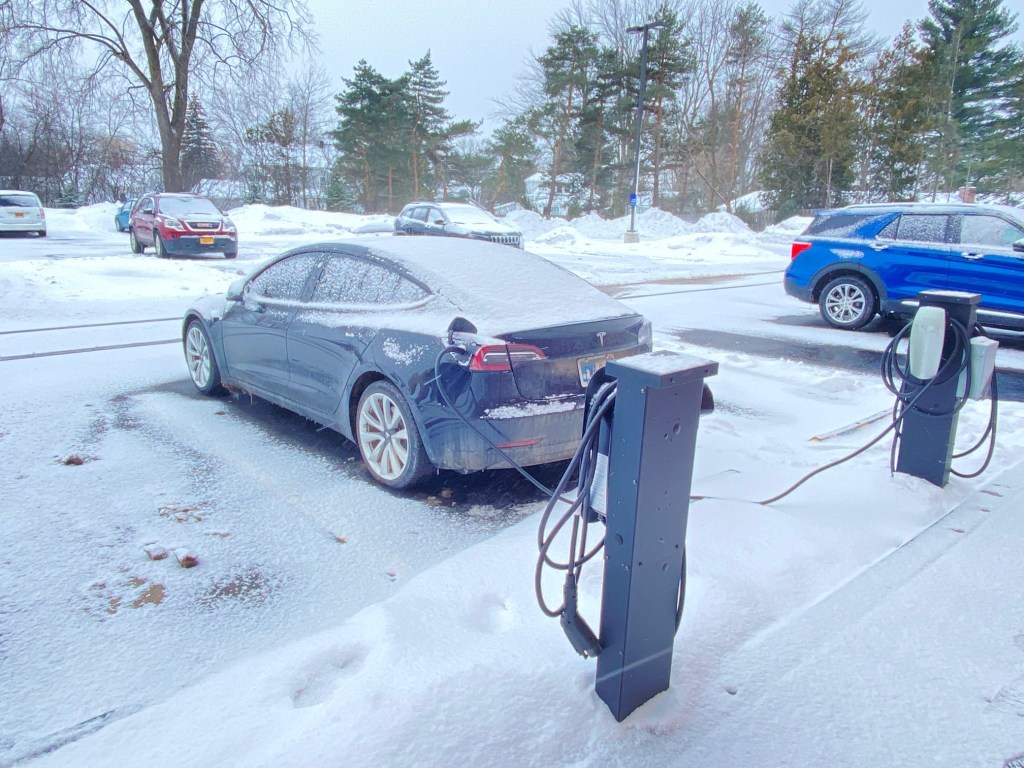
I went for a walk without checking the weather. Reaching Regan Rd I could hardly go on, the wind was so strong. The meltdown created a pond that looked like a raging ocean to me, as the video at the bottom of this page shows. I wondered how strong a wind would need to be, to make me airborne (a quick Google search later revealed that a 100 lb person will be lifted off the ground by winds of 40 mph. I am heavier than that, but the scaling isn’t linear, and what’s more the weather channel warned we should expect wind gusts of up to 55 mph). Hanging on to a post on Rte 11 as pebbles, grit and twigs struck, I marveled at the power of nature. Since 1987 when I moved to North Country, I had not experienced such fierce winds except on the high peaks, and considered that we’re entering a new weather-era. The work being done by Potsdam’s Climate Smart Community suddenly became more pertinent. This group meets monthly to report on efforts and progress to reduce Potsdam’s carbon footprint, while supporting soil conservation, air quality, as well as the hardships these efforts may create for our community. Anyone can join: https://www.potsdamny.us/community/climate-smart-community.html

It’s a Bit Cold, No?

as reported by M. M. Tirion

Pulling out of my garage, the car’s thermometer registers lower and lower temperatures. As I near Leroy St, it steadies at 1F. Waiting at the traffic light I see a young mom, hatless, carrying a bundled baby towards downtown.  As the traffic light turns green, I turn onto Leroy St, turn on the emergency flashers, pull over to the side of the street as I open a window, and holler over the snow berm:

“Hi there! Need a ride?” 

The young mom replies “We’re just going to the doctor’s.” 

I repeat: “Ok! Need a lift?”  

This time she smiles and says sure, it’s only as far as Raymond St. (“That’s over a mile away!” I am thinking).  As she hops in, I don’t know whether to admire her grit or bemoan her folly, to walk with a baby in these temperatures.  

Driving down Leroy I venture: “It’s a bit cold today,” to which mom replies cheerfully “Yes, and I also overslept so we are running late!”  

“Is the doctor’s appointment for you or the baby?”

“It’s for the baby, her two-year check up.  She turned 2 yesterday!”

My husband and I cheer: “Hurrah! Congratulations!” while the baby claps along.

I venture one last query: “Don’t you have a car?”

She replies: “I can’t afford a car. I can only work every other week. The weeks when I have the baby I can’t work”

We arrive at her destination, and with a lot of thanks and cheer, we say goodbye.

Hamstrung!

as reported by M. M. Tirion

Potsdam is enjoying a resurgence.  The inordinately successful Children’s Museum, the new and growing St Lawrence Arts Council, the recently opened Quarry apartment complex at the site of the historic St Lawrence Academy and Potsdam Normal Schools, a new field of solar power generators between the middle school and Debra Dr apartments, an expanding airport facility,  several new cafes and restaurants,  along with lucrative state and federal fundings that promise a riverwalk trail, a skatepark,  pickle ball courts, a new Food Coop and several other exciting additions, suggest vibrant growth. The expansions, additions and revisions enabled by state and federal funding require multiple, complex and interconnected matters to be resolved by village officials: engineering and architectural challenges, environmental and safety matters, visual appeal, rights of way, fees and maintenance costs that must be considered and evaluated lest costly mistakes get made.  

Avoiding mistakes requires foremost an appreciation of the challenges, challenges that may be technical (hydrodams) or developed from issues of earlier times (rights of way) or enveloped in legalese (insurance and hiring matters).  Bringing people with different skill sets to the table is a prerequisite for gaining an appreciation of the various roadblocks. After listing and understanding the problems ahead,  resolving those matters likewise requires a plentiful supply of discussions, suggestions, ideas and coordination.  Such open discussions call on all the skill, expertise and experience amongst participants and ideally result in the honing of ideas en route to optimal solutions. Imagine such discussions not being allowed! And yet, they are not.

I quote Alex Aichinger, former professor at Northwestern State University in Louisiana, from an article published in 2009:

Open meeting laws, also called sunshine laws, require that, with notable exceptions, most meetings of federal and state government agencies and regulatory bodies be open to the public, along with their decisions and records…it is not mentioned in the First Amendment…Open meeting laws are a relatively new development. They ensure the public’s right to access to the internal workings of government at all levels. This “right” cannot be traced back to America’s common law tradition with England or to practices in place when the United States was founded…Although these laws guarantee that the public and the media can attend, they do not guarantee the public’s right to speak…What constitutes a meeting is usually defined by its purpose — to perform public business (social gatherings are not considered meetings) — and the number of participants—a quorum or majority. All such meetings, unless specifically and legally exempted, are presumed to be open to the public, and agencies are required to give advance notice of the date, time, place, and agenda.

I am a strong advocate of transparency and accountability.  I applaud and am frankly amazed at the breadth and depth of the data bases available in NYS: sales tax received per NAICS per county per quarter; outstanding debts per village, town, city, school or fire district or county; complete current loan profiles per jurisdiction; numbers of Covid-19 patients intubated per day per hospital: any data that NYS government collects, it shares (data sets not always easy to locate nor manipulate). But open meeting laws go further than requiring equal access to data or freedom of information generally: the law precludes any spontaneous discussions amongst elected officials. 

Imagine: a new board member sees two fellow board members chatting at a local coffeeshop, and walks over to ask for clarification about the agenda for next day’s board meeting. This, she is hurriedly informed, is disallowed! Three board members constitute a quorum and may not deliberate in this way without giving advance notice!  Imagine:  The board is in session after advance notification online and in print. Now every word and gesture of each participant is recorded and broadcast live, on Zoom or on FaceBook and later reported upon, in print.  Do participants feel comfortable cogitating on gnarly problems in this format?  Can a relaxed back and forth discussion ensue when every nuance can be de-contextualized and rebroadcast in possibly unfavorable terms?  Imagine: the board moves and votes to close a meeting, the recording devices are turned off, while a few attendees remain seated. Someone raises a spontaneous idea pursuant to the meeting just ended: “Could we forego the closure of that facility by subcontracting the work to a local outfit?” It is a fair question and a decent idea, but illegally posed! The query may be entertained only if 3 of the 5 board members immediately leave the room.  

I do not yet see how to function effectively as a village board member within the straightjacket of the “advance notice of date, time, place and agenda” of any assembly of 3 or more board members.  How can the 5 members of the board consult together and with outside experts within this constraint? Comments sent by email likely will be misunderstood or suffer from delayed responses.  Phone calls between two individuals often end irresolutely as any two may not have the relevant expertise to address the technical issues.  This aspect of the Open Meeting Law seems inordinately unhelpful.  We’ve all heard and probably said: “Government is dysfunctional.” In days past, I considered as culprits gerrymandering and slanted primaries that permit fringe candidates to win;  changing educational norms; unconstrained social media platforms;  and click-bait news headlining. But after two months aboard the PV board, I see a very different culprit: the open meeting law mandating all gatherings of 3 or more board members to be pre-announced as to date, time, place and agenda.  Contrast this requirement to the situation in the Perimeter Institute in Waterloo Ontario, where every office, every hallway and every restroom is outfitted with whiteboard and markers! Here one does not gamble the loss of an insight that might explain the foundations of the universe! Could something similar not be developed to protect for democracy the ability to think, organize, cogitate, plan and resolve?

Entry 2/2/22: A Potsdam Vignette

as reported by M. M. Tirion

Enjoying a soy-decaf cappuccino in the Bagelry today, I sit next to a retired couple. After imbibing the warmth of the coffee and the Sun, we start chatting. The couple is not from around here, but from Fulton, south of Syracuse. They had been planning to go to CA for vacation, but cancelled their flights at the last moment, deciding instead to stay closer to home. Surfing the web for fun places to visit, they hit upon Potsdam! They loved snow-shoeing at Higley State Park yesterday, enjoyed the Clarkson Inn for one night as well their Airb&b, and were now heading to Stevie’s Trail. No, they had not heard that the cemetery at the end of that walk is also very picturesque and rich in history. Do they regret swapping CA for Potsdam? No! They definitely plan to visit here again. We wish each other a nice rest of the week, and say bye for now.

Entry 1/31/22: Trustee Troubles

as reported by M. M. Tirion

Potsdam Village trustees attend twice-monthly board meetings and vote on things. Each item that board members vote on are listed in an agenda made available prior to each meeting. For example, the agenda for the next board meeting (the January 17, 2022 meeting that has been postponed to January 31, 2022) can be viewed at the vi.potsdam.ny.us website

A not atypical resolution in the current agenda reads:

Whereas, the Village of Potsdam is desirous of St. Lawrence County Department of Highways providing shared services such as paving, road stripping, blasting and other routine maintenance activities to the village, and

Whereas, both the Village of Potsdam and County of St. Lawrence are desirous of promoting partnering efforts for the safety of the traveling public in St. Lawrence County, and

Whereas, in this joint cooperative endeavor, the Village of Potsdam and the County of St Lawrence desires to be reimbursed for their expenditures, and

Whereas, the village is aware that the county may incur liability in the providing of the services and wishes to indemnify the county in this regard,

Now, therefore, be it resolved that to the fullest extent permitted by law, the Village of Potsdam will indemnify and hold harmless the County, their officers, directors, partners, representatives, agents and employees from and against any and all claims, suits, liens, judgments, damages, losses and expenses, including legal fees and all court costs and liability (including statutory liability) arising in whole or in part and in any manner from injury and/or death of person or damage to or loss of any property relating to or arising out of any negligence or intentional acts and/or omissions of the Village of Potsdam or any of its directors, officers, employees, contractors, representatives, or agents.

Reading this once, I draw a blank. Twice, a slight suspicion awakens; perhaps this is important? I fire off an email, asking how it is that we can’t hold the county responsible for misconduct? Is this normal, do other jurisdictions in the County pass similar resolutions? I receive one reply: the Village has passed this resolution for decades, and the insurance companies require it. Feeling slightly relieved that this is somehow old-hat, and more than a little bemused to still have no comprehension of the basis of the resolution, even after after a third, fourth and fifth readings, I wonder whether I should vote yes, no or abstain. None feels right. Should I try to connect with the village’s lawyer? That seems a bit hubristic. A chance meeting with a fellow trustee finally brings some clarity to the matter: The County is obligated to tend to certain matters within the village (pertaining to county road repair and maintenance, for example). Rather than send its own crews to do this work, the County subcontracts the work to village employees to do the work for them. To receive this funding, however, the county requires the village to not hold the county responsible for incidents involving these subcontracted individuals. This, finally, begins to make some sense. This had nothing to do, as I initially balked at, with not holding county officials accountable for their actions! Nothing at all. I will vote aye on this resolution, and feel somewhat mollified to have penetrated another inscrutable mystery. I also decide to maintain some “Notes to Trustee-Self” explaining these mysteries to future self, or others who find themselves elected onto the village board.