Meanwhile, Elsewhere…

From Albany’s Times Union daily newspaper, an article dated May 20, 2025 by Nora Mishanec demonstrates the troubles local municipalities get into. While this article pertains to a town of 9,800 in the mid-Hudson valley, the details sound very familiar:

PLEASANT VALLEY — Residents of Pleasant Valley may have overpaid in taxes for years after a state audit of town finances found that the town’s board did not develop realistic budgets or properly manage its money.

The audit of the Dutchess County town of 9,800, released this month by the state comptroller’s office, determined that Pleasant Valley’s five-member town board consistently underestimated tax revenue and overestimated expenses from 2019 to 2023, resulting in a $6.4 million budget surplus.

The budgeting flaws over that period “may have placed a higher tax burden on taxpayers than necessary to provide services,” according to the report.

The report noted that town officials “generally agreed” with the findings and would take steps to correct the imbalances noted in the audit. Supervisor Mary Albrecht, the chief executive and financial officer responsible for the town’s day-to-day financial operations, did not respond to a request for comment. Albrecht was appointed to the board in 2019. 

“While the audit focuses on past practices, I believe the steps we’ve taken demonstrate a clear course correction and commitment to continual improvement,” Deputy Supervisor Michael Rifenburgh, who joined the board in 2022, said in an email.  

New board members had “worked diligently to deliver responsible and transparent fiscal planning” in the three budget cycles since the audit, Rifenburgh said. Under new leadership, the town tax rate “decreased by approximately 17% and total budgeted expenses have dropped to 2022 levels — despite inflationary pressures, rising personnel costs, and the lingering impacts of the COVID-19 pandemic.”

The largest budgeting errors appeared to have occurred during the 2021 fiscal year, when town officials estimated they would receive about $400,000 in sales tax but brought in more than $1 million. That same year, officials estimated collecting about $100,000 in mortgage tax but received quadruple that amount. The discrepancies, auditors noted, reflected that the board “did not consider historical or known revenues and expenditure trends when preparing annual budgets.”

The town’s two main operating funds each accumulated millions in budget surpluses. Property and sales taxes collectively generated an operating surplus of $5.1 million for the town’s general fund, while the highway fund’s surplus exceeded $1.2 million. Town officials “lacked a plan on how the funds (would) be used,” auditors said, adding that “there was no rationale” for accumulating such significant sums.

“As a result, the board maintained real property taxes at a level higher than necessary for operations and missed opportunities to lower real property taxes,” according to the report.

Town officials told auditors that they had not updated their budgeting practices from prior years and agreed to improve budget estimates by considering historical trends.

Our Taxes Just Went Over the Top

In the previous posts we discussed the Water and Sewer tax/fee rates and reported that the rates adopted by the Treasury department do not match the stated Appropriation requests. The rates quoted in the budget report will bring the Treasury a combined $400,000 excess revenue. Unfortunately, I cannot find an updated, corrected Budget document.

In another post, we discussed how the Hydro Fund expenses are almost completely borne by local property tax dollars, in violation of the “Less Non-property Tax Estimated Revenues” column on page 30 of the budget report.

Before commenting on the proposed General Fund portion of the Mayor’s budget, I had hoped to hear the Mayor’s comments, as that important document is full of pain and promise. Unfortunately, I was unable to access the village board’s live-stream of the board meeting last night, and have seen no written comments by anyone in the administration on why the General Fund appropriation ballooned this year.

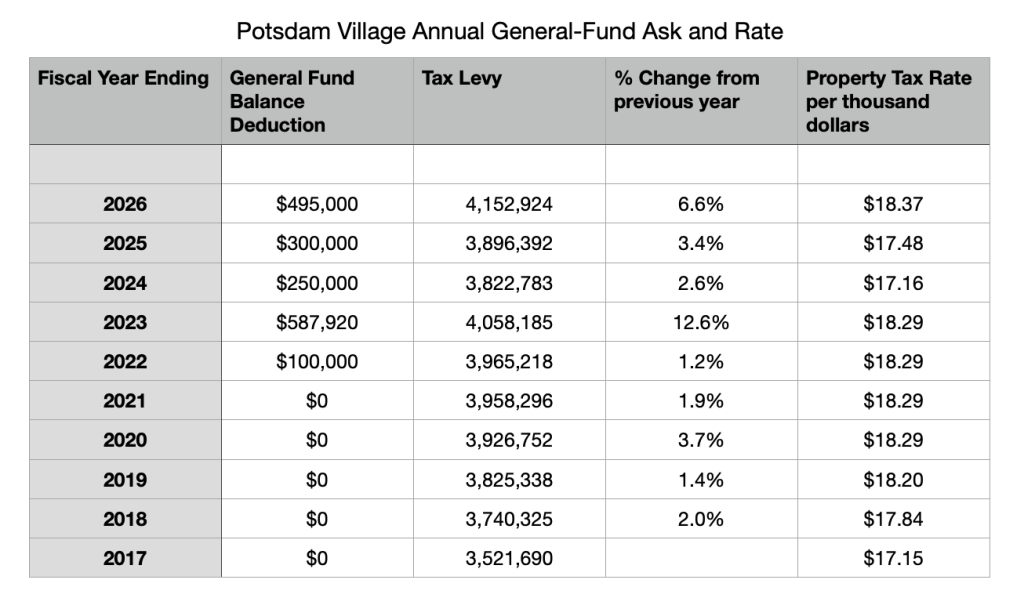
For the sake of historical context, I therefore post two data sets today.  The first  lists the Tax Levies by village boards for fiscal years dating back to 2017.  Note that before 2021, Village Boards did not withdraw funds from any “left-over” moneys (General Fund Balance Deduction) remaining in the fund balance at the end of each fiscal year.  The Covid pandemic changed this habit, with boards dipping into village savings accounts to cover expenses.

Note that the tax rate stayed steady at $18.29 for many years.  During my time on the board, I urged the board to lower the tax rate in 2024, as we were clearly receiving more revenue than appropriations required. That brief respite was immediately turned around, and this year, the Village of Potsdam proposes to charge the highest tax rate it has ever charged! $18.37 per thousand dollars in property value! This in spite of the fact that they will take half a million dollars out of  savings to lower the levy! And that huge savings-withdrawal, in spite of not knowing the actual amount in savings.  (The promised external audit reports for the past few years did not arrive, and our Treasury cannot ascertain how much of the moneys in our investment account has already been committed to the many projects that are underway.)

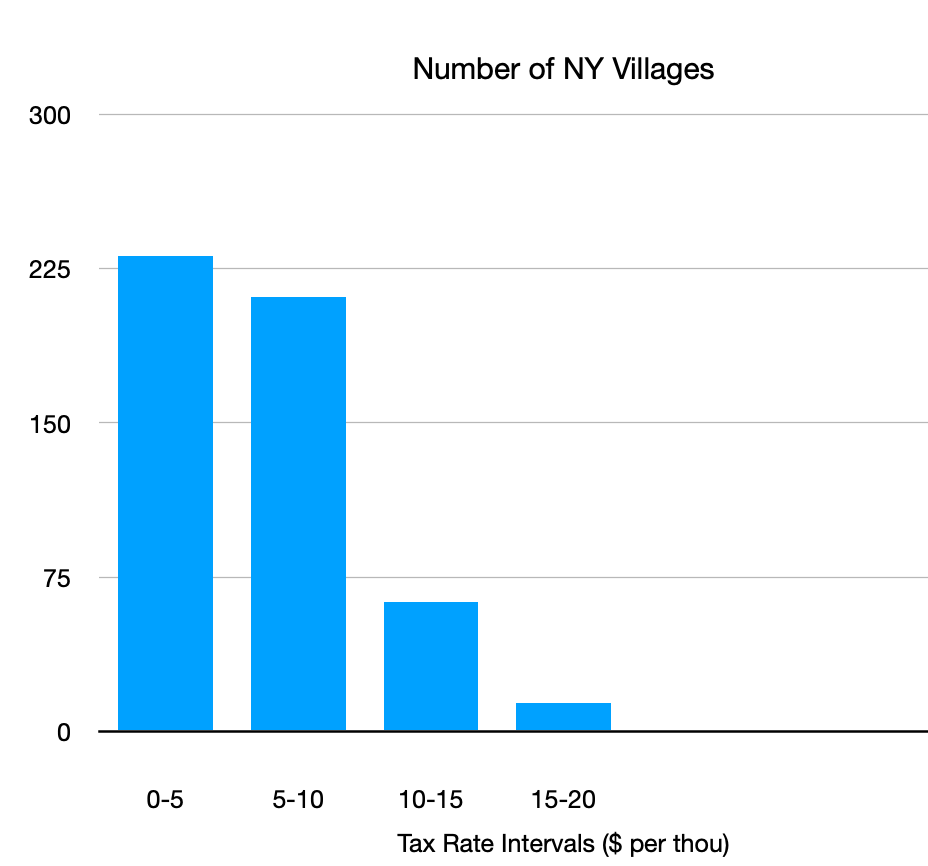
Looking at the latest (2024) published tax rates across all villages in the State we see that our municipality will have the dubious distinction of having the second highest tax rate of any of the 520 villages in NYS.  Only Herkimer in Herkimer County pays a higher tax rate, at $18.61. The average tax rate across all villages in the state, in 2024, was $6.14. Ours is almost exactly three times higher than the State average. To see where we stand relative to other villages, I plot a histogram of tax-rates binned in $5 dollar intervals; so for example, in 2024, 231 villages had tax rates under $5.00, and merely 14 villages had tax rates over $15.00.  Potsdam’s is right up there, almost at the top.

In the interest of full disclosure I must report one indiscretion: the phrase “our municipality” will no longer apply to me after today.  Today, we closed on our beautiful village home of the past 3 decades, and have moved downstate to be close to family. I have requested access to any external Audit report(s) that might come out, and would be happy to comment on those reports, in view of the grim finances implied by the current budget document.  I hope to continue hearing from many of you and also hope to enjoy visits from and to you. Best to all.

Budget Woes: HydroElectric Folly

Politics is not a spectator sport: Everyone is responsible for the success of government operations. Here another dive into the proposed 2025-2026 budget, to ascertain if the numbers reported there make any sense. https://vi.potsdam.ny.us/wp-content/uploads/2025/03/Budget-25-26-V2.pdf

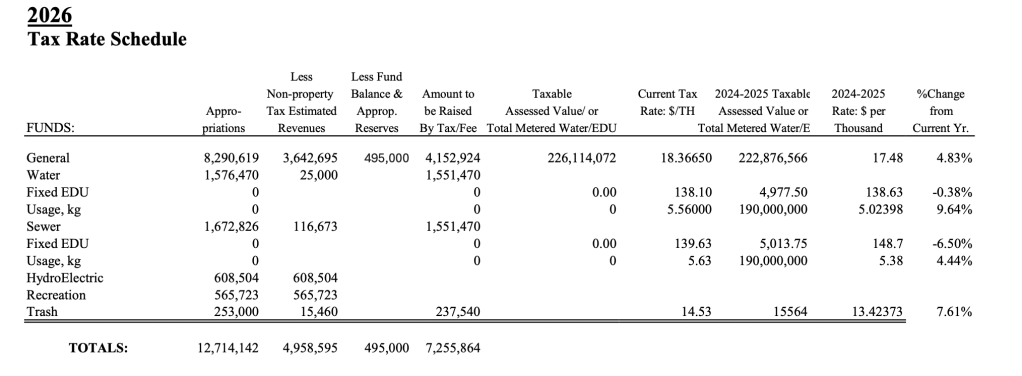
The first column on the Tax Rate Schedule on page 30 (reproduced below) lists how much money each department needs to run its operations. So for example the HydroElectric plant requires a $608,504 appropriation for the next fiscal year.  (If the magnitude of this number shocks you and you wish to know why  it costs so much to run a couple of hydroelectric power generation plants, then look at pages 24 and 25.)

The column after Appropriations is titled “Less Non-property Tax Estimated Revenues”. In other words,  not all revenue for the appropriations need come from property taxes! And for the HydroElectric Fund, the “non-property tax estimated revenue” happens to be exactly equal to the department’s appropriation of $608,504 (a very precise estimate!).  This is so misleading!

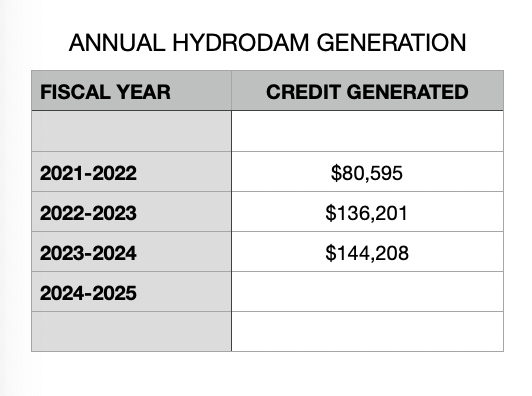
Where, if not property taxes, does the revenue to the HydroElectric Fund come from?!?  Well, it is coming from the power and credit generated by the hydroelectric dams.  And herein lies the problem that no administration will discuss: the credit generated by the two dams is tiny compared to the cost of running the plants! In all of fiscal year 2021-2022, the dams generated $80,595. In all of fiscal year 2022-2023 they generated $136,201. And in all of fiscal year 2023-2024 they generated $144,208.

But the Hydrolectric Plant requires $608,504 the next fiscal year! So there will be another shortfall of $500,000 that will be paid by our property tax dollars! Is that even permitted? Quoting from an Office of the New York State Comptroller’s Division of Local Government Report entitled “Examination on the Village of Potsdam Financial Condition” from May 2017: “the general fund has been loaning money to the hydroelectric fund to help subsidize its operations. As of May 31, 2016 the hydroelectric fund owed the general fund about $222,000, and it had no cash available to repay the loan…While General Municipal Law allows the Village to temporarily advance (loan) moneys from one fund to another, the borrowed cash must be repaid by the close of the fiscal year in which the advance was made. The use of interfund advances is a permissible form of short-term borrowing to meet current cash flow needs, but it is not intended to be used as a long-term approach to provide financial resources from one fund to another fund”.  No administration wishes to discuss this problem as there is no obvious solution, but the Treasury department has been bailing out the HydroElectric plant for 10 years, illegally to my understanding. As the Treasury department has not released audit reports since May 31, 2022, we do not know exactly how much the HydroElectric Fund owes the General Fund, but I estimate it to be well over $1,000,000.  

So I would encourage every village resident to question why the Treasury Department misguides us into a false belief that the dams pay their own way. They do not. Is it not time to sell the dams, or to simply shut them down? At the start of the village 2021 administration, Steve Warr and myself were seated on a Hydro Committee in an effort to find a way out of this financial millstone drowning our finances. Unfortunately, the Mayor dissolved that committee and attempted to resolve the problem on her own, apparently to no effect. Had I a vote, I would have voted to shut both dams down.

Reval Assessment & Tax Burdens

This week everyone is concerned about the new assessments: “Will my taxes double if my assessment doubled?” Or: “The notice indicates that my taxes are going down, even though my assessment went up? Is that correct?

So how will the new assessments affect your future property taxes?  Assessments of and by themselves cannot increase the taxes collected by any municipality (village, town, school and county).  Only municipalities have the taxing authority to decide how much property owners will be required to pay. How does this play out?  

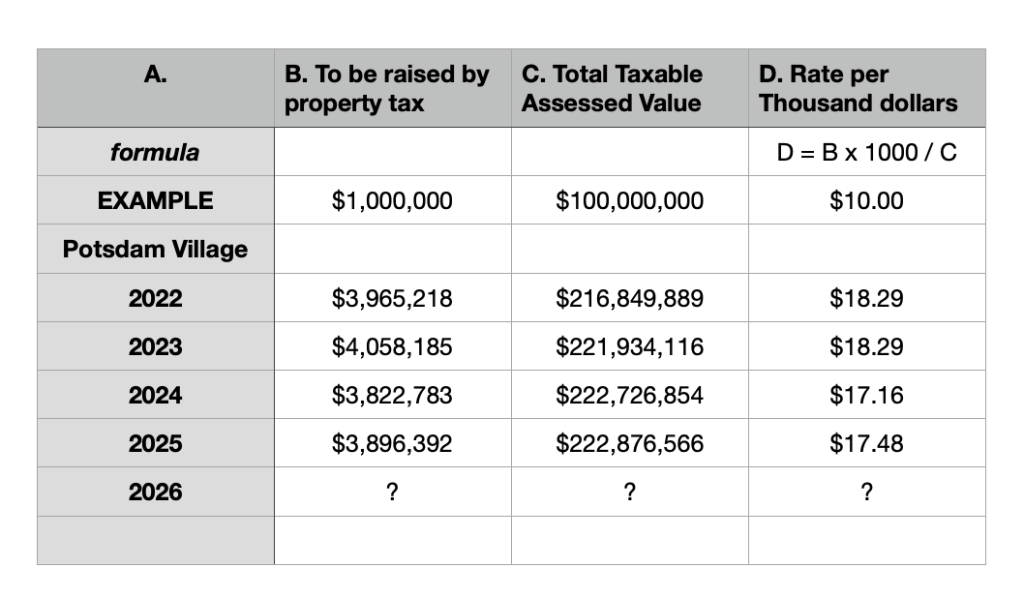
Let’s say a municipality needs to raise $1 million this year in order to run their operations. Let’s say the sum of all the taxable properties in that municipality comes to $100 million. As indicated in the EXAMPLE row in the first Table, the municipality would have to charge a tax Rate of $10 for every thousand dollars of property value in order to raise the required $1,000,000 levy.

How does this example compare to the actual numbers used by the village of Potsdam? Looking at the published village budgets found at: https://vi.potsdam.ny.us/category/news/budgets/ from 2022 through 2025, we see that the amount “To be raised by property tax” in the village has been around $4 million since 2022.  The Total Taxable Assessed Value of all properties in the village was $217 million in 2022 and rose to $223 million by 2025; and the resultant tax rate went from $18.29 in 2022 to $17.48 in 2025.  (This information is on the second-to-last page of each year’s budget document, under “Tax Rate Schedule”)

The assessment agency, using their new assessment information, and rightly trying to steer clear of any responsibility for future tax burdens, poses the simple question: “IF the levy imposed by your municipality stays the same ($1 million for example), WHILE the total taxable value went up to, say, $200 million dollars from $100 million, THEN the tax rate would have decreased to 1,000,000 * 1000 / 200,000,000 = $5 per thousand dollars of property value: i.e. halve as high as the previous rate when the total property value was $100 million.  Using that hypothetical, the assessment agency then multiplied your actual new property value by this new hypothetical rate to give you an ESTIMATE of how your tax burden would have changed from last year’s.  At best, this gives  a sense of whether your property value increased more or less than the average.

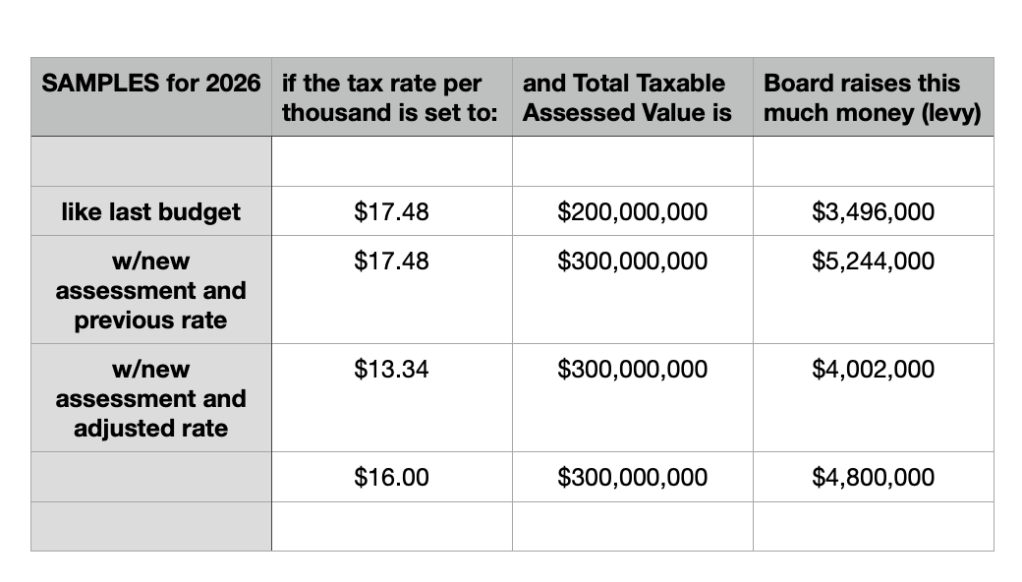
What options exist for the village board as they construct the new budget due June 1, 2025?  In the second Table, I illustrate with a few extreme examples. Everything depends on the new Total Taxable Assessed Value, a value that has not yet been made public (though I did not try to ask the Town’s assessor for this value; it will be available once the village board decides to release the new “Preliminary” budget document. It will also be published by the county government at stlawco.gov under Tax Rolls for 2026). For the sake of a concrete example, let’s say the new total assessed value rises from around $200 million to $300 million. If the village board keeps the same tax rate as last year’s, i.e. of $17.48 per thousand dollars of property value, then they would raise a whopping $5.2 million instead of $3.5 million.  That might be fun for the village board and staff, but obviously that would double the tax burden on everyone. At the other extreme, if the board decides to requisition the same levy as always, around $4 million, THEN the tax rate would decrease to $13.34 per thousand dollars of property value. Most municipalities compromise: lower the tax rate a bit, perhaps to $16.00/thousand in this example, and thereby still increase the levy significantly, from $3.5 million to $4.8 million. In sum, it is not the tax rate nor the assessments that determine your tax burden, but the LEVY that the municipality imposes. 

So under the header “caveat emptor,”  it behooves everyone to keep a close eye on the “Amount to be Raised by Tax” column of the Preliminary budget document that should be made public any day now.  As indicated, the village has requisitioned around $4 million each year since 2022. NY state law requires that municipalities not increase their annual levy by more than 2%.  Unfortunately, this law may be overwritten by a simple agenda resolution. Such a resolution is on the village board’s agenda for Monday April 7, 2025 at 5:45pm: at that time the public is invited to provide comments to the board about the board’s intention to override the state’s tax levy limit.

By simply asking “What amount of money is to be raised by property taxes next year?” And “How does that compare with last year’s $3.9 million?” And if the levy is set to increase by more than 2%, then ask: “Why is that?”  Everyone should be on board in developing a fair and equitable village budget.

Fees or Taxes, What’s the Difference?

As the time nears for developing a new village budget, let’s compare the tax rates the village board imposes.

By state law, water departments must charge “user fees” or “rents” to cover their costs, not taxes. Similarly, sewer departments must charge user fees, not taxes, to cover their costs of operations. And this is extremely helpful: by naming the water and sewer rents “fees” rather than “taxes”, everyone pays for these services; no-one is exempt.

Let’s see how that translates for us in Potsdam.

Rounding to the nearest dollar, I paid $525 in total in 2024 for water and for sewer fees. The final budget document on the village website shows that for 2023-2024, the water and sewer departments cost $3.3 million to operate.  So I personally contributed 16 cents to every thousand dollars those two departments needed. Keep in mind that homeowners, businesses as well as nonprofits contribute to water and sewer fees. Let’s compare this to our property taxes that run the General Fund.

I paid $2,500 in village property taxes last year.  The final 2024 budget document (posted on the village website) shows that the village board needed to raise $3.8 million in property taxes to operate its General Fund (i.e. DPW, the police department, civic center, parks & recreation etc). So I contributed 64 cents to every thousand dollars for village operations, a 4.0-fold increase compared to the water and sewer costs.  

Why? Yes indeed, because in the village fewer than 1/3 of all property owners contribute to taxes. The total property value in the village, currently, before the new valuation kicks in, is listed by the county as $684 million. The total taxable property value in the village, however, stood at $222 million, or or 32% of the total.  

Currently DPW, the second most expensive department within the General Fund, covers the cost of building, maintaining and repairing water and sewer lines.  If those costs were instead carried by the water and sewer departments, everyone would end up contributing to the upkeep of our infrastructure, not just the property tax payers. A quick phone call or email to NYCOM counsel would quickly inform us of the legality of such an adjustment, which has the potential to significantly lower the tax burden on village residents.  Join me in urging the Mayor and village staff to pursue this possibility, via emails, phone calls or attendance at village board meetings.

Missing Financial Data

As citizens of the village and their elected representatives continue to wait for the release of  the FY23-24 (June 1, 2023 – May 31, 2024) annual budget report to learn the sizes of the village budgets’ surpluses or deficits, I will at least highlight a couple of items from the previous year’s FY22-23 budget report. With particular interest about how the village accrues excess dollars, I scanned the FY22-23 annual budget report for larger-than-expected revenue items as well as smaller-than-anticipated expense items. Three items (out of about 900 items) in particular jumped out.

The Board budgeted $10,000 in revenue from Interest & Earnings. However, as interest rates hovered near 5% and the village’s investment portfolio was sizable, the FY22-23 budget report shows that the village earned $247,192 in Interest & Earnings, not $10,000.  In other words, the village’s revenue in this category exceeded expectations by $237,192.

Sales Tax revenue was budgeted to bring in $1,550,000 but instead our municipality received $1,781,490. In other words, the village received $231,490 more sales tax revenues in FY22-23 than expected and budgeted for. (Sales Tax revenues often exceed expectations, as the State Comptroller wisely encourages municipalities to make conservative revenue-estimates to protect against downturns in spending.)

Finally, the 5 Contingency line items (to cover unexpected expenses in the General, Water, Sewer, Hydro and Recreation Funds) were funded by the Board for $327,285 at the beginning of the fiscal year.  At the end of the fiscal year (i.e. by May 31, 2023), the budget report shows that $114,909 were spent by these 5 contingency items. That means that the village received $212,376 more in (tax) revenue than it spent on its Contingency line items.

Together these 3 items resulted in a net profit to the village of $681,058.  To put that in perspective, that amount of money could have been delivered by $2.95 per thousand dollars of village property value.  It is very nice to have a big buffer in savings to shield against misfortune, but should the village operate with such profits?

The Board has yet to see the budget report for fiscal year FY23-24 that ended 6 months ago, on May 31, 2024. The Board budgeted $12 million towards operations: how many of those dollars were not necessary? Hopefully the people and their representatives will soon see that annual budget report, with actual end-of-year expenses and revenues, both on the village website as well as an excel version for Trustees to analyze. Without financial data, the Board can not deliver oversight and accountability. I encourage everyone to peruse these documents, or request them from the village Clerk, to gain familiarity with the where and hows of village operations, revenues and expenses.

Squaring the Budget?

The village of Potsdam is currently in the middle of its 193rd fiscal year! Yes you read that correctly: our village was incorporated in 1831 so we have nearly 200 budgets under our belt!

Village budgets start anew every June 1, so our current fiscal year ends May 31, 2025. Before looking at the design of next year’s budget, which will itemize where all our municipal dollars are spent, first a brief overview on how many tax dollars businesses and residents contribute to maintain village operations.

Property owners in the village paid $17.48 per thousand dollars in property value in 2024. For example, if the Assessor listed a residential home’s assessed value at $100,000, then that owner owed $1,748.00 in village taxes.  If a property’s assessed value is twice that, or $200,000, then the owner paid twice as much, or nearly $3,500 in village property-taxes.

It is worth keeping in mind that commercial enterprises, including apartment owners, pay exactly the same village property-tax rate as residential (“R1”) owners. This is significant since businesses are always assessed at much higher valuations: For example, my neighbor’s $150,000 home sits on 0.9 acres of land and contributes $2600 in taxes (rounding a bit).  The new Stewart’s Shop on Market St. sits on a smaller 0.7 acres, but it has a market value of nearly $1,000,000 and so pays closer to $17,000 in village taxes.  Germaine to the current discussion: If this business, with the same assessed value, had been located in neighboring Canton, it would have paid $10.75 per thousand, or around $10,000 in Canton village taxes.  The difference, of around $7,000 is “real” money, being equivalent to nearly 500 NY minimum-wage hours of labor. (Note, interestingly, that when businesses shutter for whatever reason, the owner continues to pay the same amount of village taxes lest the County assumes ownership of that property.) 

As the current and following blog posts will follow the development of the next village budget, we need to ask whether the village property-tax is all the tax that residents pay towards village government? No! Residents also pay a fee for water and sewer services. How much? That depends on how much water customers use (there is one water meter per customer), but let’s assume that a customer uses 120 gallons per day. (This amount of water consumption is referred to as 1 EDU or Equivalent Dwelling Unit).  A one-family home then would pay $742.85 annually towards municipal water and sewer services. Businesses that use a lot  of water, whether a car wash or a laundromat or a college dormitory, may pay 10 or 100 times this amount. (Yes, non-profits also pay water and sewer fees.)

So for example, if my $150,000 home uses about 120 gallons of water per day, I must pay the village nearly $3,400 in village combined taxes. Next I will try to summarize what operations and services these dollars enable, before posing the question: would it make sense to activate a different tax rate for commercial vs non-commercial enterprises?

Surplus Moneys

The village administration’s financial goal? To ensure that none of the village’s budgets operate with deficits: The net revenues received each year must cover both the anticipated and surprise expenses for that year (surprise expenses are covered by so-called “contingency” lines in the budgets). And so the Treasurer, with help from the Administrator, carefully records and monitors every single payment to ensure that the board-approved budget holds.  

But every budget is designed with unknowns: We make best guesses as to how much sales tax revenue we will receive this year compared to last, for example.  Such guesses are likely to be off, resulting either in a reduction or an increase in anticipated revenues. Expense estimates are also likely to be off: Prices may rise significantly, for example, for chemicals like salt and sand for de-icing roads or there may be an increase or decrease in the cost of gasoline that leads to over- or under-spending certain line items. In spite of the uncertainties, department heads make conservative expense lists and the Treasurer carefully monitors and reports to the board whenever any line item begins to be overspent, requiring transfers from other line-items that are expected to be underspent. The board approves all such transfers and adjustments during the open board meetings.

In all, this strategy of operating without budget deficits has served the village well: it is now 10 years since any of our 3 main budgets (for the water, the sewer & the general funds) has been in the red:  The village’s various budgets have operated with surpluses for all that time. How much surplus? Well, 10 years ago the village inadvertently eliminated its general, sewer and hydro fund balances, wiping out all its holdings in those funds. This emergency required a sudden $500,000 loan in order to pay employees. The emergency also drew the attention of the Office of the New York State Comptroller, who drafted a “how to avoid going into fiscal stress” manual for the Village of Potsdam, linked below. And today, far from being in the red, we currently hold a cumulative $7m in “the bank”, seemingly amounting to an average surplus of $700,000 per year…or is it?

Surprisingly, I have not been able to ascertain how and where most of these surplus dollars arose: the sources of the annual surpluses remain unclear in both the published, board-approved budgets as well as in the monthly budget reports. Are surpluses caused by one or more funds requesting more funding than necessary to cover their actual costs? Were there unplanned infusions of federal or state funds?  Or are most of the “surpluses” actually not surpluses at all, but money already committed to pay for services or parts not yet delivered? This information might be included in annual board-approved budgets and/or in monthly budget reports, but it is not. Instead, this information has been provided to Trustees by external annual audit reports: independent CPA firms that pour over every aspect of our municipal financials in order to confirm that everything is correct. The external, independent auditors create voluminous annual Financial Statement reports that summarizes all aspects of village expenses and revenues; from health benefit costs for current and former employees and their dependents to total debt payments on current and future debts, to any red flags that indicate caution required. Unfortunately, the external audit reports have either been missing or provided too late to aid in budget preparation the last few years.  This very unfortunate development provides our Treasurer’s office with a great opportunity to include these data in our in-house data reports: both in the monthly budget reports as well as in the annual board-approved budgets, to aid Trustees to develope future budgets.

Without knowing the so-called “unrestricted” amount of savings in each fund at the end of each fiscal year, the board cannot design the best budgets. Best budgets are made when Trustees see why, and by how much, revenues and expenses fluctuate every year, and adjust the tax rates accordingly.  We most definitely do not want to go into the red in any fund, but neither do we have permission to operate any fund at a profit: If tax payers can pay all the bills with a 15% reduction in tax rates, then they have the right to know that, or the board needs to justify why the rates need to remain inflated.  Caution dictates that we should invest every resource available to obtain the annual fund-balance numbers in-house and not wait a moment longer for external auditors to report on the annual unrestricted fund balance for each fund.

References:

https://www.northcountrypublicradio.org/news/story/31231/20160310/how-did-potsdam-become-the-most-fiscally-stressed-village-in-the-state

https://www.osc.ny.gov/local-government/audits/village/2017/05/26/village-potsdam-financial-condition-2017m-61

What’s in the Pipeline for the Village?

The village is currently involved with numerous projects in various places in the pipeline from conception to engineering & environmental reports to execution.  Projects still in the early, planning stages can be adjusted and affected by public input/ideas/suggestions/concerns: these can be shared directly with staff and board members during board meetings or communicated via emails and/or letters to the editor.

Here is a partial list of projects, in random order & filtered thru my limited grasp of  particulars:

Downtown StreetScape Enhancement  A re-design of sidewalks & crosswalks in the downtown area, to improve overall appearance and appeal. Design and funding complete; awaiting actual construction. Funded by NYS grant program (DRI)

Riverwalk Trail  An attempt to create an inviting, continuous riverfront walking trail along the Sandstone Dr overpass to Garner Park and Raymond St, on to Market St and Maple St, and so back to Sandstone Dr.  This project fits in naturally with the Munter Trail and will hopefully blend in with an eventual Garner Park to Fall Island Footbridge, described below. Design specifications and funding complete, awaiting actual construction. Funded by a NYS grant program (DRI)

Garner Park to Fall Island Footbridge  An effort to replace an exposed and vulnerable cross-river sewer line with a secure line beneath a footbridge linking Garner Park to Fall Island. Preliminary designs complete, and efforts to secure funding for the engineering & environmental reports underway.

Skatepark An effort to site an in-ground skatepark on Fall Island at 19 Maple St. Funding by NYS DRI approved, but environmental remediation required, as this spot was once occupied by a gas station. This site may also face higher scrutiny due to its proximity to the river as well as sites listed on the National Register of Historic Places (Trinity Church as well as 17 Maple St)

Brooks St  A new short roadway to link Depot St and Raymond St alongside the Potsdam Mall.  Funded separately from the DRI projects mentioned above, this new roadway is an integral part for improved car and foot traffic behind the downtown portion of Market St. This project has obtained its requisite Environmental Impact Report and its design specifications are being finalized before construction can begin. Funding for the engineering & design specifications came from a Federal grant (NBRC).

Toilet for Ives Park  This idea appeared in the 2013-2023 Potsdam Village Comprehensive Plan. Project nearly complete. Funding for construction came from the Federal American Rescue Plan (ARPA)

Boathouse for Ives Park  Another concept being discussed is the construction of a boathouse on Ives Park. Boating enthusiasts would be able rent space to store their boats and non-boat owners could rent kayaks to paddle the Raquett, taking advantage of the handy boat launch already installed.  The boathouse committee consists of 2 trustees and 3 residents who all enjoy paddling. This project is still in its early planning phase and welcomes comments from the public.

Lead Lateral Identification and Replacement Currently on-going, a federally as well as state mandated effort to identify and eliminate every trace of lead in our water pipes. Testing to ID all water lateral lines contaminated with lead is funded by a NYS grant (EFC)

Airport Improvement Efforts to lengthen and improve our runway and fencing around the municipal airport to permit larger carriers, including UPS and possibly commercial airlines, to land and take-off here. Design complete and construction due to start in summer of 2025.  90% of funding from Federal grants (FAA), the remainder (about $20,000 as I recall) from local property taxes

Safe Streets and Roads for All This addition to the village’s project list is an effort to obtain funding to improve roadways throughout the village. Part of this effort is in conjunction with the Town of Potsdam.  Likely included in this effort would be redesigns of Rtes 11, 11b and 56 to improve both safety and visibility for pedestrian and bicycling usage.  This project is still in its initial planning stage: funding is sought for an overall study.

Stormwater Drainage Improvement: An urgent new addition to the village’s ToDo list: An effort to identify funding opportunities for the design of large holding basins (small lakes essentially) upstream from downtown, to lessen the volume of stormwater into the downtown region during massive rain events. Two preliminary studies ID-ed locations for possibly 3 holding basins to protect low lying areas along the eastern shores of the Raquette river. New engineering report required; funding sources have recently been ID-ed but applications not yet written.

Pine St Flooding Engineering Reports to study and address flood risks on the western shore of the Raquette River have not yet been undertaken. A recent significant flood event on Pine St. occurred not due to heavy rains, but due to a beaver dam break. Multiple beaver dams exist on private land and present a danger to village- and private-landowner properties downhill. A redesign of flood waters flowing past properties along Pine St and to the Raquette River is needed, but not yet in the pipeline.

Inflow and Infiltration into Sewer Lines  The sewer plant experiences significant threat of overflows during heavy rain events due to persistent inflow and infiltration of rain water into sewer lines during rain events. In addition to the threat of overflows at the sewer plant, I&I leads to the eruption of untreated sewage onto village properties when sewer manhole covers erupt during rain events. An Engineering Report describing the I&I problem facing Potsdam’s sewer lines was completed in 2022 and remedies suggested, but no action was taken and no further work on this in the pipeline.

Comprehensive Plan  Every municipality is strongly encouraged by funding agencies as well as the Office of the State Comptroller to have a comprehensive 10-year plan delineating its visions for the future. This document not only protects the municipality from legal challenges of ad hoc or capricious taxation, it also provides strong support for funding from agencies: If two municipalities submit equally compelling funding requests, the funding is likely to go to the one with an up-to-date comprehensive plan.  Potsdam’s comprehensive plan expired in 2023 and while funding has been requested to have an outside agency oversee the generation of a new plan, no committee has been named to work with the Planning and Zoning committees to tackle the many preliminary tasks involved.  Resident involvement here especially vital.

Sale of Municipal Hydrodams  Potsdam’s return on investment on the hydroelectric facilities has been negative since 2008. To date, village tax payers have been required to cover the cost of a 20 year, $5 million loan for the west dam, as well as a 20 year $3 million loan on the east dam. The west dam is inoperative, after 5 years of service. The east dam works at close to optimal efficiency and generated $136,000 in credit last year while the total annual operating costs (including debt payments) of both hydrodams amounted to $490,000. Local property taxes paid for the difference. The sale of the hydrodam(s) is on hold: no discussions around this critical matter are occurring.


Pine St Arena The arena at Pine St is in bad shape and needs a complete overhaul.  Funding requests for an Engineering Report have been submitted.

Other matters brought up during board meetings include: Reducing the village’s carbon footprint by making municipal buildings more energy efficient; Studying food waste recycling efforts; Filling empty storefronts downtown and on outer Market St; Isolating water use on the three campuses (SUNY, CU & CPH) so the village does not pay for water losses on those campuses; Rebuilding the retaining wall on Fall Island, among others. Public input welcomed on all matters, including new members for the village, zoning and planning boards as well as the eventual comprehensive plan committee…

The Role of Village Trustees?

While the Potsdam Village Board of Trustees busied itself with Ives Park projects and parking matters, I wondered what the village’s department heads considered high priority projects? Thanks to “Village Department Head Surveys” completed last year as part of the 2023-2033 Comprehensive Planning Process, residents can learn which tasks our department heads consider vital for the village. I report here primarily on the most cost-heavy items.

The head of the Hydro Plant lists as the first item:  Sell the west dam. The west hydrodam was meant to cost $3.5m and to begin operations in 2009 for 30 years. Instead it required $5.5m in loans, began operations in 2015, and ran for merely 5 years. The two municipal hydrodams together require around $120,000/year to operate and maintain. In addition, there are the debt payments: the West dam debt payment is $265,000 annually, until 2029. The East dam debt payment is $115,000 annually, until 2046.  The operating east dam meanwhile generated $136,201 in credit last fiscal year, leaving an annual deficit of $455,544 that continues to be paid from the tax-payer’s General Fund. 

The head of the Water Treatment Plant (WTP) lists 13 capital projects and equipment needs required to ensure the continued operation of the WTP, to the rising purification standards set by State and federal laws…and to prevent the roof from leaking (The water treatment plant on Raymond St dates from 1983 so is over 40 years old). I understand that this update/upgrade will be as expensive as the sewer plant update of 2020.

The head of Planning & Development states “Village infrastructure will be the single largest challenge for the next decade and beyond. Water and sewer lines, the cross town canal, underwater sewer lines and new federal standards for drinking water/waste water will only add to the cost and complexity of the Village’s systems…The Village needs to focus its efforts on infrastructure, preparing engineering studies so that it is prepared to annually apply for funding…An engineering study for the tail race wall at Evans & White needs to be commissioned. The wall is in poor condition and may be undermined given water bubbling up under pressure from Evan’s parking lot…”

The head of the Recreation Department writes that the expansion and remodeling of Pine Street Arena is a high priority goal.

The head of the Sewer Department (aka the Waste Water Treatment Plant or WWTP) does not report urgent needs at that plant thanks to the complete recent rebuild of the WWTP, a rebuild that required a $12m loan that will be paid off in 2051. (While there are no operation issues here, the head of the WWTP points to the fact that one high-expense item at any waste water treatment plant is power consumption, and that technology exists to extract energy from the heat and gasses generated during waste water treatment.  Incorporating such technology at our WWTP would reduce expenses and waste.)

Between the water treatment plant on Raymond St. and the sewer plant on Lower Cherry St. run about 30 miles of underground water and sewer piping as well as the various ditches and channels that constitute our storm-drain system, all of which is purview of the Department of Public Works or DPW.  While maintaining streets, picking up brush, clearing fallen trees and snow etc, DPW also monitors the operation of all sewer and water mains as well as the cross town canal. DPW  also deals with random challenges and crises, from beaver-dam breaks that inundate properties on the western shores of the Raquette river, to tiled fields to the east that direct massive inflows of stormwater into our cross town canal drainage system. In addition, two cross-river sewer lines “have reached the end of their useful lives and need to be replaced” according to a 2022 Engineering Report  entitled Inflow and Infiltration Study prepared for the Village of Potsdam by the firm EDR. This report additionally details  how and where leaks enter  the sewer lines during rainstorms, and quantifies which below-ground pipes must be lined. The challenges DPW is tasked to resolve, in other words, are many, diverse and complex, and may not have obvious resolutions in some cases.

The heads of other departments (Police; Clerk/Registrar; Treasurer/Administrator; Fire; Safety/Code Enforcement; Museum) either had not yet filed survey reports or did not report urgent and high-cost Capital Outlay/Equipment needs.

Infrastructure repairs and construction bear high costs:  The EDR Inflow and Infiltration Report, for example, quoted a cost of $9.3m to replace the aging cross-river sewer pipes and to line all leaking underground sewer pipes.  For context, the current tax rate in the village is $17.48 per thousand dollars of property value.  If the Board had been tasked to raise an additional $1m from property taxes this fiscal year, we would have had to raise the tax rate to $21.97 per thousand dollars of property value. For a home worth $150,000, that would have represented an increase from $2,622 to $3,296, an additional 673 dollars.  

Department heads run their respective departments efficiently and effectively. They will continue to work with the Administration to ensure the continued operation of every aspect of infrastructure and services, and will resolve each issue/crisis as it arises.  Getting Trustees up to speed on the many gnarly issues that each department faces would benefit everyone-so that realistic budgets for the next budget year as well as upcoming budget years may be developed.  But reports such as these Department Head Surveys are not generally distributed to Trustees: it took weeks, if not months of repeated requests to obtain copies of these reports. Likewise, it was by chance that this Trustee obtained a copy of the 2022 EDR Engineering Report that provides hugely helpful insights into the why, where and how costly is the  inflow/infiltration problem facing the sewer lines, a report that should have been front and center in the hands of every Trustee. 

Why is it so difficult to share information? Is it unwise for residents to be aware that the wall abutting Evans & White is crumbling and may give way? Why should Trustees not read a village-funded EDR Engineering Report-while we were yes asked to approve a seemingly competing “Raquette River Utility Crossing Project”?  It is deeply frustrating that the Village Board of Trustees are informed of developments only after all groundwork is complete, all pertinent decisions have been made, and all boundary conditions laid down – Trustees are requested to approve only the final budgeting. The frustration arises as many questions appear not to be asked and many angles appear not to be considered, increasing the likelihood of unproductive and costly dead-ends, like the West Dam.  Does the administration believe that questions and open discussions imperil rather than strengthen the chances of a projects’s success?