Water and Sewer Tax Rates

Prior to 2018, the village of Potsdam, like most municipalities, billed for water and sewer according to how many thousand-gallons of water (kGallon) were used per customer.  In the sample tax rate schedule below,  the tax rates for three funds are presented.
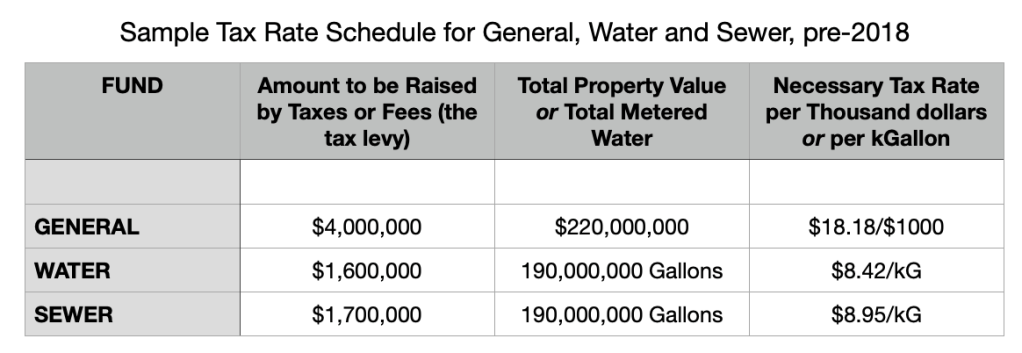
The General Fund, as described in an earlier post, typically needs to raise $4,000,000 from the total taxable property value of the village. The total taxable property value of the village is close to $220 million.  So therefore the necessary village property tax rate for every thousand dollars of property value is $4,000,000/$220,000=$18.18

Similarly, the Water Fund might need to raise $1.6 million from water taxes (which are termed water rents).  How many total gallons of water are billed for in the village annually? It is close to 190 million gallons.  So prior to 2018, to raise the needed  water-tax levy of $1.6 million, the water tax rate for every thousand gallons of water had to be set to $1,600,000/190,000kG = $8.42/kG.

Similarly, the Sewer Fund perhaps needed to raise $1.7 million from sewer taxes (termed sewer rents). The number of gallons of sewage generated is assumed to equal the number of gallons of water billed. So the sewer tax rate (sewer rent) required to generate $1.7 million of revenue equals $1,700,000/190,000kG = $8.95/kG. (This information is required, by law, to be published in the budget reports filed on the village website, and is typically found on the second to last page of the documents: see vi.potsdam.ny.us/treasurer )

Everyone more or less understood these things.  But the problem the village had was that whenever the water and sewer tax rates were increased (to perhaps pay for some expensive repair or piece of equipment at the water or sewer departments), people would conserve water accordingly, so that their billing remained level.  Revenues therefore did not increase and either or both funds went into the red. Frequently.

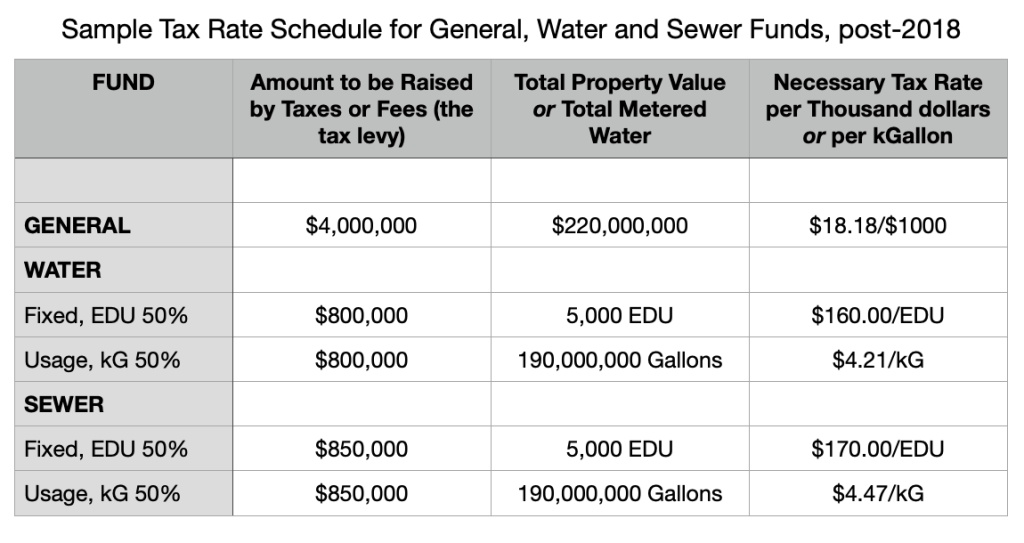
So starting in the early 2000s, municipalities all over the country began to divide their water and sewer billing into a usage portion as well as a fixed portion. Everyone would pay a mandatory, fixed portion, whether they used any water or not, plus a usage portion. This resulted in tax rate schedules like the one below.  In the case of our village, 50% of the water (sewer) levy is raised from the fixed portion and 50% is raised from a usage portion.  So the tax rates for the usage portions are exactly half their previous rates (the usage levy is 50% of $1.6 million = $800,000 while the total number of gallons of water billed remains at 190 million gallons).  But whence the fixed water and sewer tax rates?
Each user (or account) would be assigned an EDU (Equivalent Dwelling Unit) value. Single family homes, for example, all receive an EDU assignment of 1.  A two family home receives an EDU assignment of 2.  And businesses and nonprofits obtain EDU assignments based on how much water they use: so a laundromat or a car wash would get a higher EDU assignment than a minimart, for example.  (One EDU is equal to 120 gallons of water use per day). To see who gets how many EDU, see our online local laws: 
ecode360.com/attachment/PO0885/PO0885-173a%20Appendix%20A.pdf

Given that the total number of water and sewer EDUs assigned throughout the village is 5000 EDUs, then the water-tax rate required to raise $800,000 is $800,000/5000EDU = $160.00/EDU.  Similarly, the sewer-tax rate required in order to raise $850,000 is $850,000/5000EDU = $170.00/EDU.

This would be a good place to end this discussion, but let me continue to itemize my concerns with the system as implemented by our municipality. Businesses, for profit as well as non-profits, have changed their water use significantly over the years (especially during and after Covid), yet their assigned EDUs have never been adjusted. This creates significant inequities. In addition, while water and sewer tax levies have been adjusted, tax rates have not been adjusted accordingly. This makes the accounting of fund balances and encumbrances dubious.  Without clear numbers on whether each fund is growing, shrinking or holding steady, the Board can not set prudent tax-rates.

The Preliminary Budget for Fiscal Year 2024-2025 is Now Available

Yesterday, village Trustees received the Preliminary Budget for 2024-2025. The Budget Report is freely available at the village website: vi.potsdam.ny.us/treasurer 

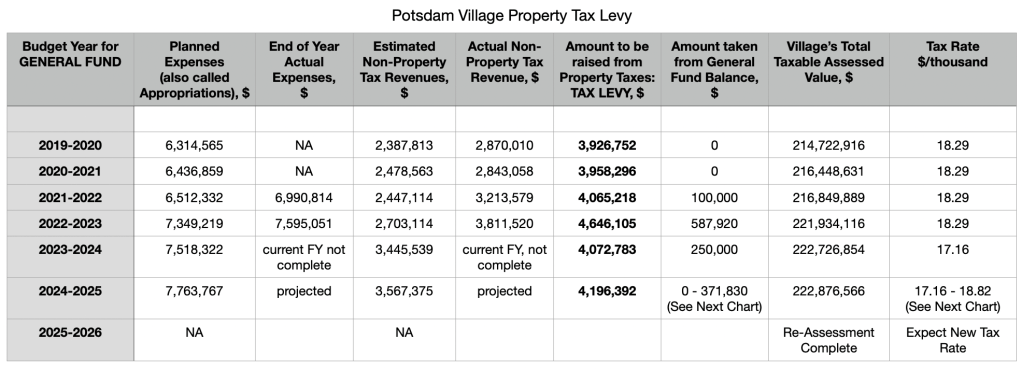
Requisition requests (“Planned Expenses”) for the General Fund amount to $7.8 million for fiscal year 2024-2025, an increase of a quarter million dollars, or 3%, over the previous year’s requisition requests (see chart below).  Non-property-tax revenue (primarily sales tax revenue, plus interest earned on savings and income from fees) is estimated to be $3.4 million. Hence the Tax Levy on property, the difference of those two, is $4.2 million, an increase of $124,000 or 3% over the previous year. 

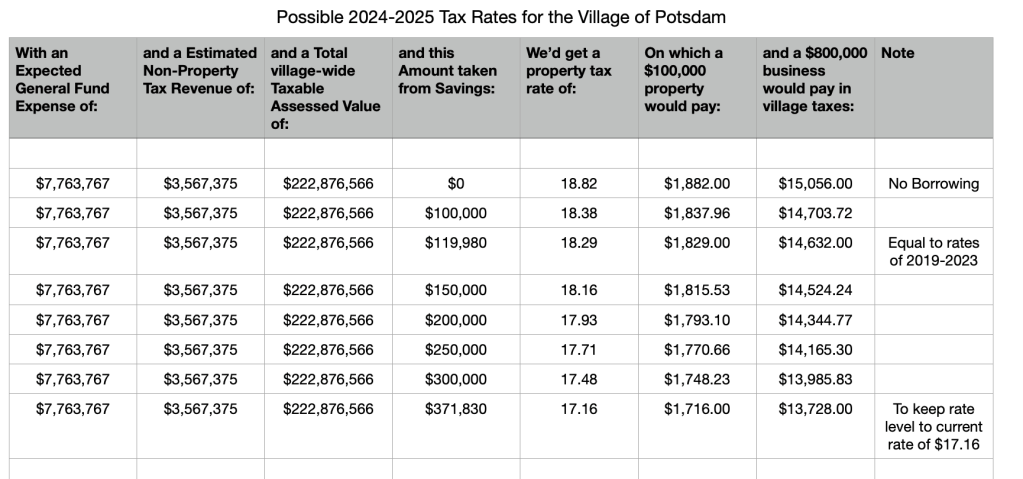
What will be the resultant property-tax rate?  Will it be $17.16 per thousand dollars in property value, like last year, or will it be $18.29 as during the years 2019-2023, or will it be somewhere in between?  That depends on how much the Administration pulls out of savings. Prior to budget year 2021-2022, I can find no instances of money being appropriated from the General Fund balance sheet in order to lower the tax rate (see column “Amount taken from General Fund Balance” above).  However, in budget year 2021-2022 a new $3 million loan for a East Hydroelectric Plant rehabilitation became active, requiring either increased tax rates or withdrawals from the General Fund balance sheet.

As you see in the chart below for the next budget year, if we do not pull money from savings, our tax rate would be a prohibitive $18.82 per thousand dollars in property value. However, to keep the tax rate at the current level of $17.16, the Administration would need to pull $372,000 out of savings, which also seems imprudent,  as the Board does not know the current Fund Balance in the General Fund.

On May 31, 2022 the General Fund held a generous Fund Balance of $4.7 million.  The board does not know the General Fund balance since that date, partly because all village revenues, whether into the General Fund, the Water Fund, the Sewer Fund, or from State and Federal grants, goes to the same investment vehicle, and separating which fund held how much is currently only deciphered by our external auditor, not in-house.

As the board begins to deliberate where to set the next year’s property tax rate, it should be noted that (1) the total Planned Expenses, or “Appropriations” at the start of a budget year typically run short of the Actual Expenses at the end of the budget year (see top chart); and (2)  Over-spending by the General Fund in recent years has been offset by greater than planned revenues to the General Fund, thanks in large part to increased sales tax revenues and generous interest earned on savings.  But both items invite caution: State Comptroller Thomas DiNapoli wrote in a  2/21/2024 press release: “Year-over-year growth in local sales tax collections has slowed significantly, with a nearly flat increase this January compared to last year…With overall growth having moderated over the course of 2023, local officials should remain cautious in their sales tax revenue projections for 2024.”   And secondly, if the Administration depletes Fund Balances, the village loses a valuable income stream from interest earned on savings: interest earned the General Fund $250,000 in revenue last year, for example.

Budgeting Operations

The village’s budget year ends on 31 May, 2024.  As we approach the end of this budget year, the Treasurer, Department Heads and Mayor are busy developing a new budget for 1 June 2024 – 31 May 2025.  How does that work?

Village operations are funded by different sources.  All operations that are funded by property taxes and sales taxes are paid from a fund called the General Fund. The General Fund funds the police department, the department of public works (which maintains our infrastructure including underground pipes and roads), support for emergency services (fire & EMS), parks and recreation, economic development, clerical services, health insurance, salaries, pension payments, computer and software support, the hydroelectric department (unfortunately) and more.  What operations does the General Fund not fund?  Only the water and the waste-water (sewer) departments. Both the water and the sewer departments have their own funds,  called the Water Fund and the Sewer Fund, that receive their revenues from water-use fees and sewer-use fees (from the quarterly water/sewer/trash bills).

The game plan for each of these 3 funds (General, Water and Sewer) is identical: Match expenses to revenues.  The process starts when Department Heads, looking at prior year expenses and extrapolating future costs,  obtain their best estimate for next year’s expenses, and request a certain level of funding.  After all Department Heads have submitted funding requests for the following year, the Treasurer compares the sum of requests to the expected level of revenue for each fund.  

For example, the Treasurer receives total expense requests of $7 million for all General Fund operations. The county provides an estimate of $2 million for next year’s sales tax revenue, based on current and past sales.  So that means that the Treasurer needs to set our property-tax rate to generate $5 million.  Let’s say the Assessor tells us that the total taxable property value in the village is $200 million. To raise $5 million from property taxes, therefore, we’d have to set a tax rate of $25 for every thousand dollars of property value.  

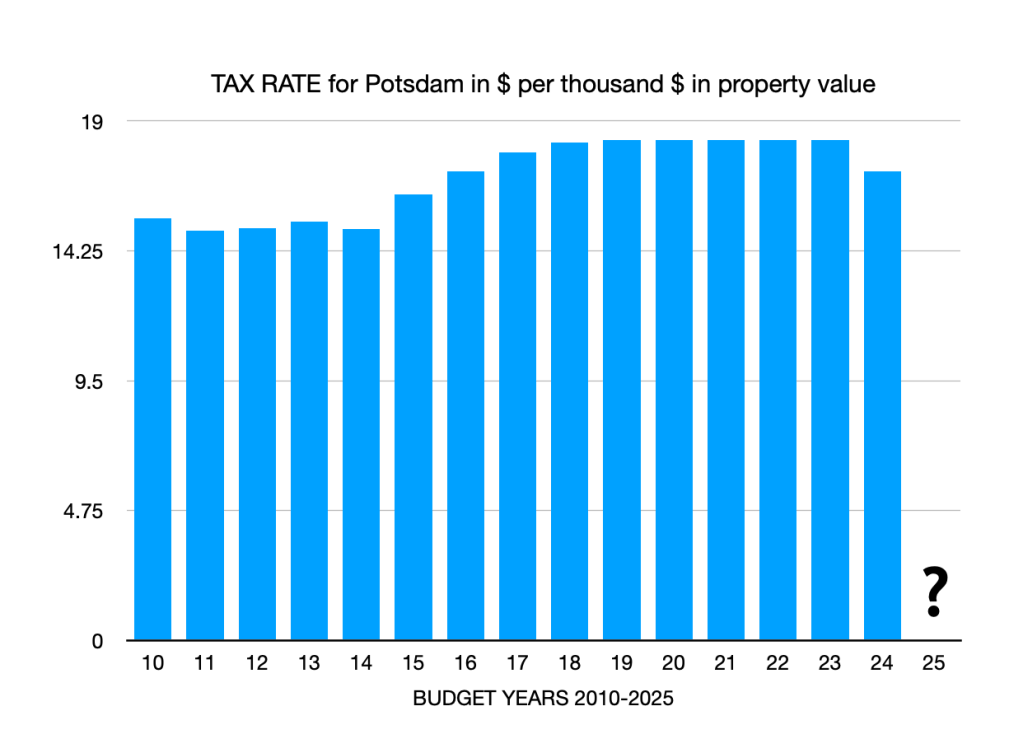
That tax rate is much higher than our current tax rate (see figure) and unacceptable on many levels. And so negotiations begin: to lower expense requests; to examine whether we can withdraw funds from savings to offset some of the expenses;  or to find alternative revenue streams, such as from parking meters.  Ultimately, the aim is to not raise the property-tax rate from last year, and hope that an increase in overall taxable property value (because of new construction for example) provides any needed boost in property tax revenue.

For those interested in the actual numbers: This year the General Fund expense requests totaled $7.5 million (the requested amount for next year’s budget will soon be released). The village is projected to receive $1.8 million in sales tax revenue this budget year, and the Assessor reports that the total taxable property value in the village is currently $223 million.  The entire “preliminary” budget for next year will become available on the village website: https://vi.potsdam.ny.us/category/news/budgets/

Why are People Leaving?

Between 2010 and 2022 the population of the USA grew by 7.7% while the population of NY State grew by 1.4%. Here in the North Country, however, we have seen a net decline: the population of St Lawrence County dropped 3.7%, from 111,821 in 2010 to 107,733 in 2022.  Ominously, the population within the village of Potsdam dropped much more: the village hosted 9,428 residents in 2010 and 8,312 in 2022, a drop of nearly 12%.  The population of neighboring Canton Village meanwhile grew by over 13% during those same years! What is the story?  Is there a reason people preferentially settle in Canton over Potsdam?

In 2010, the village tax rate in Potsdam was $14.99 per thousand dollars in property value. By 2022 that tax rate had increased by $3.30, to $18.29 per thousand dollars in property value, a whopping 22% increase! What happened in the village of Canton? Their 2010 village tax rate of $10.48 per thousand dollars increased by two cents over the same period, to $10.50 per thousand dollars, a mere 0.2% increase.  To put this in context, the 2022 village tax rate of Potsdam was the 8th highest out of 529 villages in NYS, while the average NYS village tax rate was $6.65 per thousand dollars.

Potsdam is a very nice village to live in, but we all must gauge how best to invest and allocate our earnings.  Given that the population of Potsdam is shrinking relative to Canton, people are making their preferences known. 

During my two+ years on the board, I have heard no discussion on why our tax rates are unusually high nor any discussion on how to lower the rates to make this village competitive with our neighboring towns and villages.  Will this year be different?

Hydrodam Woes

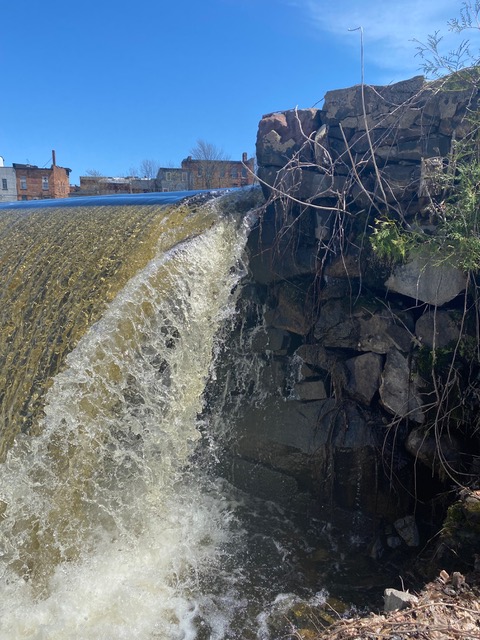
During the last Fiscal Year (June 1, 2022 – May 31, 2023) the village’s two municipal dams generated $136,201.33 worth of (electric) credit. That sounds like a lot, but the Fiscal Report of 5/31/2023 states that the municipal dams cost the village $533,183.06 during that same FY.  The two dams, therefore, generated a revenue shortfall of $396,981.73 during FY23. This nearly $400,000 shortfall is paid for by tax dollars from the General Fund.

By how much do Trustees have to raise the village tax rate to cover a shortfall of $400,000? The village’s total taxable property-value in FY23 was  $210,000,000 and the tax rate  was $17.16 per thousand dollars of property value. For every $100,000 reduction in appropriation requests (expected expenses), therefore, the board can lower the village tax rate by $0.48 per $1000 of property value.  To pay for the shortfall generated by the hydrodams, the board increased the village tax rate by $1.90 per $1000 in property value.  For the average village home valued at $104,000 this corresponds to an increased property-tax levy of $198.00 to the homeowner.

The municipal dams have been operating at a loss since at least 2014 in spite of repeated and generous infusions of funds to upgrade performance.  In fact, the losses reported by the Hydro Fund have been growing bigger year after year, as new and growing debt payments come due. As of the end of last year, the municipal dams owed the general fund approximately $1,052,122.95.  Is it time to try to transfer responsibility and ownership of the municipal dams to an agency specialized in operating these complex machines?