Our Taxes Just Went Over the Top

In the previous posts we discussed the Water and Sewer tax/fee rates and reported that the rates adopted by the Treasury department do not match the stated Appropriation requests. The rates quoted in the budget report will bring the Treasury a combined $400,000 excess revenue. Unfortunately, I cannot find an updated, corrected Budget document.

In another post, we discussed how the Hydro Fund expenses are almost completely borne by local property tax dollars, in violation of the “Less Non-property Tax Estimated Revenues” column on page 30 of the budget report.

Before commenting on the proposed General Fund portion of the Mayor’s budget, I had hoped to hear the Mayor’s comments, as that important document is full of pain and promise. Unfortunately, I was unable to access the village board’s live-stream of the board meeting last night, and have seen no written comments by anyone in the administration on why the General Fund appropriation ballooned this year.

For the sake of historical context, I therefore post two data sets today.  The first  lists the Tax Levies by village boards for fiscal years dating back to 2017.  Note that before 2021, Village Boards did not withdraw funds from any “left-over” moneys (General Fund Balance Deduction) remaining in the fund balance at the end of each fiscal year.  The Covid pandemic changed this habit, with boards dipping into village savings accounts to cover expenses.
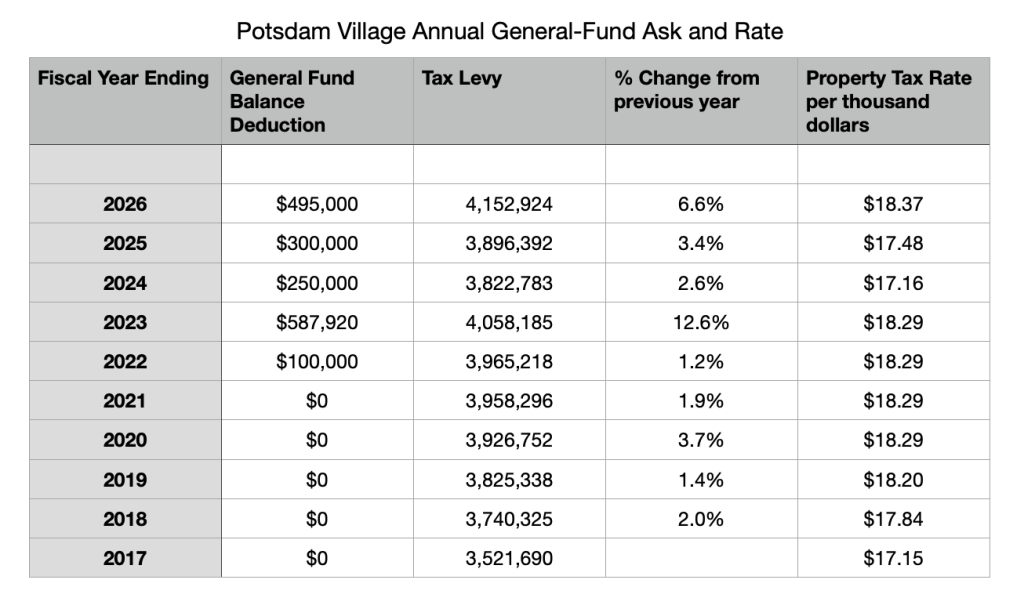
Note that the tax rate stayed steady at $18.29 for many years.  During my time on the board, I urged the board to lower the tax rate in 2024, as we were clearly receiving more revenue than appropriations required. That brief respite was immediately turned around, and this year, the Village of Potsdam proposes to charge the highest tax rate it has ever charged! $18.37 per thousand dollars in property value! This in spite of the fact that they will take half a million dollars out of  savings to lower the levy! And that huge savings-withdrawal, in spite of not knowing the actual amount in savings.  (The promised external audit reports for the past few years did not arrive, and our Treasury cannot ascertain how much of the moneys in our investment account has already been committed to the many projects that are underway.)
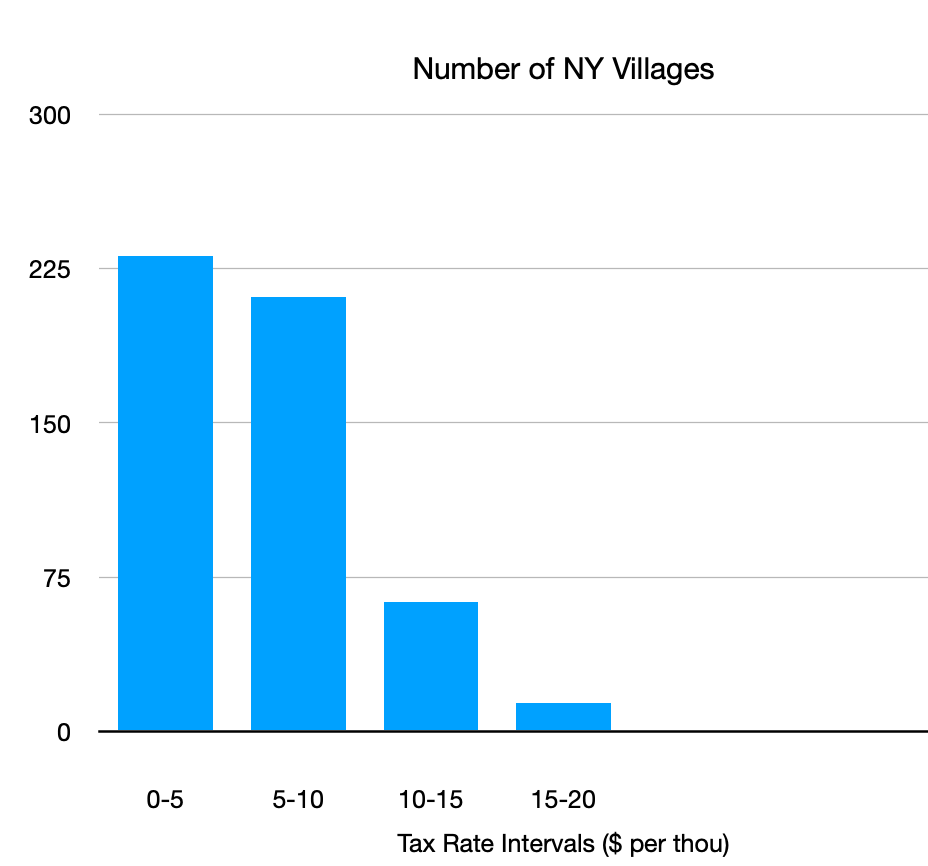
Looking at the latest (2024) published tax rates across all villages in the State we see that our municipality will have the dubious distinction of having the second highest tax rate of any of the 520 villages in NYS.  Only Herkimer in Herkimer County pays a higher tax rate, at $18.61. The average tax rate across all villages in the state, in 2024, was $6.14. Ours is almost exactly three times higher than the State average. To see where we stand relative to other villages, I plot a histogram of tax-rates binned in $5 dollar intervals; so for example, in 2024, 231 villages had tax rates under $5.00, and merely 14 villages had tax rates over $15.00.  Potsdam’s is right up there, almost at the top.

In the interest of full disclosure I must report one indiscretion: the phrase “our municipality” will no longer apply to me after today.  Today, we closed on our beautiful village home of the past 3 decades, and have moved downstate to be close to family. I have requested access to any external Audit report(s) that might come out, and would be happy to comment on those reports, in view of the grim finances implied by the current budget document.  I hope to continue hearing from many of you and also hope to enjoy visits from and to you. Best to all.
Who Butters our Bread?

Who pays the highest property taxes in the village?

I ask this question not in order to point fingers at any particular institution, but in order that our administration might confer recognition and perhaps better support for this sector of our community. Currently, this sector labors under the most onerous local tax burden, which might discourage further investments.

Two facts determine the property-tax burden within the village. The first is whether a property belongs on the tax-exempt roll (tax roll 8) or not.  Institutions that are on tax roll 8, like  hospitals, colleges & public schools and churches, pay no property taxes (and their property values tend to be asymmetrically high).  The second fact is the property’s assessed value. If the property is not on tax roll 8, its owner will be required to pay her share of the village-board’s mandated tax levy. Currently, our tax rate is about $18 for each thousand dollars of assessed value. If the property, for example, is assessed at $100,000 its owner must pay $1,800 in property taxes. If the property is worth 10 times as much, one million dollars, its local property tax will be $18,000. Everyone who owns property in the village and is not operating a tax-exempt business, pays the same tax rate of $18 per thousand dollars of assessed value (barring a few  tax exemptions for some).

So then the question of who pays the highest property tax in the village turns into the question of which property within the village has the highest assessed value?  Is it the Price Chopper Plaza? No. Is it a bank or a car dealership? No.  When you ask around, I find it surprising how laws get enacted and local tax-rates set, without this being common knowledge.  In fact, the highest property tax is paid not by a commerce business at all, but an apartment complex. In fact, in the top ten most valued properties within the village, there are several apartment complexes, as well as a commercial enterprise, a tourism enterprise, and, surprisingly, a green energy enterprise.

The point I hope to stress here, is that we should all have the good sense to know who butters our bread. As I have discussed in an earlier blog post, when the village switched to an EDU-based water and sewer fee system, the tax burden on apartment owners increased disproportionately. Why? Because each apartment in the complex now pays a hefty water and sewer rent, whether the apartment is occupied or empty.  So apartment complex owners pay both higher property taxes since apartment complexes are expensive and then in addition they pay a greater fixed share of the water and sewer tax fees.  

We need apartments. My husband moved into Meadow East in 1987 upon arriving in Potsdam, before we found our house.  Now, we would like to downsize again, to a high-end apartment. But as has been pointed out to me by several friends, and I now discover for myself, there are no high-end apartment complexes in the village-most apartment complexes are in the tax-exempt category that may not accept individuals in higher income brackets. Others are geared towards students or temporary laborers, whether nurses or teaching associates.  At this time there is nary an option for retiring boomers who prefer to live in town. Creating a more tax-friendly environment for apartment complex owners strikes me as an important objective for the village.

The Role of Village Trustees?

While the Potsdam Village Board of Trustees busied itself with Ives Park projects and parking matters, I wondered what the village’s department heads considered high priority projects? Thanks to “Village Department Head Surveys” completed last year as part of the 2023-2033 Comprehensive Planning Process, residents can learn which tasks our department heads consider vital for the village. I report here primarily on the most cost-heavy items.

The head of the Hydro Plant lists as the first item:  Sell the west dam. The west hydrodam was meant to cost $3.5m and to begin operations in 2009 for 30 years. Instead it required $5.5m in loans, began operations in 2015, and ran for merely 5 years. The two municipal hydrodams together require around $120,000/year to operate and maintain. In addition, there are the debt payments: the West dam debt payment is $265,000 annually, until 2029. The East dam debt payment is $115,000 annually, until 2046.  The operating east dam meanwhile generated $136,201 in credit last fiscal year, leaving an annual deficit of $455,544 that continues to be paid from the tax-payer’s General Fund. 

The head of the Water Treatment Plant (WTP) lists 13 capital projects and equipment needs required to ensure the continued operation of the WTP, to the rising purification standards set by State and federal laws…and to prevent the roof from leaking (The water treatment plant on Raymond St dates from 1983 so is over 40 years old). I understand that this update/upgrade will be as expensive as the sewer plant update of 2020.

The head of Planning & Development states “Village infrastructure will be the single largest challenge for the next decade and beyond. Water and sewer lines, the cross town canal, underwater sewer lines and new federal standards for drinking water/waste water will only add to the cost and complexity of the Village’s systems…The Village needs to focus its efforts on infrastructure, preparing engineering studies so that it is prepared to annually apply for funding…An engineering study for the tail race wall at Evans & White needs to be commissioned. The wall is in poor condition and may be undermined given water bubbling up under pressure from Evan’s parking lot…”

The head of the Recreation Department writes that the expansion and remodeling of Pine Street Arena is a high priority goal.

The head of the Sewer Department (aka the Waste Water Treatment Plant or WWTP) does not report urgent needs at that plant thanks to the complete recent rebuild of the WWTP, a rebuild that required a $12m loan that will be paid off in 2051. (While there are no operation issues here, the head of the WWTP points to the fact that one high-expense item at any waste water treatment plant is power consumption, and that technology exists to extract energy from the heat and gasses generated during waste water treatment.  Incorporating such technology at our WWTP would reduce expenses and waste.)

Between the water treatment plant on Raymond St. and the sewer plant on Lower Cherry St. run about 30 miles of underground water and sewer piping as well as the various ditches and channels that constitute our storm-drain system, all of which is purview of the Department of Public Works or DPW.  While maintaining streets, picking up brush, clearing fallen trees and snow etc, DPW also monitors the operation of all sewer and water mains as well as the cross town canal. DPW  also deals with random challenges and crises, from beaver-dam breaks that inundate properties on the western shores of the Raquette river, to tiled fields to the east that direct massive inflows of stormwater into our cross town canal drainage system. In addition, two cross-river sewer lines “have reached the end of their useful lives and need to be replaced” according to a 2022 Engineering Report  entitled Inflow and Infiltration Study prepared for the Village of Potsdam by the firm EDR. This report additionally details  how and where leaks enter  the sewer lines during rainstorms, and quantifies which below-ground pipes must be lined. The challenges DPW is tasked to resolve, in other words, are many, diverse and complex, and may not have obvious resolutions in some cases.

The heads of other departments (Police; Clerk/Registrar; Treasurer/Administrator; Fire; Safety/Code Enforcement; Museum) either had not yet filed survey reports or did not report urgent and high-cost Capital Outlay/Equipment needs.

Infrastructure repairs and construction bear high costs:  The EDR Inflow and Infiltration Report, for example, quoted a cost of $9.3m to replace the aging cross-river sewer pipes and to line all leaking underground sewer pipes.  For context, the current tax rate in the village is $17.48 per thousand dollars of property value.  If the Board had been tasked to raise an additional $1m from property taxes this fiscal year, we would have had to raise the tax rate to $21.97 per thousand dollars of property value. For a home worth $150,000, that would have represented an increase from $2,622 to $3,296, an additional 673 dollars.  

Department heads run their respective departments efficiently and effectively. They will continue to work with the Administration to ensure the continued operation of every aspect of infrastructure and services, and will resolve each issue/crisis as it arises.  Getting Trustees up to speed on the many gnarly issues that each department faces would benefit everyone-so that realistic budgets for the next budget year as well as upcoming budget years may be developed.  But reports such as these Department Head Surveys are not generally distributed to Trustees: it took weeks, if not months of repeated requests to obtain copies of these reports. Likewise, it was by chance that this Trustee obtained a copy of the 2022 EDR Engineering Report that provides hugely helpful insights into the why, where and how costly is the  inflow/infiltration problem facing the sewer lines, a report that should have been front and center in the hands of every Trustee. 

Why is it so difficult to share information? Is it unwise for residents to be aware that the wall abutting Evans & White is crumbling and may give way? Why should Trustees not read a village-funded EDR Engineering Report-while we were yes asked to approve a seemingly competing “Raquette River Utility Crossing Project”?  It is deeply frustrating that the Village Board of Trustees are informed of developments only after all groundwork is complete, all pertinent decisions have been made, and all boundary conditions laid down – Trustees are requested to approve only the final budgeting. The frustration arises as many questions appear not to be asked and many angles appear not to be considered, increasing the likelihood of unproductive and costly dead-ends, like the West Dam.  Does the administration believe that questions and open discussions imperil rather than strengthen the chances of a projects’s success?

How Much Village Land is Taxable?

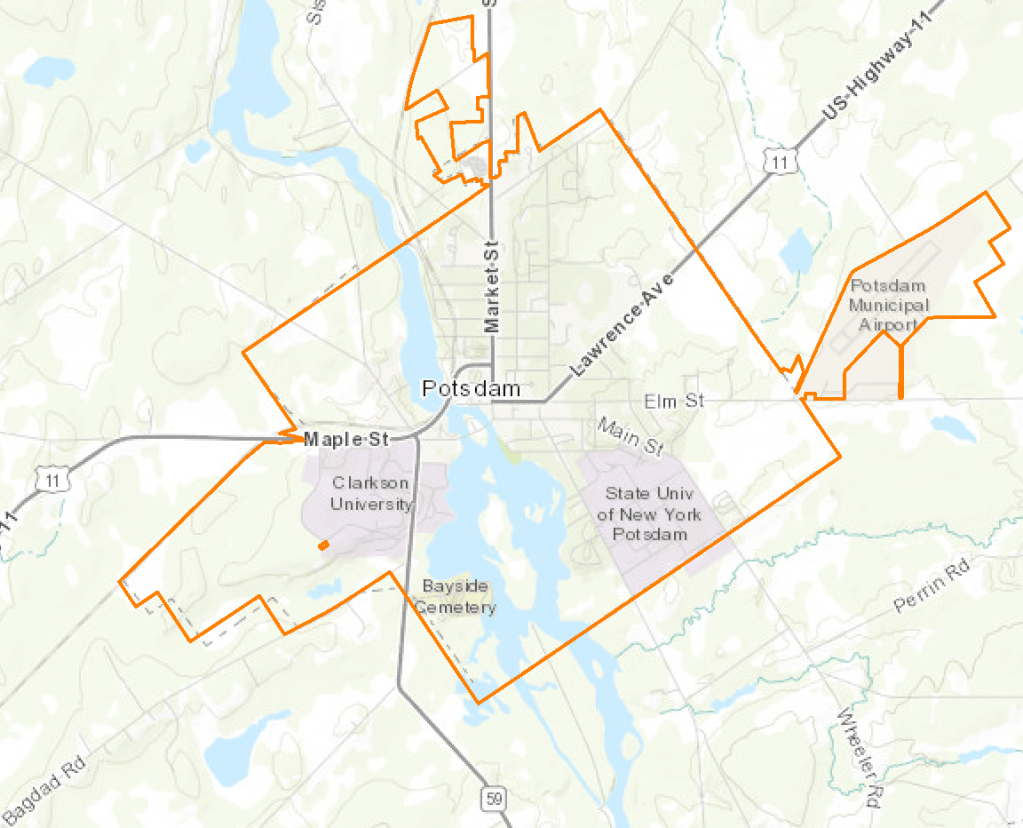
The village boundary was once a square 2 miles by 2 miles, encompassing  2,560 acres.  Additional lots have been incorporated:  Clarkson University added 415 acres around the water tower trail. The Price Chopper, Lowe’s and the Mayfield apartment lots added another 131 acres around outer Market St.  The airfield beyond Hatch Rd. added a further 256 acres. So the village boundary currently encompasses a bit over 3,100 acres.

How much of this land is in private hands and taxable?  

The river removes 316 acres from development.

What other properties are tax-exempt? Clarkson University’s 640 acres.  NY State’s 240 acres of the SUNY Potsdam campus. The Potsdam village municipality owns the 80 acres of the 3 Potsdam Central School District schools. Potsdam village altogether owns 313 acres (a large fraction of that being the airport).  The Town of Potsdam owns about 15 acres of village land. Rochester Regional Health, between its Canton Potsdam Hospital Leroy St campus as well as its Lawrence Ave campus, owns 36 acres. 

Other nonprofits with significant landholdings include Bayside Cemetery Association, with over over 71 acres, the Potsdam Housing Authority with 18.7 acres at Evergreen Park on the Racquette Rd and the Midtown Apartments with 2.6 acres. Mayfield Apartments sit on 13 acres.  Other nonprofits with smaller holdings include The Church of Latter Day Saints with nearly 4 acres,  our two Baptist churches with a bit over 8 acres and Trinity on Fall Island with 3.2 acres. NYSUT occupies 2 acres. When you sum the land owned by these various nonprofits, it totals to nearly 1,450 acres.

How many acres do our roadways occupy?  Analyses indicate that roads take up between 18-30% of urban land.  If we assume a low 15% of land to be taken up by roads on the original 2 by 2 square miles, this subtracts another 384 acres from development.

How many acres of land remain that are taxable? Of the 3100 acres, no more than 954 acres are currently taxable. Or slightly less than 31%.

If we prefer to look at the actual value of the lots, rather than acreage: The total assessed value of taxable lots (tax rolls 1, 5, 6 and 7) in FY23 came to $223 million. The total assessed value of all nonprofits came to $459M. So the fraction of the total assessed value that contributes to the tax base is 223/(223+459)=33%.  That this fraction is slightly larger than the acreage fraction is perhaps due to the fact that roadways are not  assigned assessed values.

These numbers, while stable, are not fixed. The 5-member village board of Trustees can vote to classify and re-classify the Property Class Code of every parcel in the municipality.  Places of worship may be established, federal, state or county-supported low-income housing can be created, hospital and university campuses may expand and the town/village line may occasionally be redrawn (as for the Airport Diner recently). 

Nonprofits provide valuable and laudable services that appeal to visitors and residents alike. Without our famous landmarks, Potsdam would be a very different place. But the nonprofits, in turn, require a robust tax base to finance the departments of public works, police, civic center, recreation, as well as debt payments, salaries, health insurance and retirement benefits for current and former employees and their dependents.  Given that our municipality can obtain no tax revenue from more than 2100 of our 3100 acres, should the administration continue to cede parcels to the nonprofit sector?  The annual ask (appropriations) of the village’s General Fund  went from $6.5 million in fiscal year 2022 to $7.5 million in 2024, a 15% increase. Sales tax revenue has also increased, but not enough to keep our tax rate level. Is it therefore in the residents’ interest to cede land via sale (as we did with a portion of Cottage St) or via permanent easement of residential land  (as was just done with the 2 acre lot at the end of Clough St)?  Unless a reliable alternative revenue source for the General Fund is identified, I would advise caution in relinquishing more land to the wholly exempt section of our tax rolls.